
Most adults think they already know the answer to what is play. That confidence usually disappears the moment someone tries to define it in a workplace setting.
A leader can point to a strategy game, a creative challenge, a lively workshop or a team activity and call it play. Yet the same activity can feel energising for one person and uncomfortable for another. That's where most definitions break down. The activity alone doesn't tell the whole story.
A more useful starting point is this. Play is not just something people do. It is a state people enter. When leaders understand that shift, they stop trying to force fun and start creating better conditions for trust, curiosity and performance. Corporate Challenge Events explores this idea further through The Play Philosophy.
Table of Contents
Why What Is Play Is a Deceptively Hard Question
The phrase what is play sounds simple because almost everyone has felt it at some point. In Australia, that familiarity starts early. The Australian Bureau of Statistics reported in 2023 that 92% of children aged 5 to 14 participated in non-organised physical activity, showing how common informal play is before working life begins, according to the ABS figure cited here.
That childhood familiarity creates a false sense of clarity for adults. People recognise play easily when they experience it, but naming exactly what makes something playful is harder. The confusion usually begins when play gets reduced to visible activity. A game must be play. A meeting cannot be play. A workshop might be play if people laugh. Those shortcuts miss the actual mechanism.
Play is often easier to notice than to define.
In corporate settings, this matters because leaders rarely need a philosophical answer. They need a practical one. They want to know whether play at work can support communication, adaptability and morale without feeling forced or misaligned with serious goals.
A more accurate answer starts with a shift in perspective. Play is less like a category of tasks and more like a human mode of engagement. Once that idea is clear, the rest of the science of play becomes easier to understand.
The Search for a Single Definition of Play
Researchers have spent a long time trying to settle the definition of play, and the disagreement itself is useful. It shows that play is not a narrow category with one clean boundary.
Some definitions focus on freedom and choice. Others focus on intrinsic motivation. Some examine learning and development. Others look at imagination, rules, experimentation or social connection. None of those lenses is wrong. Each captures one part of a bigger picture.
Why definitions keep shifting
The biggest problem is context. What feels open and rewarding in one environment can feel exposing in another. A timed problem-solving exercise may feel playful to a confident, connected team. The same format may feel high-pressure to a team already carrying tension.
That is why simple binaries don't help much. Play is not the opposite of work. It is not the opposite of learning either. In practice, play can sit inside both.
Australian institutions already reflect that broader view. The Early Years Learning Framework, updated in 2022, positions play-based learning as a key pedagogical approach for building communication and self-regulation, as described in this referenced summary of the framework update. For leaders interested in how different adults access play differently, discovering your play personality at work offers a practical lens.
Play works better as a spectrum
A spectrum model is more useful than a fixed label. Play can be:
Free or guided when people shape the experience themselves or work within light structure
Social or individual depending on whether energy comes from collaboration or private exploration
Physical, imaginative or strategic depending on how engagement shows up
Spontaneous or designed depending on the setting and objective
For workplace leaders, this removes a lot of unhelpful pressure. Teams do not need one universal play format. They need multiple entry points that respect personality, role, confidence and context.
Play State vs Playfulness A Practical Analogy for Leaders
The clearest way to understand what is play is to separate a temporary experience from a longer-term tendency.
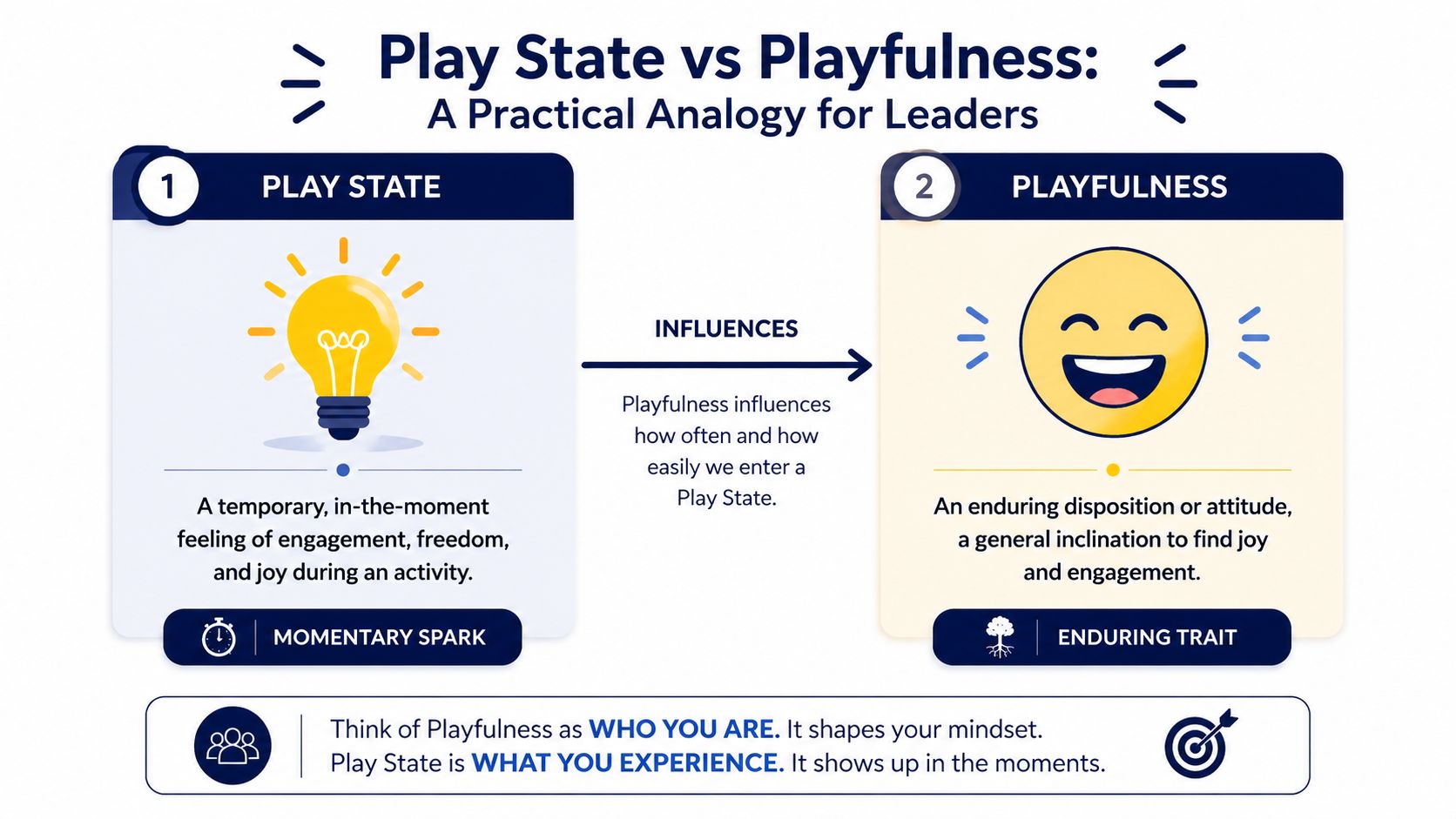
Play state is the weather
A play state is an in-the-moment condition. Someone feels engaged, curious, absorbed and willing to explore. Attention narrows in a good way. Pressure loosens. The person is participating because the experience feels rewarding in itself.
According to the National Institute for Play, play is best understood as a biological state with five core elements: it is self-directed, intrinsically motivated, has rules, involves imagination, and supports a mental state free from stress or external judgment, as outlined by the National Institute for Play foundations.
In a workplace, that might appear during a collaborative challenge, a well-facilitated ideation session or a problem-solving task where people feel safe enough to test ideas without over-editing themselves.
Playfulness is the climate
Playfulness is different. It is a broader disposition that makes the play state easier to access. A playful person may show more curiosity, flexibility, humour, openness, authenticity or creative problem-solving across many situations.
The easiest analogy is this:
| Concept | Better analogy | What leaders should expect |
|---|---|---|
| Play state | Weather | It can change quickly depending on mood, context and safety |
| Playfulness | Climate | It reflects a broader pattern over time |
A team member can have a playful disposition and still not enter a play state in a tense meeting. Another person may not describe themselves as playful at all, yet become fully engaged when the task, structure and environment feel right.
Practical rule: Leaders should design for the weather of the moment while helping build the climate over time.
Where neuroplasticity fits
This distinction also helps explain neuroplasticity in plain English. The brain changes through repeated experience. Repeated moments of low-threat exploration, engagement and experimentation can help strengthen habits associated with playfulness over time.
That doesn't mean every team game rewires behaviour. It means regular access to constructive play states can support more flexible patterns of thinking and relating. For leaders, that is the opportunity. Not forced entertainment, but repeated experiences that make adaptability and connection easier to access.
How to Recognise the Play State in Your Team
Leaders often ask the wrong question. They ask whether an activity is playful. A better question is whether the people in the room are showing signs of a play state.
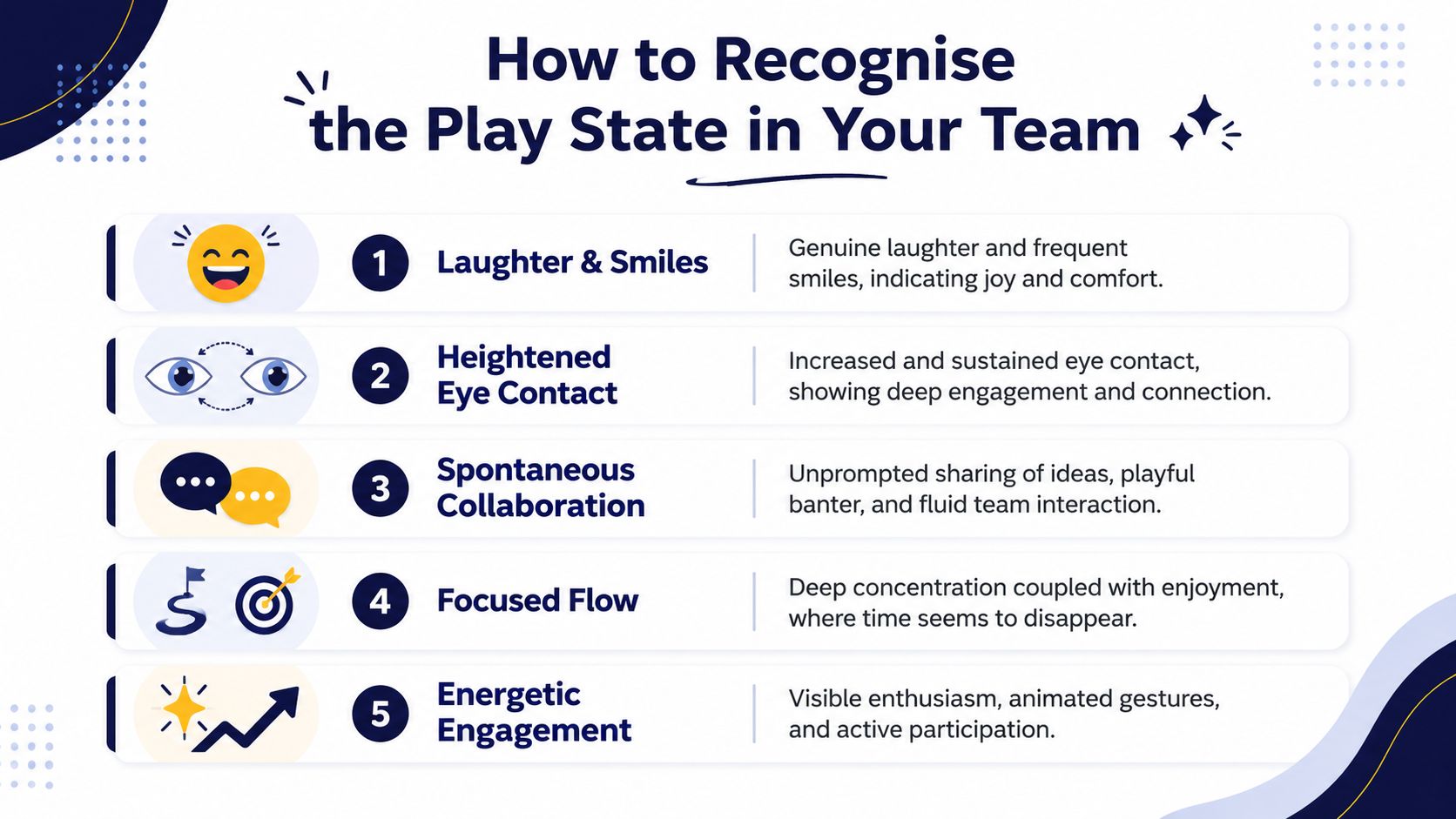
Cues worth watching
The play state usually shows up through behaviour before anyone names it. Common cues include:
Visible ease such as relaxed posture, natural smiles and less guarded interaction
Curiosity in motion where people ask questions, test options and build on each other's ideas
Focused energy where attention sharpens without becoming tense
More expressive communication including eye contact, vocal variation and spontaneous responses
Experimentation where people try, adjust and try again without shutting down quickly
These cues matter more than the activity label. A meeting can contain play. A game can fail to produce it.
Why one activity lands differently across a team
A brainstorming session is a good example. One person may experience it as energising freedom. Another may hear “share ideas quickly in front of the group” and feel exposed.
The same thing happens with team challenges. A competitive format may spark engagement in one group and caution in another. A creative task may feel liberating for some and ambiguous for others. Safety, confidence, role clarity and social context all shape the result.
If the goal is play at work, the activity is only half the equation. The felt experience is the other half.
That is why strong facilitators watch the room closely. They look for engagement, not just compliance. They adjust instructions, reduce unnecessary pressure and create enough structure for people to participate without feeling trapped by it.
Why Adult Play Is Essential Workplace Infrastructure
Adult play is often treated like a nice extra. That framing undersells it. In modern organisations, play supports core human capabilities that serious work depends on.

Australian education guidance links play-based methods to executive functions such as attention control, impulse suppression, cognitive flexibility and working memory, according to this explanation of play and learning. Those are not child-only capacities. They are the same foundations adults rely on when work becomes complex, social and unpredictable. Teams interested in the brain-based side of this can also explore BDNF and play.
The workplace capabilities play can support
In adult settings, play helps create low-risk cycles of action and feedback. That matters because many teams need practice in skills that cannot be built through policy alone.
Adaptability grows when people can test approaches without heavy penalties
Connection deepens when interaction feels human, not purely transactional
Creativity improves when teams have permission to explore before judging
Emotional regulation gets support when pressure drops enough for clearer thinking
Resilience becomes more available when people experience challenge without threat overload
Why this belongs in performance conversations
This is not an argument for replacing rigour with entertainment. It is an argument for recognising that high performance depends on human states, not just systems and deadlines.
When people feel chronically guarded, they narrow. They contribute less, risk less and connect less. Play offers a practical way to open those channels again. Not all at once, and not for every problem, but often enough to deserve a place in how organisations think about culture and capability.
How Leaders Can Create the Conditions for Play
The most useful leadership question is not “How does this team play the same way?” It is “How can this team enter play safely, in ways that fit different people?”
The need is clear. A 2024 Australian Psychological Society survey reported that 74% of workers experienced work-related stress in the previous 12 months, with workload and poor work-life balance among the drivers, as referenced in this summary of the APS survey finding. That creates a strong case for practical, low-friction approaches that support trust and communication. Leadership behaviour is central, and leadership's role in fostering play is a useful place to start.
Conditions that help play emerge
A workable definition for leaders is this:
Play is a state of engaged, voluntary and flexible participation where people feel safe enough to explore, connect, create or try something differently.
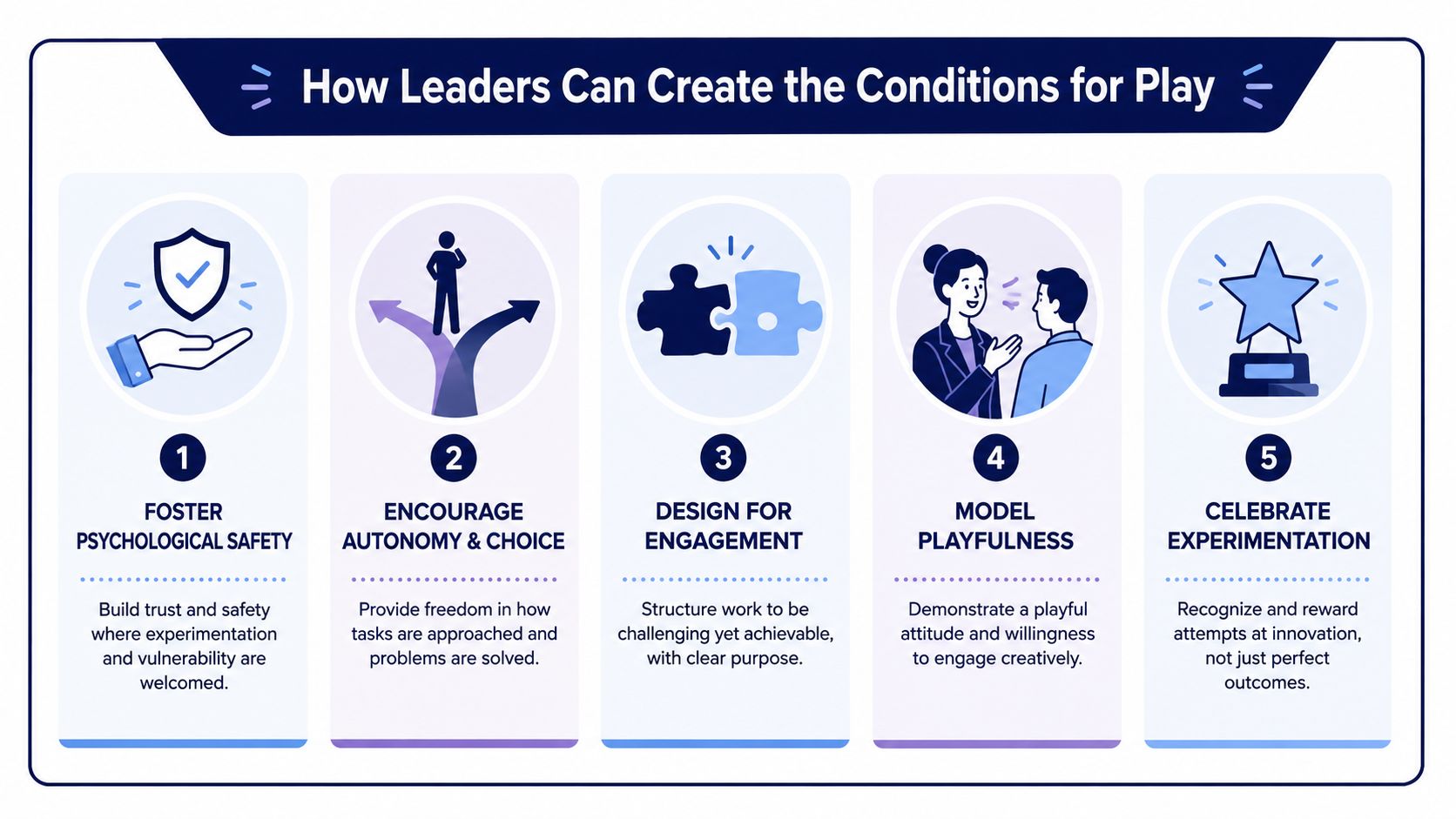
That definition shifts attention from activities to conditions. Useful conditions often include:
Psychological safety so people don't feel punished for trying
Choice and autonomy so participation has room for self-direction
Clear but flexible structure so tasks feel inviting rather than chaotic
Appropriate challenge so the experience is stimulating without becoming overwhelming
Visible permission from leaders so seriousness and play are not treated as enemies
For teams planning offsites or culture programs, resources on planning engaging corporate team builders can help translate those principles into event design.
What this looks like in practice
A leader does not need to become a performer. The goal is not to entertain the room. The goal is to remove unnecessary threat and invite better engagement.
That might mean reframing a workshop as exploration instead of evaluation. It might mean giving teams more than one way to contribute. It may also involve using facilitated options such as Corporate Challenge Events, which delivers play-based team building and workshops designed for workplace settings where connection and performance both matter.
FAQs for People Leaders and Event Planners
How can leaders measure whether play at work is useful?
The cleanest starting point is behavioural observation. Leaders can look for stronger participation, better cross-team interaction, more idea sharing and smoother communication after a play-based session. A broader commercial lens is outlined in the ROI of play.
What if some employees resist adult play?
Resistance often signals context, not attitude. Some people need more choice, clearer purpose or lower social pressure before they can engage. Voluntary entry points usually work better than putting everyone on the spot.
Does play always mean games?
No. A play state can emerge in workshops, strategy sessions, problem-solving exercises and facilitated team experiences. The activity matters less than whether people feel safe, engaged and free enough to explore.
What is the simplest way to start?
Start small. Add short moments of low-risk collaboration, curiosity or creative challenge inside existing meetings or team days. Then watch for energy, ease and participation rather than trying to force a particular style.
Corporate Challenge Events helps teams understand and experience the power of play through play based team building, workshops and facilitated team experiences that create serious fun with lasting impact.