
The calendar is full. The inbox is noisy. Meetings run long, and by the end of the day many adults don't feel playful. They feel switched on, responsible and slightly depleted. That can make play seem like something left behind with our younger years.
That idea gets adults stuck. Adults do not stop needing play. They stop recognising it.
For busy professionals, that's often the fundamental answer to why you still need play as a grown-up. Play isn't only games, costumes or high-energy activities. It's a human state of curiosity, engagement, flexibility and enjoyment. When adults lose touch with it, they often lose touch with parts of themselves that support connection, creativity, resilience and energy at work.
Table of Contents
The Difference Between a Play State and a Playful Trait
A common misunderstanding is that adult play means acting younger, being louder, or stepping away from serious work. In reality, many adults still enter play regularly without naming it that way. It happens in a lively brainstorming session, in smart banter during a team activity, in hands-on building, or in the absorbed focus of solving a challenge for the sheer satisfaction of it.
That's why the most useful starting point is this distinction. Play is both a state and a trait.
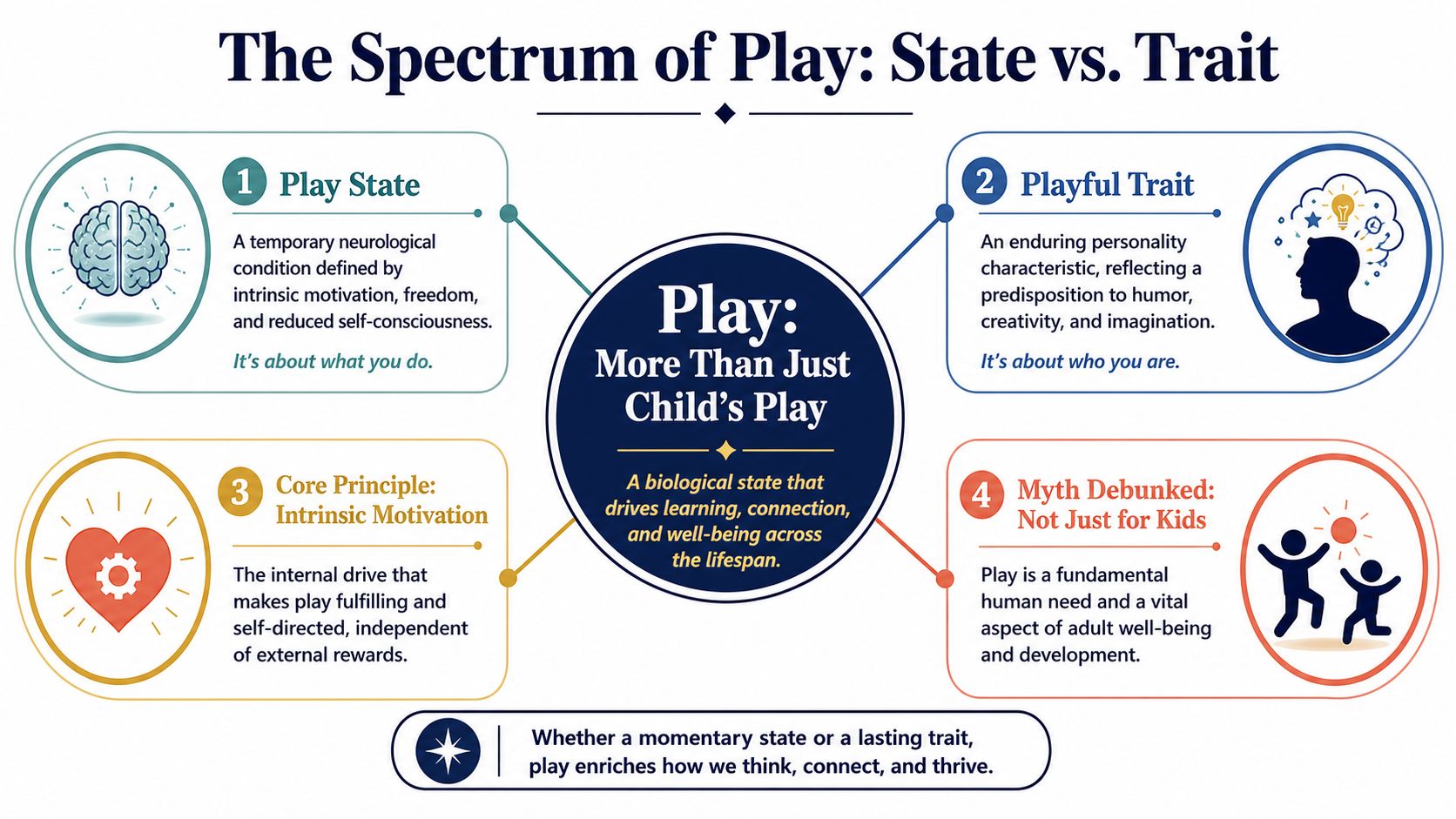
Play state is the weather
A play state is a moment. It's when a person feels engaged, curious, intrinsically motivated and less self-conscious. The task feels alive. Attention sharpens. Time can move differently.
A strategy workshop can become a play state when the room starts testing ideas freely instead of protecting status. A corporate offsite challenge can do the same when people stop worrying about how they look and start responding to the task, the team and the moment.
Practical rule: A play state is less about the activity itself and more about how a person experiences it.
Playfulness is the climate
Playfulness is the broader tendency to approach life with curiosity, humour, adaptability and creative problem-solving. If play state is weather, playfulness is climate. Weather changes quickly. Climate is the longer pattern that makes certain weather more likely.
Some adults seem naturally more playful, but that doesn't mean others missed their chance. Repeated moments of play can help strengthen access to that state over time. That idea aligns with neuroplasticity, the brain's ability to reorganise and form new neural pathways through experience. It doesn't guarantee a personality overhaul, but it can make play feel more available and less foreign.
A useful way to think about it is this:
| Term | What it means | Workplace example |
|---|---|---|
| Play state | A temporary moment of engaged, curious, flexible attention | A team becomes absorbed in solving a creative challenge |
| Playfulness | A more stable pattern of humour, openness and adaptability | A leader regularly invites fresh ideas and lowers fear around experimentation |
Adults seeking a greater understanding of play can explore The Play Philosophy from Corporate Challenge Events, which frames play as a serious human need rather than a childish extra.
Why Adults Stop Making Time for Play
Most adults haven't consciously rejected play. They've been trained away from it.
Time pressure plays a major role. Responsibility does too. Careers become more demanding, home life becomes more structured, and many workplaces tacitly reward constant seriousness. The result is that play starts to look irresponsible, even when it's exactly what a tired mind and disconnected team need.
The professionalism myth
Many adults absorb the belief that competent people should look composed, efficient and controlled at all times. In that mindset, play can feel risky. It can seem unserious. It can trigger the fear of looking silly in front of colleagues or leaders.
That fear matters because a play state needs psychological room. If a person is busy self-monitoring, defending status or trying not to make a mistake, curiosity shrinks. Flexibility shrinks with it.
A few common blockers show up again and again:
Time pressure: Work expands and play gets pushed into the category of “later”.
Overwork: Fatigue reduces the energy needed to explore, laugh or experiment.
Burnout: Even enjoyable activities can feel effortful when a person is running on empty.
Earned rest beliefs: Some adults think play must be deserved after everything else is done.
Seriousness cultures: Teams often copy environments where busyness is praised more than renewal.
Stress changes access to play
In Australia, the pressure is measurable. The Australian Bureau of Statistics reported that 30% of employed Australians experienced work-related mental health symptoms in the previous 12 months according to this discussion of the data in WHYY's piece on why grown-ups need to play. Under that kind of strain, play matters because it can interrupt stress cycles and help restore energy.
That doesn't mean play fixes every workplace problem. It means stress and play pull in different directions. Chronic strain can make the brain less available for spontaneity, humour, experimentation and social ease. Adults often interpret that as a personality change when it may be better understood as a state problem.
When adults say they don't know how to play anymore, they often mean they don't know how to access the state they used to reach more easily.
For professionals trying to reclaim that capacity without pretending life is suddenly less busy, this guide to fitting play into a busy workweek offers a practical next step.
The Seven Types of Adult Play
Many people hear “play for adults” and picture only sport, trivia or loud group games. That narrow definition shuts people out. Adult play is broader than that. It can be quiet, reflective, social, active, structured or open-ended.
Finding your play personality
| Type of Play | Description | Example |
|---|---|---|
| Social play | Shared experiences that build rapport and connection | Banter, group activities, team connection moments |
| Competitive play | Friendly rivalry with clear goals or scoring | Trivia, sport, timed challenges, games |
| Exploratory play | Curiosity-led trying, testing and asking “what if?” | Experimenting with a new idea or format |
| Physical play | Movement that changes energy and focus | Dancing, hiking, active team activities |
| Creative play | Making or expressing something new | Cooking, music, storytelling, art, design |
| Object play | Hands-on interaction with materials and tools | Building, gardening, LEGO, tactile projects |
| Imaginative play | Stepping into scenarios, possibilities or future thinking | Role-play, scenario planning, creative problem-solving |
A person who dislikes sport may still love object play. A quiet analyst may come alive in imaginative play through scenario thinking. A structured leader may prefer competitive play with rules and a clear endpoint, while another person may recharge through exploratory play and open experimentation.
Play doesn't have one personality
This wider lens helps adults realise they may not have lost play altogether. They may have only rejected the versions that never suited them.
For teams exploring more immersive formats, Studio Liddell's guide to immersive AR gaming is a useful example of how technology can support shared, interactive play experiences in a modern context.
A workplace lens can sharpen this further. This resource on discovering a play personality at work can help teams identify which forms of play feel natural and which ones need better design.
How to Find Your Way Back to Play
Reconnecting with play usually doesn't start with a major life reset. It starts with recognition. Adults often need permission before they need a plan.

A helpful first step is to look backwards before looking forwards. Earlier interests often contain clues, not because adulthood should become nostalgic, but because playful attention tends to leave a pattern.
Reflection prompts that make play easier to spot
These questions can help adults recognise where play already wants to live:
What was enjoyable before life became so busy? Not what was impressive. What felt naturally absorbing.
When does time disappear? Play often shows up where attention becomes effortless.
What brings easy laughter? Humour can reveal social play and psychological safety.
Does connection come through people or solitude? Some adults prefer social play. Others need solo play first.
Is there a preference for structure or freedom? Some people want rules. Others want room.
What restores energy most reliably? Movement, making, exploring or connecting can each point to a different path.
What is one small playful thing that could happen this week? The smaller the step, the more realistic the return.
Start where there's least resistance. Play grows more easily from interest than obligation.
Small steps count more than dramatic ones
Play can be quiet. It can be ten minutes of sketching ideas by hand before a planning session. It can be a walking brainstorm instead of another seated meeting. It can be a short creative challenge that gives a team a shared experience and a different emotional tone.
That matters in a country where social disconnection is already visible. The Ending Loneliness Together project found that 1 in 4 Australians experience loneliness, as discussed in this article on play in adulthood. Shared play creates low-pressure connection, which can help people rebuild trust and camaraderie.
Adults looking for structured prompts and ideas can use the Play Hub from Corporate Challenge Events as one practical resource. The profound shift, though, is internal. Play stops feeling childish when it is recognised as a valid way to reconnect with energy, curiosity and other people.
How Personal Playfulness Enhances Professional Performance
Incorporating playfulness into the workplace does not equate to a lack of discipline. It often results in improved environments for thinking and interacting. Teams that engage in playful activities tend to communicate with fewer defensive barriers, recover swiftly after stressful situations, and develop ideas with increased adaptability.
When adults consistently distance themselves from play, work environments can become more limited than necessary. Conversations may become more cautious, collaboration can turn purely transactional, and while problem-solving might be efficient, it can also become fragile.
What Play at Work Actually Looks Like
Play at work can show up in ordinary ways:
Playful communication: More warmth, humour and responsiveness in team interactions
Creative problem-solving: Space to test ideas before judging them too quickly
Shared rituals: Team moments that build identity and belonging
Designed experiences: Offsites, energisers and team building that shift group dynamics
Safe Work Australia estimates work-related mental health impacts cost the nation $39 billion per year, as cited in this discussion on why adults need play time. For leaders and People & Culture teams, that places play in a more practical category. It can be framed as a risk-reduction and performance-enablement tool, especially when organisations look beyond whether people had fun and instead assess trust, communication and engagement afterwards.
From individual energy to team culture
A more playful individual often becomes a more adaptable colleague. A more playful team often becomes easier to work with under pressure. That's why personal playfulness and organisational performance aren't separate conversations.
A culture of play is not a culture without standards. It is a culture where people can think, connect and respond with more of their full capacity available.
For leaders wanting a more commercial lens, this overview of the ROI of play connects playful experiences to business-relevant outcomes. In practice, structured programs such as those offered by Corporate Challenge Events are one way organisations create shared, play-based experiences for conferences, offsites and team connection.
Play Is Not a Luxury It Is a Necessity
Adults often assume play belongs to a freer season of life. A season before leadership, deadlines, budgets and care responsibilities. That assumption sounds mature, but it ignores how human beings function.
The need for play doesn't disappear with age. It becomes easier to mislabel. Adults call it chemistry, flow, creative spark, team energy, rapport, or a good day at work. Those experiences aren't separate from play. They are often expressions of it.
That is the clearest answer to why you still need play as a grown-up. Adults do not stop needing play. They stop recognising it. When play returns, adults don't become less capable. They often become more present, more connected and more flexible in the places that need them most.
For readers thinking about play alongside recovery, stress management and sustainable performance, Firacard's article on combatting burnout with self-care offers a useful companion perspective. Play isn't the whole answer to burnout, but it can be part of a healthier rhythm.
Corporate Challenge Events helps adults and teams reconnect with play through play based team building experiences that create serious fun with lasting impact. Learn more at Corporate Challenge Events.