Play is often treated as the opposite of serious work. In corporate settings, it gets pushed into the category of morale, downtime or optional culture activity, while learning, performance and change capability stay in a different bucket.
That split doesn't hold up well under pressure. Modern teams are asked to absorb new systems, work across functions, communicate through uncertainty and adapt faster than old habits allow. Those demands aren't only cultural or behavioural. They're also neurological.
One of the clearest ways to understand that link is through BDNF, short for brain-derived neurotrophic factor. In simple terms, BDNF is part of the brain's learning and adaptation machinery. It supports neurons, helps strengthen synaptic connections, and is closely tied to learning, memory and neuroplasticity.
For workplace leaders, the value of BDNF and play isn't that one playful session magically transforms performance. It's that active, social, novel experiences can support the conditions in which people learn, adjust and form new patterns more effectively. That makes play far more than a break from work. It can be a practical tool for helping teams rehearse adaptability in a way that feels real, shared and memorable.
Table of Contents
The BDNF Effect An Introduction
Most organisations still talk about adaptability as if it's a mindset people should choose. Be more open. Be more agile. Learn faster. Collaborate better.
That language sounds reasonable, but it misses something important. People don't adapt through instruction alone. They adapt through experience, repetition and conditions that help the brain encode new patterns. That's where the conversation becomes more useful for HR leaders, People and Culture teams, and anyone shaping learning environments.
BDNF and play belong in the same discussion because play often creates exactly the kind of conditions that learning needs. Well-designed workplace play can involve movement, novelty, emotional engagement, social interaction and real-time problem-solving. Those are not random extras. They are the kinds of inputs that help people pay attention, test responses and build new behavioural pathways.
Practical rule: If a team only talks about new behaviours, change stays conceptual. If a team practises new behaviours together, change becomes easier to repeat.
This is why play shouldn't be framed as the opposite of productivity. In a business setting, purposeful play can act as a rehearsal space for the capabilities leaders keep asking for: clearer communication, faster adjustment, stronger collaboration and better learning transfer.
The science doesn't justify exaggerated claims. It does support a more strategic view. Adaptability isn't just a cultural aspiration. It's supported by brain processes that respond to what people do, how they engage and the environments they move through.
What Is BDNF
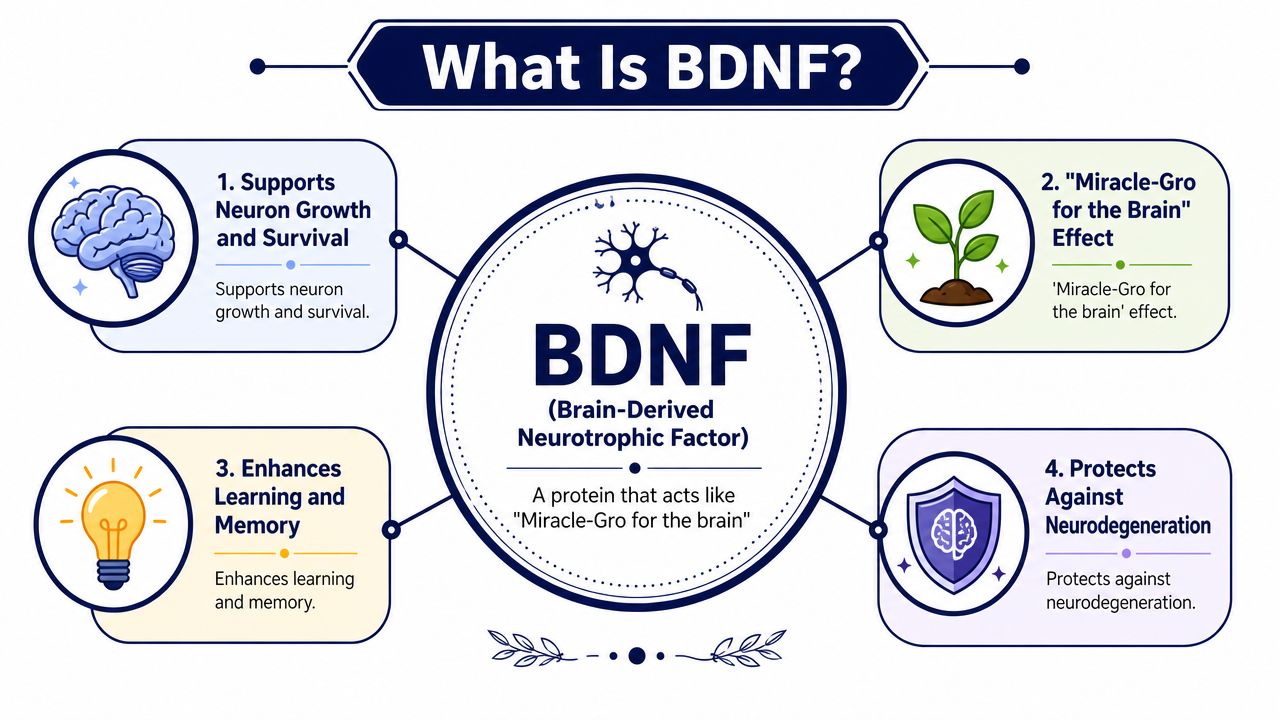
BDNF stands for brain-derived neurotrophic factor. It is a neurotrophin, which means it helps support neuron survival and plays a role in synaptic plasticity, learning and memory, according to this clinical review of BDNF and its implications.
A simple way to think about BDNF
For a corporate audience, the easiest analogy is this. BDNF works a bit like support infrastructure for the brain's learning system. It helps brain cells survive, connect and respond to experience. If learning is the process of building and strengthening useful pathways, BDNF is one of the biological factors that helps that work happen.
That doesn't mean leaders need to become neuroscientists. It means there is a biological layer beneath learning, memory and adaptability. When teams struggle to absorb new ways of working, the challenge is not always resistance alone. Sometimes the environment hasn't done enough to support attention, repetition, engagement and practice.
What the research confirms
The same review notes that BDNF was first isolated from pig brain tissue in 1982 by Yves-Alain Barde and Hans Thoenen. It also reported a mean plasma BDNF level in healthy volunteers of about 92.5 pg/mL, with a wide observed range of 8.0–927.0 pg/mL, plus higher levels in women and a decline with age in that review sample.
Those numbers are useful mainly because they show that BDNF is real, measurable biology, not a motivational buzzword. They also show why simplistic claims should be treated carefully. BDNF varies substantially across people.
For leaders, the main takeaway is straightforward:
BDNF supports brain function: It is associated with neuron survival, learning and memory.
BDNF is part of neuroplasticity: The brain changes through experience, not only through information.
BDNF is relevant to work: Learning a new system, adjusting communication habits or building trust across teams all depend on the brain's ability to form and strengthen useful connections.
Why BDNF Matters for Learning and Adaptability
Workplace learning is often discussed as if it sits inside a training calendar. In reality, it sits inside daily behaviour. A team learns when people update assumptions, notice feedback, adjust responses and remember what worked.
Learning is a connection-building process
That process depends on synaptic plasticity, which is the brain's capacity to strengthen or reshape connections through experience. Because BDNF is associated with synaptic plasticity, learning and memory, it belongs in any serious discussion about how people absorb change.
The practical implication is easy to miss. Organisations often ask teams to become adaptable while keeping the learning environment static. They deliver slides, talk through a framework and expect new behaviour to follow. That can work for awareness. It is weaker for behaviour change.
Teams don't become more adaptable because adaptability appears on a values poster. They become more adaptable when they repeatedly experience adjustment in action.
What that looks like at work
Consider the kinds of change most leaders expect people to handle:
| Workplace demand | What the brain has to do |
|---|---|
| New technology rollout | Learn unfamiliar patterns and recall them under pressure |
| Cross-functional projects | Update assumptions and respond to different communication styles |
| Organisational change | Let go of old habits and encode new routines |
| Leadership development | Strengthen self-awareness, reflection and behavioural flexibility |
Each of those situations asks the brain to do more than store facts. It has to notice, interpret, test, remember and refine. That is why BDNF and play can be a valuable pairing in workplace strategy. Play introduces lived experience into the learning process, which gives teams more than theory to work with.
For HR and L&D teams, this reframes the challenge. The task isn't just to tell people what effective behaviour looks like. It's to create environments where those behaviours can be rehearsed.
Where Play Fits In
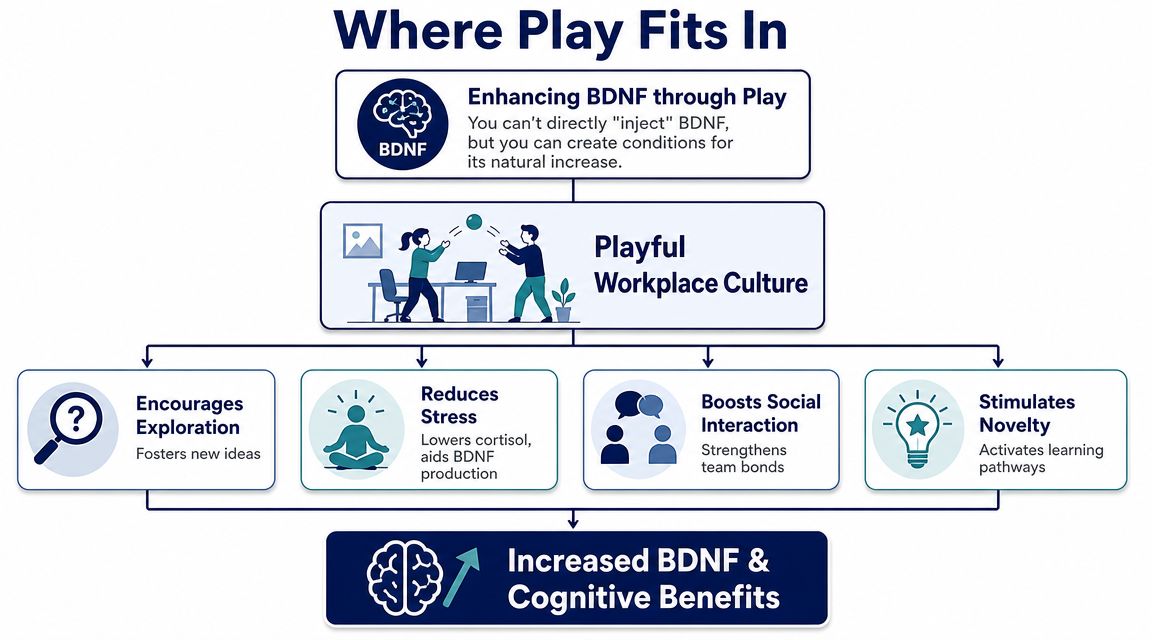
Play has a serious organisational use because it often combines multiple ingredients that support learning. It brings people into contact with novelty, movement, social interaction, emotion, feedback and low-pressure experimentation.
Play combines the right ingredients
A typical workday can trap teams inside habitual patterns. The same meeting formats, the same voices, the same assumptions and the same low-movement routines can narrow attention. Play interrupts that loop.
A well-designed activity might ask a group to solve a challenge with limited information, move physically through space, respond to changing rules and coordinate under time pressure. That sounds light on the surface, but it requires active listening, flexible thinking and rapid adjustment.
The logic behind this is stronger than many leaders assume:
Novelty changes attention: People tend to engage more fully when the task feels different from routine work.
Movement changes state: Physical activity has been linked with BDNF-related changes, which is one reason active formats have learning value.
Social interaction sharpens feedback: Teams can see communication patterns in real time.
Low-pressure experimentation supports risk-taking: People are more willing to test a new response when the stakes are contained.
For organisations interested in play-based learning at work, that combination is what gives the approach strategic value.
Why movement and social play are relevant
A 2019 review on exercise as a modulator of BDNF reported that exercise and aerobic activity can increase BDNF, and that exercise-induced changes in BDNF are associated with better cognitive function and reduced synaptic dysfunction in the reviewed research. The same review also described one study in a long-term care setting that used two 40-minute exergame sessions per week for six weeks and found a significant increase in BDNF, and another coffee-fruit trial that reported a 137% increase in BDNF in one group, as summarised in Frontiers in Cellular Neuroscience.
That does not mean a single workplace event guarantees a measurable BDNF change. It does support a careful conclusion: physical and cognitively engaging activity are biologically relevant when discussing learning and adaptability.
There is also play-specific evidence worth noting. In a peer-reviewed rat study, a 30-minute rough-and-tumble play session significantly increased BDNF mRNA in the amygdala and dorsolateral frontal cortex, as reported in this PubMed study on social play and BDNF-related pathways. Adult workplace leaders should treat that as mechanistic evidence, not a direct human office claim. Even so, it strengthens the case that social play connects with systems involved in regulation and executive control.
Play Gives Teams a Safe Way to Practise Adaptability
Leaders often ask for adaptability when what they really need is practice. Teams can't build responsiveness from policy language alone.
Adaptability needs rehearsal
A team becomes more adaptable by doing adaptable things. That includes testing ideas, recovering from missteps, adjusting communication and coordinating under unfamiliar conditions. Structured play creates a setting where that can happen without the commercial risk of a live client issue, missed deadline or difficult stakeholder meeting.
In this context, psychological safety becomes highly relevant. People learn faster when they can contribute, experiment and speak up without assuming every mistake will be punished. Play-based formats can support that climate because the activity itself signals permission to try, reset and iterate.
A short, well-facilitated micro-play approach for teams can be useful here because it gives people a repeatable way to shift state, reconnect and rehearse different behaviours during the flow of work rather than only at annual offsites.
Why low-stakes practice changes behaviour
The business value of this kind of practice is behavioural, not decorative. During a challenge, teams often reveal how they handle ambiguity, who dominates airtime, who notices hidden constraints and who helps the group reset when momentum drops.
A safe-to-fail task often shows more about a team's real working patterns than a polished status meeting does.
That is one reason BDNF and play should not be reduced to “exercise is good for the brain.” The stronger workplace argument is broader. Active, social experiences may support learning conditions, and they also give teams a place to turn capability into action.
When facilitators debrief those moments properly, the lesson becomes portable. Teams can connect an activity-based insight to project delivery, cross-functional friction, change fatigue or leadership communication.
From Brain Chemistry to Team Behaviour
The science becomes useful when it shows up in observable team habits. That is where workplace leaders can evaluate whether play-based design is doing real work.

Examples leaders can use
A problem-solving challenge can help a group practise flexible thinking. If the rules shift halfway through, the team has to abandon a comfortable strategy and quickly build a better one. That's a direct rehearsal for workplace change.
A communication task can expose listening habits. Some people jump to directing before they've understood the full picture. Others translate, connect or clarify. In a well-run activity, those patterns become visible and discussable.
A charity team-building format adds another layer. When the outcome supports a community cause, the activity carries purpose as well as energy. That can deepen emotional engagement and shared meaning, which often makes the experience easier to remember and discuss later.
Leaders looking for lighter reset formats can also learn from the broader idea behind K-12 brain break activities. The audience is different, but the useful principle is the same: short, intentional shifts in attention and movement can help people re-engage with the next task.
Why shared experiences travel back to work
A conference energiser is a good example. Its value isn't just that people feel more awake afterwards. The better outcome is that attention resets, energy becomes shared and people become more available for the next block of learning or discussion.
The same principle underpins the case for a workplace dose of play. Shared playful experiences help move a team from abstract agreement to lived evidence. People don't just hear that trust, listening and adaptability matter. They experience what those behaviours feel like together.
That shared memory often becomes the bridge back to work. A team can reference a moment from an activity far more easily than a slide from a presentation.
What Leaders Should Take From the BDNF Effect
Leaders don't need to become experts in molecular neuroscience to use this well. They need a practical filter for deciding how learning, culture and team development are designed.
Five practical implications
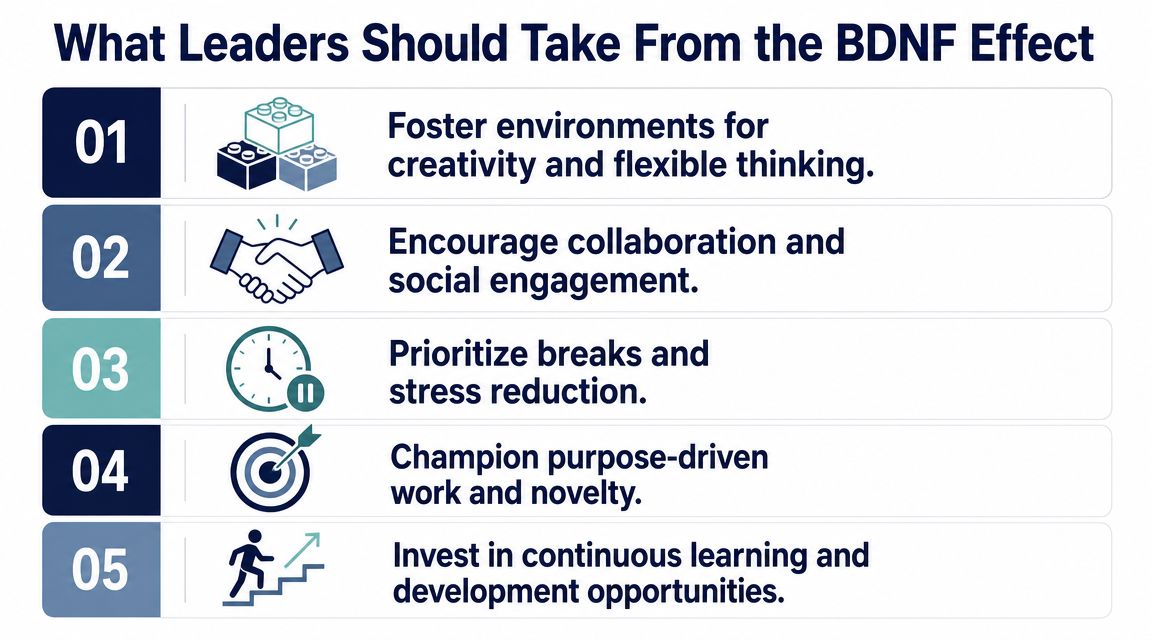
Treat learning as active: People retain and apply more when they are involved, not just informed.
Build rehearsal into change: Teams need space to try new behaviours before those behaviours are tested in high-stakes work.
Use movement and novelty on purpose: These are not event extras. They help shift attention and break rigid routines.
Design for interaction: Communication, trust and adaptability improve through shared experience, not isolated reflection.
Lead with permission: Leaders shape whether play is seen as purposeful or trivial. That is why permission to play as a leadership skill is such an important idea in culture work.
The strongest team-building programs are not entertainment with a business label. They are part of the organisation's performance infrastructure.
Seen through that lens, BDNF and play support a bigger leadership point. The conditions around learning affect the quality of the learning itself.
Build a More Adaptable Team Through Play
Australian organisations don't need more reminders that change is constant. They need better ways for teams to stay responsive inside it.
From insight to implementation
That is where play earns its place. Purposeful play gives people a way to practise the behaviours most organisations want more of: adjustment, communication, trust, experimentation and shared problem-solving. The biological discussion around BDNF helps explain why active, novel and socially engaging experiences can support learning conditions. The behavioural discussion explains why those experiences can influence what teams do together.
The most credible approach is a measured one. Play is not a cure-all. It won't replace strong leadership, role clarity or sound systems. What it can do is create an environment where people are more engaged, more present and more able to rehearse new ways of working.
Corporate Challenge Events is Australia's specialist in play-based team building, with an exclusive Australasian partnership with the National Institute for Play. That partnership reflects a serious commitment to translating play research into practical workplace experiences that support connection, adaptability and positive team culture.
For leaders navigating change, that's the genuine promise of this work. Play helps teams move from knowing what they should do to experiencing and practising it together. Resources such as the Culture Playbook can help organisations bring that thinking into everyday work, not just special events.
If a team is navigating change, learning new ways of working or needing to reconnect, Corporate Challenge Events can help create the conditions for adaptability through facilitated play-based team experiences that bring learning, connection and serious fun into the room.