Most corporate advice about performance still treats play as a reward for good work, or a distraction from it. That framing gets the sequence wrong. Teams don’t become collaborative, adaptive and creative because pressure demands it. They become those things when the conditions make it possible.
That’s why play in the workplace belongs in serious organisations. Not because work should become silly, and not because every team needs games for the sake of morale. Play matters because serious work depends on human state. When people are guarded, overloaded or socially disconnected, they contribute less freely, solve problems more narrowly and protect themselves before they collaborate.
Leaders already accept that physical environment, workload and communication quality affect performance. The same logic applies to play. It helps create a lower-threat, more connected state that supports trust, learning, recovery and contribution. That is not a soft extra. It is part of the operating conditions serious teams rely on.
Table of Contents
Why Serious Workplaces Still Misunderstand Play
Many leaders say they want innovation, resilience and stronger team culture. At the same time, they still treat play as something separate from real work. That’s the contradiction.
The misunderstanding is easy to recognise. Play gets reduced to awkward icebreakers, novelty office perks or activities that interrupt “actual productivity”. In serious workplaces, that creates resistance before the conversation even begins. Teams hear the word and assume childishness. Leaders hear it and think time away from deadlines.
Yet the capabilities most organisations want are not produced by pressure alone. Trust, openness, experimentation and fast learning tend to grow when people feel safe enough to contribute without excessive self-protection. That’s part of the thinking behind The Play Philosophy at Corporate Challenge Events, which positions play as a practical way to shift team state rather than an entertainment layer added on top.
The real issue isn’t seriousness
Serious work doesn’t require a permanently serious emotional tone. It requires people who can stay engaged with complexity, recover from mistakes and communicate under strain. Those are human conditions before they are process outcomes.
Play works with human biology, not against it.
When workplace play is dismissed too quickly, organisations often miss a useful performance lever. The question isn’t whether a team should stop focusing on targets. It’s whether the team has enough connection, trust and cognitive flexibility to meet those targets well.
The Human State Required for High-Performance Work
High performance is often discussed as if it starts with strategy, role clarity and process. Those matter. They just aren’t enough on their own.
People do their best thinking when they can regulate pressure, read social cues, speak up without unnecessary risk and stay flexible when the plan changes. A team can have talented people, clear KPIs and a well-built operating model, yet still underperform because the collective state is tense, cautious or fragmented. That’s one reason discussions about why teams need a dose of play resonate with leaders who’ve seen a technically capable team struggle to connect.
State shapes contribution
When people are overloaded or guarded, they often narrow their thinking. They contribute less early, challenge less constructively and default to familiar patterns. That’s not always a motivation problem. Often, it’s a state problem.
Serious work depends on conditions such as:
-
Psychological safety at work: People need enough interpersonal safety to offer ideas, ask questions and admit uncertainty.
-
Social trust: Teams collaborate faster when they don’t spend energy interpreting intent or protecting territory.
-
Emotional regulation: Under pressure, regulation supports judgement, listening and recovery from setbacks.
-
Adaptive attention: Complex work requires people to shift between focus, curiosity and cooperation.
Performance isn’t only about effort
Many workplace problems are framed as behaviour problems when they’re partly state problems. A quiet meeting may not reflect low capability. It may reflect defensiveness. A stalled project may not reflect lack of care. It may reflect low workplace connection, weak trust or fatigue.
That’s why leaders who care about outcomes need to think beyond task management. They need conditions that help people enter the state required for serious work.
Redefining Workplace Play Beyond Perks and Ping-Pong
Leaders are right to be sceptical of anything that looks like theatre at work. Ping-pong tables, novelty perks and awkward icebreakers rarely fix the problems leaders are paid to solve. They do little for low engagement, poor collaboration or teams that freeze when conditions change.
A better definition is more useful. Workplace play is a deliberate way of shifting people into a state where they can experiment, connect and respond with less social friction. In business terms, it is performance infrastructure. It helps teams access curiosity, attention and cooperation under conditions where routine management alone often falls short.
In practice, that might mean a structured challenge, a timed problem-solving exercise, a creative sprint with clear constraints, or a low-risk prompt that changes who speaks and how. Small, repeatable practices such as these micro-play ideas for teams are often more effective than big set-piece activities because they fit real working rhythms and do not ask people to perform extroversion.
What play is not
Badly designed play tends to fail for the same reasons.
-
It has no business context: People cannot see the connection to better meetings, better decisions or better teamwork.
-
It asks for too much, too soon: Activities create social exposure before the group has enough trust.
-
It rewards one style of participation: Quieter people, neurodivergent employees and reflective thinkers get pushed to the edge.
-
It stops at the activity: There is no reflection, no behavioural takeaway and no link back to the work.
That failure is usually a design issue, not proof that play has no place at work.
For office managers trying to lift wellbeing and day-to-day energy, practical resources such as wellness advice for office managers can help. On their own, though, they are not enough. Teams need working conditions that support better interaction, not just isolated wellbeing gestures.
What play actually does
Used well, play changes the conditions under which people work together. It reduces overcontrol, increases social responsiveness and gives teams a safer way to test ideas, roles and reactions before the stakes rise.
Collaboration problems frequently manifest as process issues well before they are identified as state issues.
The neurobiology matters here. Play is associated with lower threat and more flexible social engagement, which is one reason researchers such as the National Institute for Play argue it supports learning, adaptation and connection in groups, as outlined in its overview of the science of play. In a workplace, that can translate into faster rapport, broader participation and better recovery when a team hits ambiguity or pressure.
This is why the perk framing misses the point. Properly designed play is not a break from performance. It is one of the conditions that helps performance happen.
The Commercial Case for Play in a Disengaged Workforce
Play often gets dismissed as soft. From a workforce performance perspective, that is a costly reading.
Leaders already pay for disengagement through slower decisions, lower discretionary effort, avoidable turnover and change fatigue. The question is whether work design helps people stay socially connected, cognitively flexible and willing to contribute under normal operating pressure.
Australian evidence continues to link employee engagement with stronger business results. Aon’s market analysis has associated higher engagement with better retention and stronger organisational performance, as summarised in this review of play at work and business outcomes. For leadership teams, that shifts play out of the perks category and into performance infrastructure. If a practice improves how people connect, participate and recover their focus, it deserves the same scrutiny as any other operating investment.
Why this matters in Australia
In Australia, the commercial argument is tied to risk as well as performance. Safe Work Australia reports that mental health conditions make up a growing share of serious workers’ compensation claims, which reinforces a point many employers have learned the hard way: psychosocial strain is not separate from productivity. It sits inside it. The underlying trend is outlined in Safe Work Australia’s reporting on work-related mental health conditions and serious claims.
That does not mean a play session fixes overload, poor management or bad role design. It means leaders should stop treating human state as incidental. Teams do better work when the environment lowers unnecessary threat and supports interaction that is adaptive rather than guarded.
Play as performance infrastructure
In practice, structured play gives organisations a low-risk way to improve the behaviours that disengaged cultures struggle with most: participation, trust, experimentation and recovery after friction. Those are operating conditions. They influence how quickly teams solve problems, how openly they raise issues and how much energy is available for change.
That is the commercial frame behind the ROI of play in workplace performance. The value is not whether an activity looks productive for 30 minutes. The value is whether people communicate better, contribute sooner and stay more engaged in the work that follows.
How Play Helps Teams Practise for Pressure
Teams do not rise to the occasion under pressure. They fall back on what they have practised.
That is the business case for play based team building. Used well, it gives teams a controlled way to rehearse how they respond when conditions get messy: incomplete information, time pressure, shifting roles, competing views and small mistakes that can either spiral or be absorbed quickly. Leaders who dismiss play as a soft extra often miss its operational value. It is training for the social and cognitive demands of real work.
Play as a state and playfulness as a trait
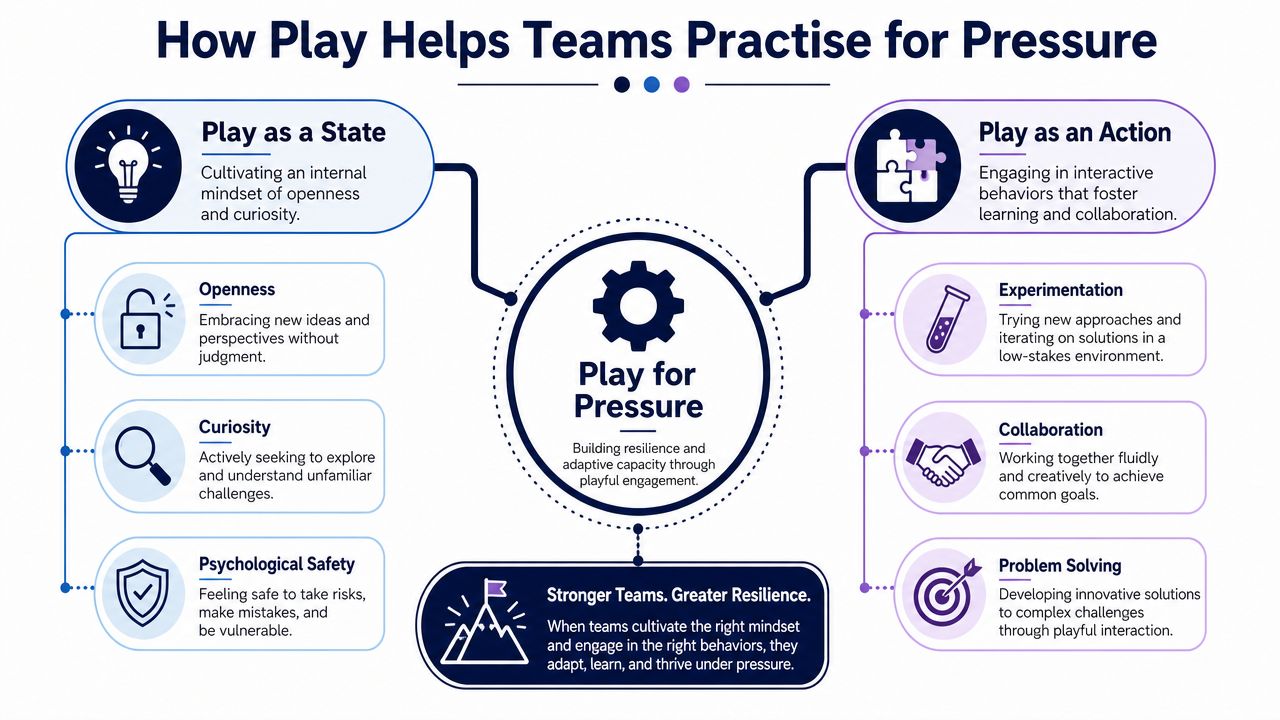
A single well-run play experience can shift a team’s state fast. People become more alert, more socially open and less preoccupied with self-protection. That matters because threat and performance have a complicated relationship. A little pressure can sharpen focus. Too much social threat narrows thinking, reduces contribution and makes people protect status instead of solving the problem in front of them.
Repeated exposure changes more than the moment. It helps teams build a pattern of response.
Over time, that pattern can show up as playfulness in practice: curiosity under ambiguity, flexibility when plans change, optimism after a setback and a greater willingness to test ideas before they are fully polished. From a neurobiology perspective, this is useful because repeated experiences shape future access. Teams that regularly experience safe challenge and shared problem-solving get faster at returning to those states when the stakes are real.
Play is rehearsal for the conditions serious work demands.
What teams rehearse through play
Pressure tests more than technical skill. It tests whether people can stay connected, think clearly and keep moving when the answer is not obvious.
A purposeful play session gives teams a low-risk setting to practise behaviours that are expensive to learn during a live project, a customer issue or a period of organisational change:
-
Solving problems without freezing
-
Experimenting before certainty exists
-
Working independently without losing alignment
-
Adjusting when roles, rules or expectations shift
-
Recovering from mistakes without tipping into blame
-
Staying curious when disagreement appears
-
Making decisions with incomplete information
This is not about making work childish. It is about reducing the social friction that stops capable adults from using their full range under pressure.
That mechanism is reflected in organisational research on positive emotion and broadening attention. Barbara Fredrickson’s work on the broaden-and-build theory of positive emotions helps explain why teams in a more open, connected state tend to generate more options, share more information and recover faster from stress. In practice, that gives leaders a route into better collaboration and more adaptive behaviour, not just a lighter mood.
Why repeated practice matters
One event can create movement. Habit comes from repetition.
The teams that handle pressure well usually have small, repeated chances to practise it before the high-stakes moment arrives. That can mean short problem-solving challenges in team meetings, role-switch exercises, structured improvisation, timed collaboration tasks and debriefs that focus on how the team responded, not just whether it won.
We have seen this work best when the activity is followed by a clear translation back to work. What helped people speak up sooner. Where did coordination break down. Who adapted quickly when the rules changed. Without that reflection, play stays as an experience. With it, play becomes performance infrastructure.
Consistency matters more than spectacle. Regular practice makes it less likely that pressure will push a team into silence, rigidity or blame.
The Observable Team Benefits of Structured Play
Leaders don’t need vague promises about culture. They need signs they can observe.
Structured play changes what happens between people. That might show up in a meeting where quieter team members start contributing earlier, or in a cross-functional session where people ask more questions before defending their own view. It can appear in faster recovery after a mistake, more humour without loss of focus, or stronger participation from people who usually stay on the edge.
What shifts in day-to-day team behaviour
The benefits are often behavioural before they become strategic.
| Team moment | What leaders may notice after structured play |
|---|---|
| Project kick-off | More willingness to test ideas before they are polished |
| Brainstorm | Broader participation and less premature shutdown of options |
| Cross-functional work | Easier peer-to-peer interaction across roles |
| Setbacks | Less blame, quicker regrouping and clearer communication |
| Hybrid meetings | Greater energy and more visible contribution from quieter attendees |
One useful proof point comes from collaboration research. Stanford research found that people who believed they were working collaboratively persisted 48 to 64% longer on challenging tasks and reported less fatigue, as referenced by Corporate Challenge Events’ summary of collaborative performance research. That doesn’t mean every play activity will produce the same result. It does show how perceived collaboration can affect resilience and effort.
Signs that play is supporting positive team culture
A healthier team culture often looks ordinary rather than dramatic. People interrupt less harshly. They ask for help sooner. They take low-risk initiative. They stay in the conversation when a problem gets messy.
A good play intervention should leave behind better behaviours, not just better memories.
Those are the kinds of shifts leaders can look for if they want workplace play to be judged on practical terms.
How to Design Purposeful Play and Overcome Resistance
Resistance to play at work is common, and often rational. Teams are busy. Managers are under delivery pressure. Some employees dislike public exposure. Others have sat through enough awkward icebreakers to distrust the whole category.
That doesn’t mean play is the problem. It usually means the design is poor.

Three design rules that reduce pushback
Effective play-based systems combine user-centred design, persuasive cues, a learning orientation, and a balanced mix of competition and collaboration. Leaders should treat play as a repeatable behavioural protocol by setting clear rules, keeping stakes low, requiring shared participation and measuring post-event behaviour change, according to this peer-reviewed review of gamification and play-based design.
In practical terms, that usually means starting here:
-
Set context first
Explain that the activity is designed to lower barriers, improve workplace connection or strengthen communication. People are more open when they understand the point. -
Start low-risk
Don’t open with something exposing, loud or highly improvisational. Begin with simple collaborative tasks where different contribution styles are possible. -
Reflect back to work
Debrief what happened. Ask where trust showed up, who adapted, how decisions were made and what can carry into the next project cycle.
Securing Leadership Buy-In for Play Based Team Building
Leadership buy-in rarely fails on budget alone. It fails when the proposal sounds optional.
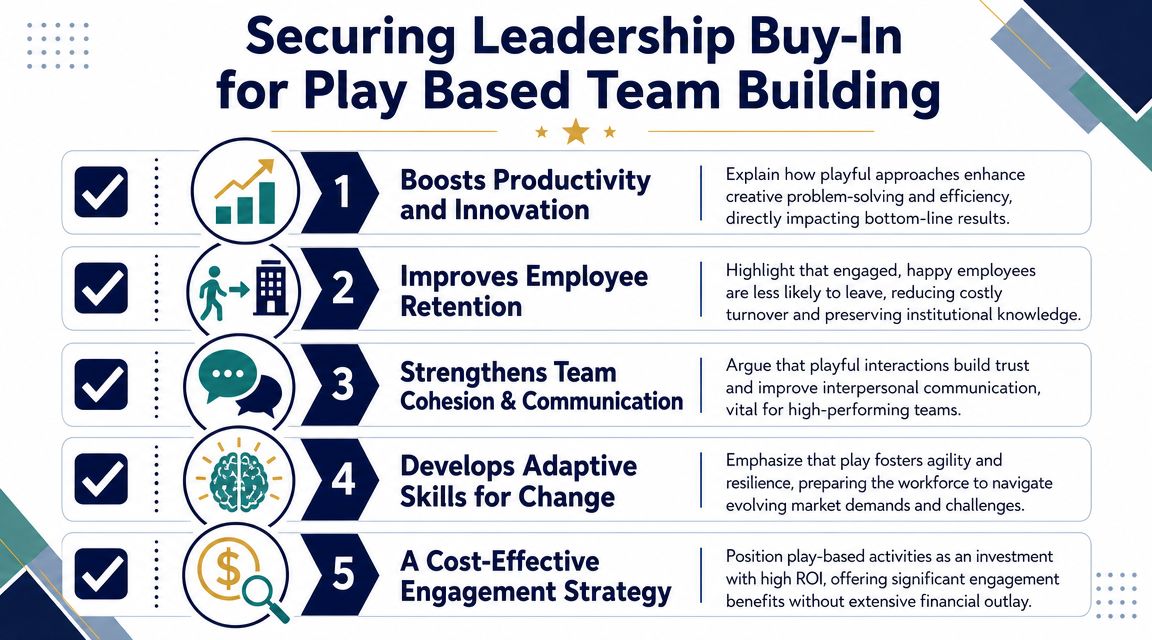
Senior leaders approve work that addresses execution risk, culture risk, or people risk. Play based team building needs to be framed in those terms. The case is stronger when it is presented as performance infrastructure that helps teams communicate under pressure, recover social trust after change, and work with more flexibility when the plan shifts.
Language that tends to land with leaders
Leaders listen differently when the proposal is tied to business conditions rather than morale language.
-
Play supports execution quality by improving how people listen, respond, and coordinate with each other.
-
Structured play creates practice time for judgment, adaptation, and shared problem-solving before those skills are tested in live work.
-
Teams under pressure default to habit. If collaboration, candour, and flexibility have not been practised, pressure exposes the gap.
-
The return is behavioural, not decorative. Better meeting contribution, faster relationship formation, and lower friction across teams all affect delivery.
Communication also affects adoption. If leaders want employees to take the program seriously, they need to explain why it exists, what problem it is solving, and what good participation looks like. Wideo’s insights on video communication are useful here, especially for organisations that need managers to carry a consistent message into team meetings.
Build the case around business risk
A credible proposal starts with a business issue the leadership team already recognises. That might be slow cross-functional work, low participation in meetings, post-change fatigue, weak onboarding into team norms, or a noticeable drop in discretionary effort. The intervention then needs a clear chain of logic. If social hesitation and low trust are getting in the way of performance, a well-designed shared activity gives people a low-stakes environment to test communication, contribution, and decision-making patterns.
This is also where many People and Culture teams lose momentum. They pitch an event. Leaders are looking for an operating outcome.
A stronger internal case usually includes three elements:
-
The current risk: disengagement, silos, poor collaboration, change resistance, or interpersonal strain
-
The mechanism: a structured play experience that creates interaction, participation, and reflection across the team
-
The evidence to watch: manager feedback, cross-team contact after the session, meeting participation, idea flow, and visible shifts in team behaviour
For teams preparing a formal proposal, team building approval guidance helps turn those points into a business case a decision-maker can assess quickly.
One practical point matters here. Do not sell certainty. Sell usefulness. A single session will not repair a fractured culture, but it can create the conditions for better conversations, faster rapport, and more honest participation. For many leadership teams, that is a reasonable commercial starting point.
Corporate Challenge Events designs play based team building experiences that help serious workplaces create connection, trust and lasting impact through structured, purposeful play.