
CSR in the workplace is outgrowing the mechanisms that used to define it. Annual reports, donation tallies and carefully worded executive statements still matter, but they no longer carry the full weight of proving a company’s values are real. Employees want to see those values in motion, and increasingly, they want a hand in creating that impact themselves.
That shift is structural, not cosmetic. Leaders haven’t stopped investing in sustainability and social impact. What’s changed is the standard employees use to judge that investment: not “what did the company say it would do,” but “can I see it, join it, and believe it.”
The organisations pulling ahead are the ones treating CSR as something people do together, giving employees practical, visible ways to contribute, with real outcomes for communities and real benefits for teams. That turns CSR from an announcement into a shared experience.
The stakes here extend well past CSR itself. Safe Work Australia’s research on psychosocial safety climate and productivity estimates that low psychosocial safety climate costs Australian employers approximately $6 billion each year through sickness absence and presenteeism. CSR isn’t a substitute for psychological health and safety, but the same underlying principle applies to both: what employees experience matters more than what an organisation promises. When responsibility, culture and employee experience run in separate lanes, even genuine commitments can land as hollow.
Table of Contents
The New CSR Landscape in 2026
CSR in the workplace is entering a more visible phase. According to Deloitte’s 2025 C-suite Sustainability Report, sustainability remains a top-three priority for C-suite leaders, while Benevity’s 2026 State of Corporate Volunteering reporting, referenced in the same verified dataset, shows corporate volunteers logged 23.7 million approved hours in 2025, a 175% increase since 2019. The strategic signal is clear. Executive attention is still there, and employee-facing participation is expanding at the same time.
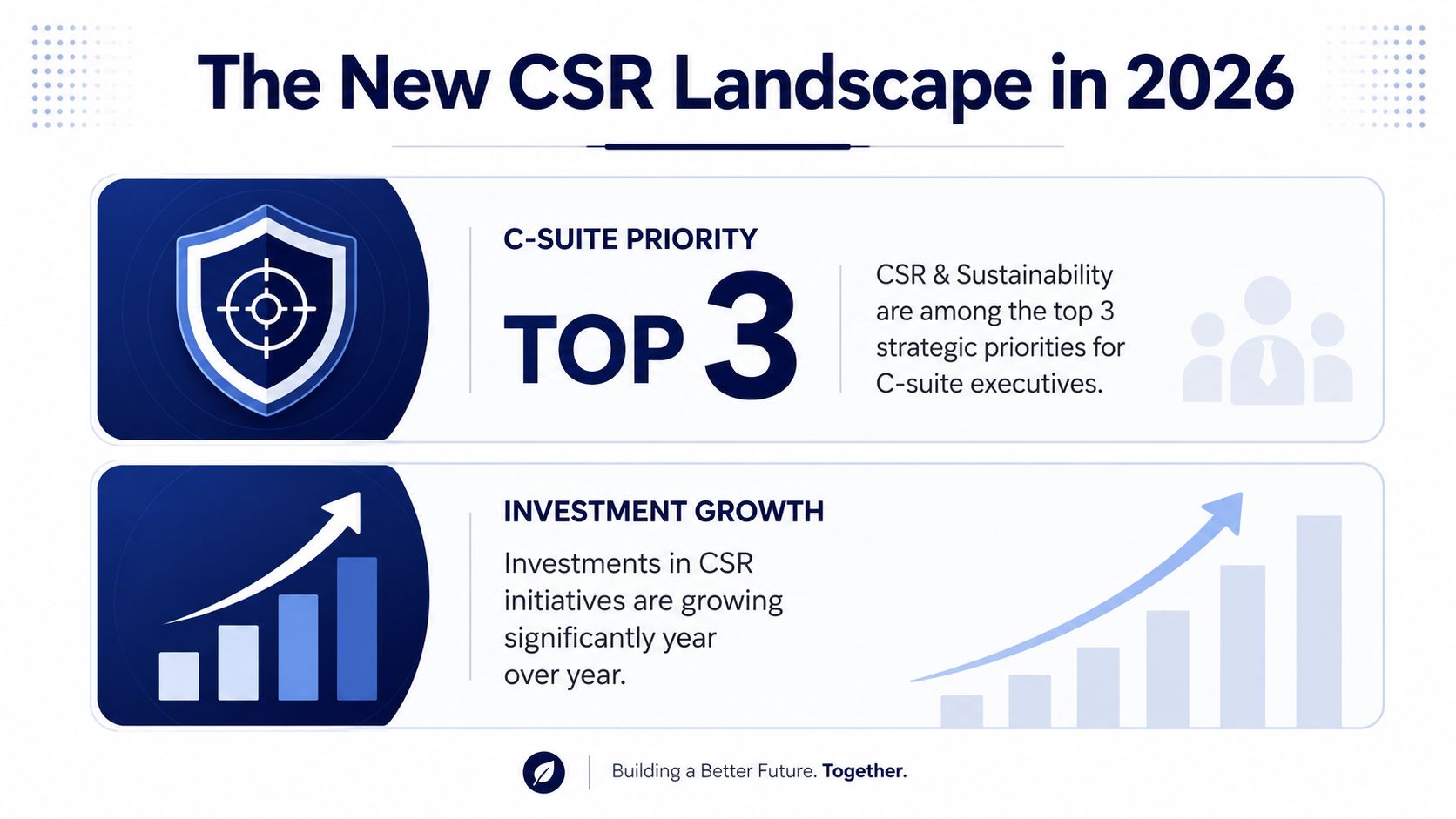
Leadership intent is strong
This isn’t a story about corporate virtue. It’s a story about operating priorities. With sustainability holding firm near the top of the executive agenda, leaders aren’t debating whether CSR belongs in strategy anymore. They’re deciding what form of CSR can survive scrutiny from employees, boards and customers alike.
Traditional CSR (policies, disclosures, donations) has matured. Employee expectations have simply outgrown it. That base layer still builds legitimacy, but legitimacy isn’t the same as a lived sense of purpose inside the business.
For leaders tracking how the model has evolved over time, this history of corporate social responsibility and workplace culture is a helpful reference point because it shows how CSR has steadily moved closer to culture, leadership and workforce design.
Employee expectations have changed the operating model
Rising corporate volunteering numbers point to something more specific than generosity: employees want CSR that’s actionable, social, and easy to join. That reshapes who owns it. CSR can no longer sit exclusively with sustainability or corporate affairs; it now intersects with onboarding, employer brand, offsites, conference design and leadership development.
The practical rule: the more visible an employee’s role in creating impact, the more credible the CSR becomes.
That’s the tension defining 2026. Leaders are investing. Employees want meaning. The organisations that connect the two through shared participation will build deeper trust than those relying on reports alone.
The Cost of Disconnected CSR Strategies
Disconnected CSR is a quiet but material business problem. A company can fund causes, publish commitments and communicate values fluently, and still leave employees with no felt connection between those commitments and their actual work. That’s not just a branding gap. It’s a gap between stated purpose and lived reality, and it shows up in hiring, retention, trust and team performance.
Purpose now affects recruitment and retention economics
Deloitte Australia reports that 94% of Gen Zs and 92% of millennials prioritise meaningful work, according to its media release on younger workers seeking money, meaning and wellbeing. The same research reports that 40% of Gen Zs and 39% of millennials have turned down an employer over personal ethics or beliefs, while 52% of Gen Zs and 46% of millennials have left a job that lacked purpose.
That changes how CSR should be evaluated, not purely as reputation management, but as part of the employee value proposition itself. For a growing share of the workforce, values alignment shapes the decision to join, to stay, and to recommend the organisation to others.
The deeper issue is credibility. Reports and giving support legitimacy, but they rarely shift employee belief on their own. People trust values more when they can see them, help shape them, and contribute to them alongside colleagues. Participatory formats, including play-based charity team building programs, solve a problem that reporting cannot. They convert abstract intent into visible action inside teams.
Employees do not judge CSR only by what the company funds. They judge it by whether they have any role in creating the impact.
Poorly integrated CSR produces operating costs
The financial stakes are real. Australian evidence already links weak psychosocial conditions and low engagement to significant workplace costs. The broader lesson: fragmented, top-down approaches to responsibility can coexist with genuinely poor employee experience. A company can support worthy causes and still erode trust if CSR stays disconnected from how teams actually work and gather.
This is why so many organisations still treat CSR as a communications stream instead of a management system. Community investment sits with one function. Culture sits with another. Team rituals and recognition sit somewhere else entirely. Employees end up encountering purpose as a message, not a practice, and a weak conduct framework compounds the problem, since standards only become meaningful through repetition and social proof, a point this Learniverse blog on business conduct makes well.
The failure pattern is usually easy to spot:
-
High symbolism, low participation. Employees hear about CSR after decisions are made and have little role in shaping outcomes.
-
Short campaigns, thin follow-through. Activities happen at set moments, but they do not influence leadership habits, team norms or how success is recognised.
-
Functional ownership, limited operational reach. Sustainability or community teams carry the agenda while managers, People and Culture teams, event organisers and business-unit leaders stay at the edge.
Those patterns create predictable consequences.
| Disconnected CSR signal | Likely organisational effect |
|---|---|
| Values are announced but rarely experienced | Lower confidence in leadership messages |
| Community support is mostly transactional | Weaker employee pride and less ownership |
| CSR is separate from team routines | Lower participation and limited cultural impact |
The commercial case is straightforward. Passive CSR does not just underperform. It can increase cynicism, make retention harder and leave culture investment disconnected from one of the few mechanisms employees consistently remember: doing meaningful work together.
From Reporting to Participating A New CSR Model
The next era of workplace CSR is built around participation. Reporting doesn’t disappear, it just stops being the centre of gravity. That shifts to employee involvement, visible contribution, and experiences that connect values to action.
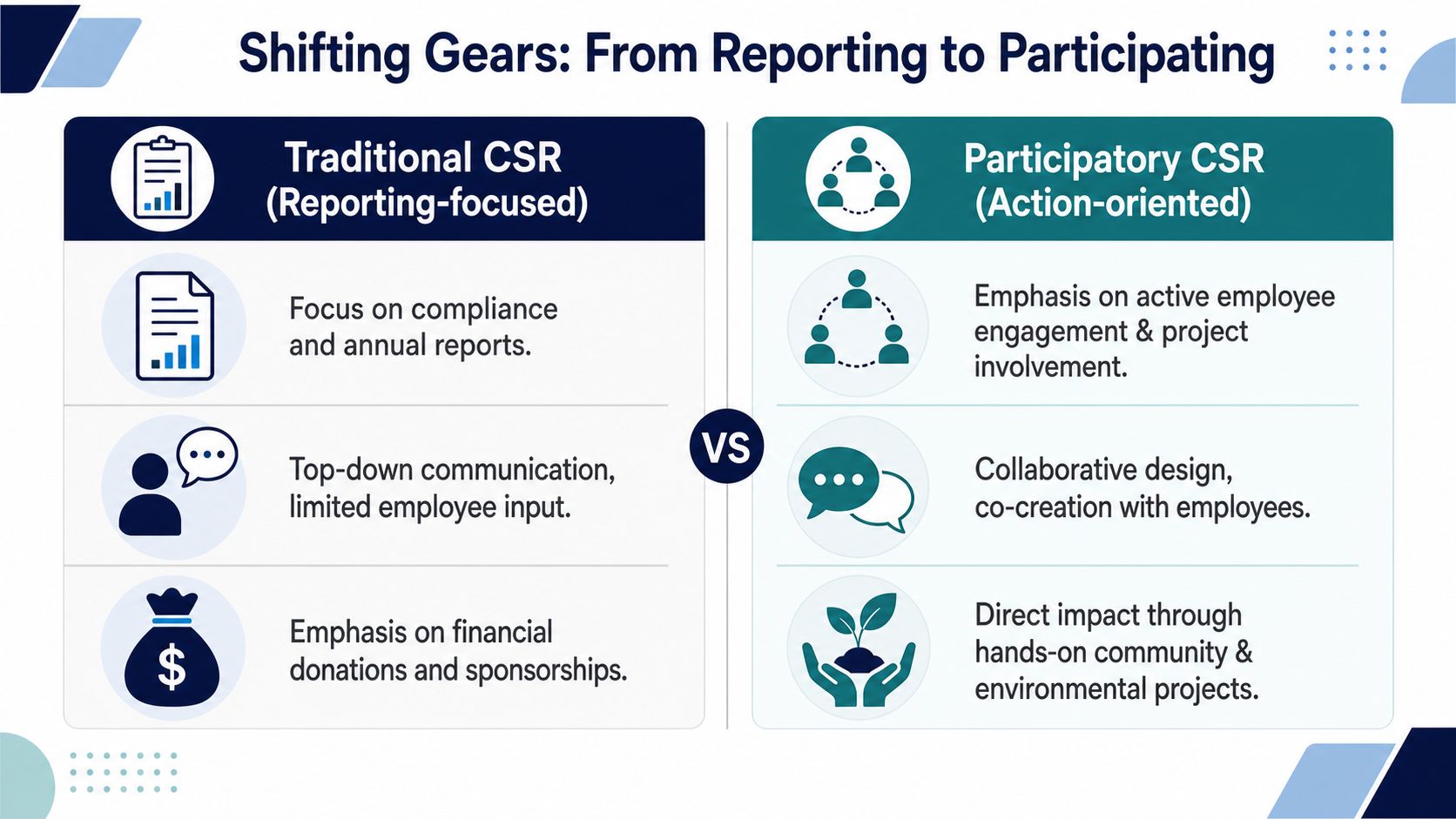
Traditional CSR is too distant from daily work
Traditional CSR often relies on a narrow set of mechanisms. Annual disclosures. Sponsorships. Donations. Senior-led messaging. Those tools still have a role, especially for governance and accountability, but they operate at a distance from everyday employee experience.
Participatory CSR closes that distance. It gives employees a direct role in creating social or environmental outcomes through the way teams gather, volunteer, collaborate and celebrate. In that model, CSR becomes something people do together, not only something the company funds on their behalf.
This approach also strengthens internal coherence. A company that wants stronger values alignment needs more than a statement of principles. It needs behavioural infrastructure. A clear guide to business conduct is one part of that infrastructure because it translates ethics into expected actions. Participatory CSR complements it by creating visible opportunities to practise those values as a team.
The Business Case
The strongest business case is retention. A 2026 analysis cited by Procurement Tactics’ CSR statistics found that companies prioritising workplace CSR see a 35% increase in employee retention over five years. Participation is likely to outperform passive CSR because it changes belief formation. Employees don’t just hear that the company cares. They experience the company allocating time, attention and shared effort to something beyond immediate output. That generates a different form of credibility.
A useful way to think about the shift is this:
-
Reporting proves intent
-
Participation proves culture
-
Repetition turns both into trust
For teams looking at models that bring that shift into practice, play-based CSR experiences offer a strong example because they combine visible community benefit with team interaction, rather than separating the two.
Leadership lens: The future of CSR won’t be decided by what sits in the appendix of the annual report. It will be decided by what employees can join, see and talk about afterwards.
How to Build a Participatory CSR Program
A strong participatory CSR program is designed for uptake, not just approval. That means leaders need to think like experience designers as much as policy owners. The right question isn’t only which cause to support. It’s which format allows the broadest range of employees to contribute in a meaningful, low-friction way.
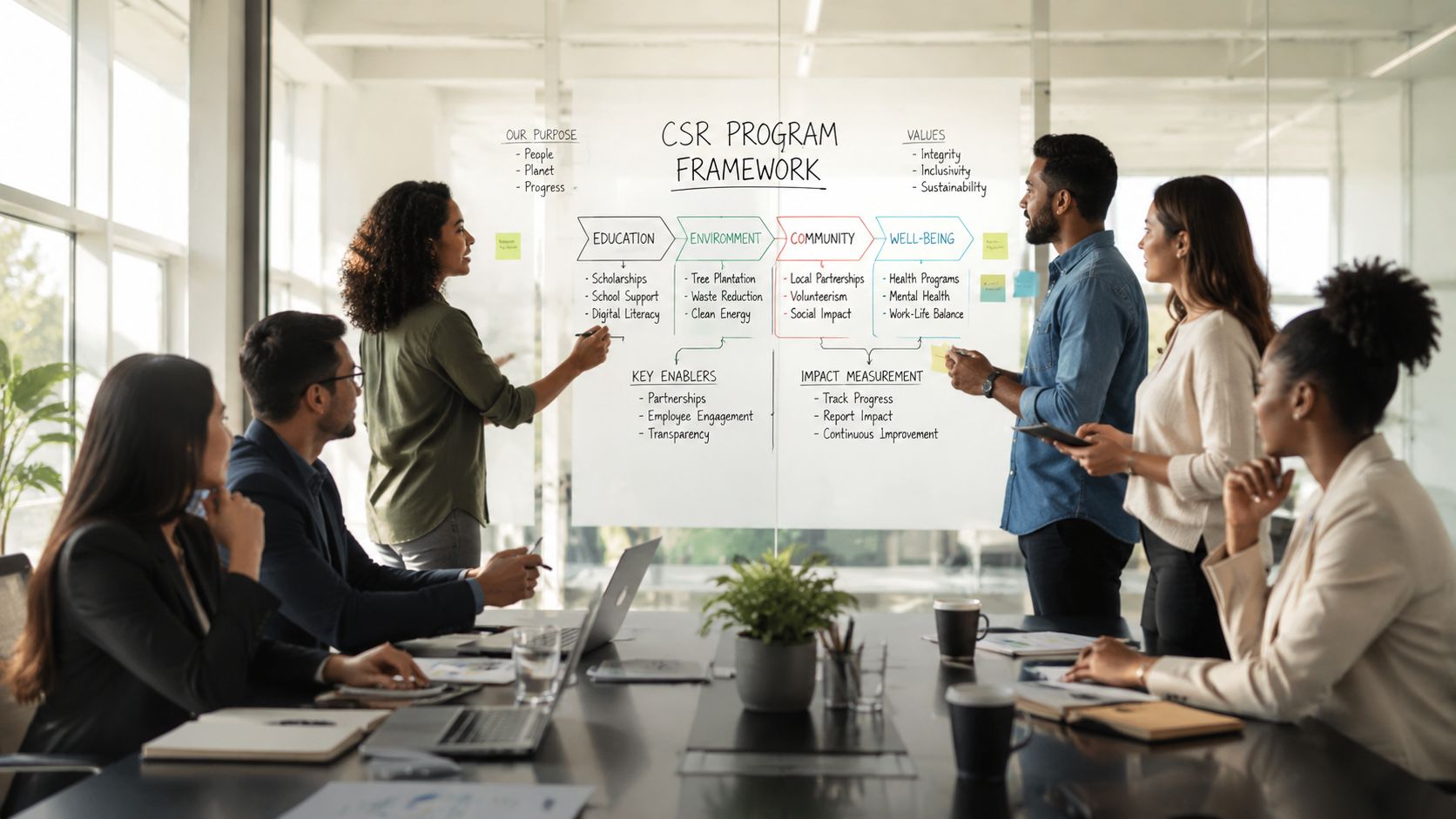
Start with program mechanics people can actually join
Business Events Australia’s overview of corporate social responsibility experiences: points to four structured mechanics already common across Australia’s events sector: eco-friendly accommodation, social enterprise dining, community give-back team activities, and direct support for native wildlife. Each serves a different need:
Each format serves a different organisational need:
-
Eco-conscious operational choices suit conferences and offsites where procurement decisions can reflect stated values.
-
Social enterprise dining works well when leaders want spending itself to support community outcomes.
-
Community give-back team activities create the clearest line between employee involvement and social impact.
-
Wildlife support initiatives can connect place-based events with local environmental relevance.
For People & Culture teams, the most effective portfolio usually mixes visible flagship moments with lighter participation options. Recognition can support that strategy too. A practical complement is thoughtful employee acknowledgement after participation. These employee appreciation gift ideas are useful because they can help organisations reinforce contribution without reducing CSR to a transaction.
Use play to improve the quality of participation
The more distinctive insight sits in the design of the activity itself. Reserach from the National Institute for Play indicates that play activates ancient brain circuits linked to social attunement and emotional regulation, which are precursors to genuine compassionate action, as explained in this overview of the science of play. That gives leaders a real, evidence-based reason to think carefully about format, not just cause.
Hands-on, play-based CSR can produce a different team state from passive giving. It asks people to solve, build, communicate and coordinate together. That can make the social impact experience more relational and memorable, while also supporting collaboration and cohesion inside the team.
A participatory CSR event works best when the team experiences contribution as shared action, not as a side announcement attached to an event.
Design principles for stronger uptake
A workable program tends to follow a few design principles:
-
Lower the barrier to entry
If participation requires high personal time cost, specialised skills or extensive preparation, many employees will opt out. Simpler, structured formats usually bring broader involvement. -
Create visible outputs
Teams respond well when they can see what they built, packed, assembled or contributed. Tangibility helps convert abstract purpose into felt achievement. -
Match the cause to the audience
Senior leadership offsites, cross-functional conferences and Christmas team building all need different formats. The event objective should shape the CSR mechanic. -
Build employee voice into selection
Participation starts before the event. Asking teams which causes or formats resonate often increases buy-in and reduces the sense that CSR is being imposed from above.
Leaders building from scratch can use this guide to creating a CSR framework teams are passionate about as a practical planning reference, especially when the goal is to tie community impact to engagement and culture rather than running a one-off initiative.
Putting Participation Into Practice With Charity Team Building
Charity team building is where the participatory model becomes concrete. Instead of separating team culture from social impact, it combines them in one shared experience. Employees aren’t only informed that the company donated funds or sponsored a cause. They contribute directly through a structured, hands-on activity tied to a local charity or non-profit outcome.
What hands-on CSR looks like in practice
The defining feature is action. Verified data confirms that charity team building requires employees to actively participate in hands-on activities that benefit local charities and non-profits, rather than simply donating money or unused items, a distinction that shifts the employee’s role from observer to contributor.
In practice, this can mean team-based build or assembly experiences that create useful items for community organisations, or collaborative challenges where the finished output goes straight to a partner organisation at the end of the session. The strongest versions keep the link between effort and beneficiary crystal clear. Participants can see exactly what they produced, who it’s for, and why it matters.
That makes charity team building especially well suited to corporate conferences, leadership offsites, end-of-year events and cross-functional culture days. It delivers more than an activity; it creates a shared story the team carries back into the workplace.
Why this model is gaining traction
The scale of participation suggests this is no longer a niche format. In 2025, more than 14,000 people across Australia and New Zealand participated in play-based charity team experiences, according to this 2025 participation update, a strong signal of organisational appetite for CSR that’s practical, social and genuinely event-ready.
It also mirrors a wider pattern already visible in volunteering: organisations increasingly want formats accessible enough for busy teams to join, while still producing a credible impact story. Charity team building fits naturally into the rhythm of corporate life, embedded in conferences, folded into Christmas team building, or built into a broader culture and engagement program.
For decision-makers comparing program types, this overview of charity team building programs for 2026 helps distinguish options that merely bolt on a donation component from those that make participation the actual centre of the experience.
The most effective CSR experiences don’t ask employees to admire the company’s values. They ask employees to enact them together.
Measuring the Full Impact of Your CSR Program
Measurement is where many CSR programs become too narrow. Leaders count dollars donated, items delivered or attendance numbers, then stop. Those metrics have value, but they miss the broader organisational return of participatory CSR. A better measurement model captures both sides of the equation: community impact and workplace impact.
A better dashboard for CSR in the workplace
Because charity team building requires active employee participation in hands-on activities that benefit local charities and non-profits, as outlined in this explanation of the real impact of charity team building, leaders can track more than philanthropic output. They can also evaluate changes in how teams engage, connect and interpret company values.
A practical dashboard should include five categories:
-
Employee engagement
Track sign-up rates, attendance, post-event feedback and whether participants report stronger connection to team and organisation. -
Community impact
Record what was delivered, which partner organisations benefited and whether the output met a defined local need. -
Cultural value
Look for indicators such as pride in organisation, willingness to recommend the employer and perception of values alignment. -
Team performance signals
Review manager observations on communication, collaboration and cross-functional interaction after the event. -
Programme quality
Assess how easy the initiative was to join, whether the format suited the audience and what should be refined next time.
What leaders should review after every program
The strongest review process combines hard and soft evidence. Numbers show scale, narrative shows meaning, and together they make a far stronger internal case than either alone.
A simple review table can help:
| Measurement area | Useful question |
|---|---|
| Participation | Did the format attract broad involvement across roles and levels? |
| Team outcomes | Did managers observe stronger collaboration or morale afterwards? |
| Community relevance | Was the output clearly useful to the receiving organisation? |
| Employer brand | Did employees speak about the initiative positively inside or outside the business? |
Leaders who want a stronger business case should also connect participatory CSR to broader culture metrics already tracked by HR and People & Culture teams. That might include retention trends, engagement survey themes and qualitative feedback from managers after conferences or offsites. This perspective on the ROI of play is relevant here because it helps frame team experiences as performance infrastructure rather than event extras.
The most effective programs are usually the ones measured in a way that reflects how they create value. Not only through what they give away, but through what they build inside the workforce while doing it.
Corporate leaders looking to turn CSR into something employees can actively join can explore Corporate Challenge Events, which designs play-based charity team building, conference team building and workplace culture experiences across Australia and New Zealand. Its programs are built for organisations that want practical social impact, stronger team connection and a more participatory approach to CSR in the workplace.