
A team gets told to think differently, and the room goes quiet. The senior leader wants bold ideas, but people offer safer versions of the same plan, the sort of change that will not embarrass anyone if it fails.
That reaction is rarely a sign of low intelligence or ambition. People may be protecting themselves from criticism, wasted effort or becoming the person whose idea lands badly in public. Innovation does not begin when leaders demand better ideas. It begins when people feel able to explore ideas that might not work.
That shift matters because creative thinking, curiosity, resilience and flexibility are expected to grow in importance, according to the World Economic Forum’s Future of Jobs reports. For People and Culture leaders, the practical question is not whether employees have ideas. It is whether the organisation gives those ideas enough room to become useful.
Play creates that room. Not by lowering standards or turning innovation into entertainment, but by giving people permission to explore, combine and test ideas before those ideas are expected to be correct.
The real value of play is not simply that it produces more ideas. It helps move teams from protected thinking to shared experimentation.
Why Smart Teams Still Produce Safe Ideas
A workplace rarely needs more clever people. It usually needs a better climate for unfinished thinking.
When a manager asks for fresh thinking in a meeting where every suggestion is judged immediately, the team learns the real rule quickly: say less, risk less and keep every idea polished.
That is why employee innovation often stalls at the first conversation. The idea may exist, but the person carrying it does not yet trust the room enough to say it plainly.
Common barriers include:
-
Fear of being wrong in front of colleagues
-
Senior voices dominating the discussion
-
Ideas being evaluated before they have developed
-
Constant time pressure
-
Rigid approval processes
-
Rewarding efficiency while expecting originality
-
Requiring certainty before allowing an experiment
-
Employees believing nothing will happen if they speak up
Innovation does not stall only because organisations lack good ideas. Research from the US National Center for Science and Engineering Statistics identifies high costs, skills shortages, limited internal funding and competing business priorities among the most common barriers. Those pressures are real, but they also make safe, incremental thinking more likely. Play cannot remove financial or operational constraints, but it can help teams explore those constraints differently, challenge assumptions and find smaller ideas that are practical enough to test.
The latest Australian figures show more activity, but they also reinforce the implementation challenge. The Australian Bureau of Statistics reported that 46% of Australian businesses were innovation-active in 2024–25. Being innovation-active includes ideas still in development or abandoned, not only innovations successfully introduced. The ABS data makes an important distinction between attempting innovation and converting it into an outcome.
Innovation is therefore not only an idea problem. It is a permission, capability and implementation problem.
Practical rule: if a team only speaks up when the answer is already safe, the organisation is managing compliance, not innovation.
The creative problem-solving model provides one useful response. Separating idea generation from evaluation allows people to explore a problem before being required to defend a solution.
The Idea Supply May Already Exist
Leaders sometimes assume employees need to become more creative. In many workplaces, employees are already noticing problems and imagining improvements. What they lack is a credible path for those observations to travel.
The CIPD’s People-powered Innovation report found that about 60% of employees said they contribute innovative ideas. It also found that workplace context matters. Job design, relationships and employee voice were connected with whether people offered suggestions.
Employees consider how an idea is likely to be received. Someone may see an improvement clearly and still remain silent if previous suggestions were dismissed, ignored or treated as criticism.
The idea supply may already exist. The leadership challenge is creating conditions in which more of those ideas can surface, combine and progress.
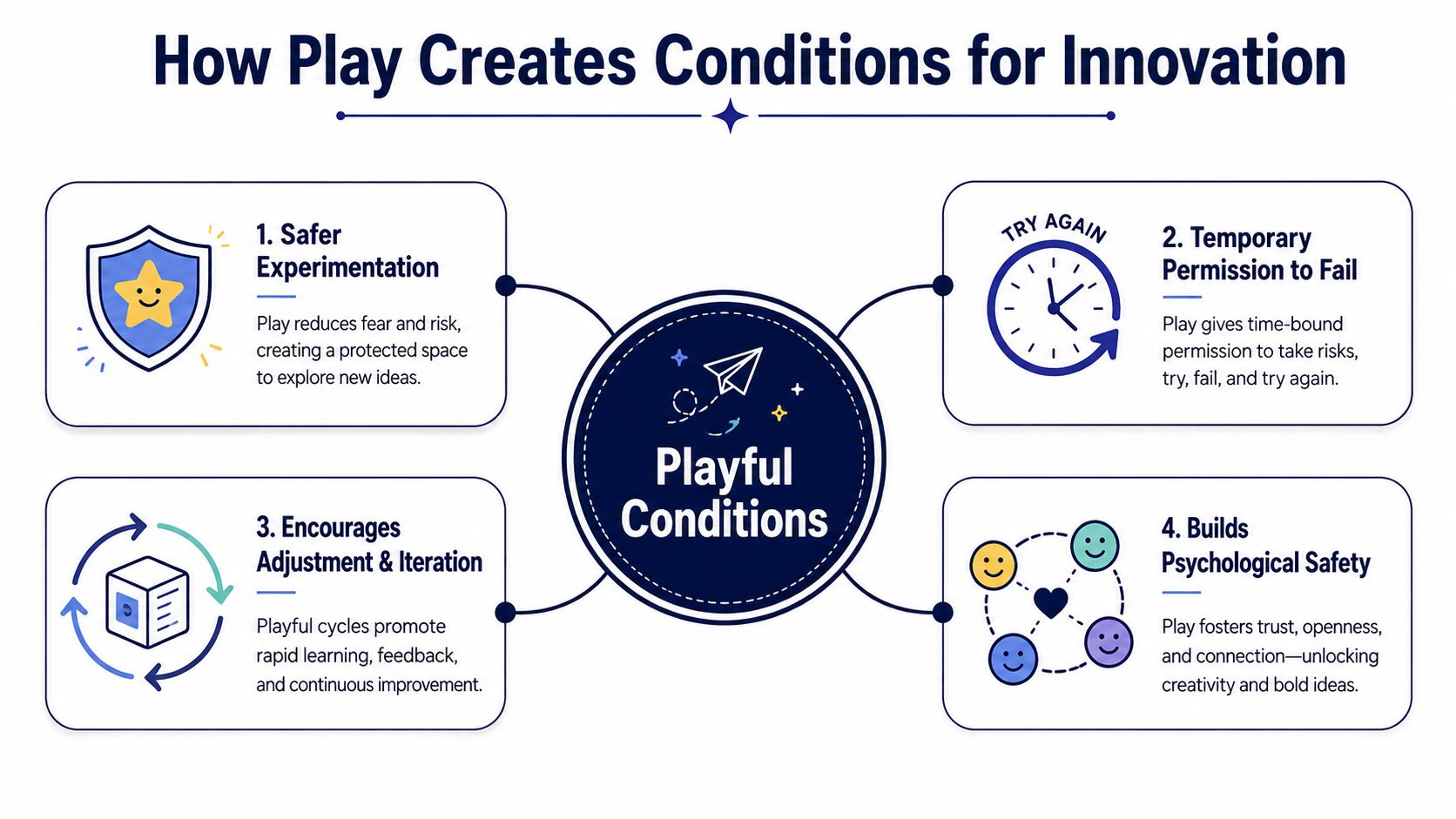
That is why psychological safety in the workplace is central to innovation. Psychological safety does not mean every idea is accepted or that standards disappear. It means people can raise questions, admit uncertainty and contribute unfinished thinking without unnecessary interpersonal risk.
How Play Changes the Conditions
Play gives people temporary permission to test, adjust and try again. A weak attempt can become useful information rather than a judgment on someone’s competence.
That shift matters because innovation is rarely a straight journey from problem to answer. It involves uncertainty, unusual combinations, failed attempts and discoveries that only appear once people begin experimenting.
Play can help teams:
-
Change perspective
-
Combine unrelated ideas
-
Question familiar assumptions
-
Build on another person’s contribution
-
Make abstract thinking visible
-
Experiment before committing
-
Recover from an unsuccessful attempt
-
Stay curious for longer
These behaviours connect with the science behind workplace play. Play can support cognitive flexibility, curiosity, motivation and social attunement, all of which matter when teams are working through uncertainty.
Play can also loosen social barriers. In a well-designed playful setting, job titles become less influential for a moment because the task requires participation, not position. A quieter employee may notice the pattern, challenge the assumption or make the unexpected connection that moves the group forward.
Research by Hoff, Carlsson and West found that introducing playful cues into workplace meetings improved participants’ experience and the creative climate without undermining productivity. The original workplace play study shows that playful design and serious work do not have to compete.
Leader’s takeaway: playful conditions maintain standards while reducing the social risk of exploring a better standard.
The Play-to-Pilot Loop
Play should not end with a wall covered in colourful ideas. It needs a path from curiosity to action.
The Play-to-Pilot Loop gives leaders a simple structure:
1. Permission
Before people contribute original thinking, they need to understand what kind of participation is genuinely welcome.
Leaders create permission by:
-
Naming the problem without prescribing the answer
-
Separating exploration from evaluation
-
Inviting challenge and alternative views
-
Responding constructively to unfinished ideas
-
Making it clear that the first suggestion does not need to be the final solution
Permission is not a motivational speech. It is created through the way leaders respond when someone actually takes the risk.
2. Play
This is where the team expands the field of possibilities.
Play might involve inversion questions, role-play, sketching, building, scenario testing, storytelling, friendly challenges or combining ideas that would normally remain separate.
Useful questions include:
-
How could we make this fail spectacularly?
-
What rule are we following that nobody wrote down?
-
What would we try if nobody could criticise the first version?
-
What would a completely different industry do?
-
What would our customer remove first?
-
What would happen if we did the opposite?
The objective is not to be silly. It is to interrupt familiar thinking long enough for another path to appear. Not everyone enters playful thinking in the same way. Some people generate ideas by talking, while others need quiet reflection, visual sketching, physical building, competition or open-ended exploration. A strong innovation process offers several ways to participate rather than rewarding only the fastest or loudest thinkers. Personalisation is not an accommodation added afterwards. It widens the range of ideas the team can access.
3. Prototype
A promising idea should become something the team can see, experience or test.
That might be:
-
A rough customer journey
-
A process sketch
-
A sample communication
-
A physical model
-
A revised meeting structure
-
A limited trial with one team
-
A simple mock-up of a service
Prototypes reduce the pressure to be correct. They turn a debate about what might happen into an opportunity to observe what actually happens.
The first test should also be small enough to begin. Some of the practical advice used to break through task paralysis can be applied carefully at a process level: reduce the size of the first action, remove unnecessary decisions and make progress visible. The point is not to diagnose a team. It is to lower the activation energy required to test an idea.
4. Proof
Once a prototype exists, the team needs evidence.
Proof does not mean proving the original idea was right. It means learning whether the idea improved the problem it was designed to address.
Ask:
-
What changed?
-
What remained difficult?
-
What surprised us?
-
What did customers or employees experience?
-
What would need to improve before another test?
-
Is this still the right problem to solve?
An unsuccessful pilot can still produce valuable proof if it reveals why an assumption was wrong.
5. Progress
The final step is deciding what happens next.
The team may:
-
Improve the prototype
-
Test it with another group
-
Scale the idea
-
Combine it with another solution
-
Return to the exploration stage
-
Stop the work deliberately
Stopping an idea is not automatically failure. Continuing without evidence can be far more expensive than learning early that an approach is not viable.
Play opens the field of possibilities. Process turns the strongest possibility into progress.
Run a 30-Minute Play-to-Pilot Session
Leaders can use the loop without organising a major innovation workshop.
Minutes 1–5: Define the problem
Choose one real issue. Describe what is happening, who it affects and why it matters. Do not begin with a preferred solution.
Minutes 6–12: Invert it
Ask the team how it could guarantee failure or make the problem worse. This often exposes assumptions, bottlenecks and behaviours that normal problem-solving misses.
Minutes 13–20: Reverse and create
Turn the failure conditions into possible improvements. Ask participants to sketch, map or build the most promising idea rather than only discussing it.
Minutes 21–25: Stress-test
Examine the idea against customer needs, cost, time, risk and operational reality. Improve the concept rather than defending it.
Minutes 26–30: Choose the pilot
Agree on one small experiment, one owner, one measure and one review date.
Hybrid teams can run the same process through breakout rooms, shared whiteboards, polls and timed challenges. These team-building games for hybrid offices offer additional formats, but the activity should always connect to the problem being solved.
One Play-to-Pilot session can unlock a useful idea, but sustainable innovation requires repetition. Embed playful exploration into project kick-offs, retrospectives, product reviews and planning sessions. Give teams regular opportunities to question assumptions, share unfinished thinking and run small experiments. Leaders can also nominate play or innovation champions, conduct occasional play audits to identify where rigidity has returned and share stories about experiments that produced useful learning. The goal is not to schedule more workshops. It is to make curiosity and iteration part of how work gets done.
Boundaries Make Experimentation Safer
Playful innovation is not brainstorming without limits. It still needs:
-
A real problem
-
Clear constraints
-
Inclusive participation
-
Time for evaluation
-
Ethical and commercial judgment
-
An accountable owner
-
A defined review point
Play opens the field of possibilities. Leadership determines which possibilities are responsible, relevant and worth testing.
That is what permission to play as a leadership skill looks like in practice. Leaders create enough freedom for exploration while remaining clear about purpose, safety and accountability.
Play does not require every part of an organisation to become flexible. Leaders can use process standardisation to identify the steps that must remain consistent, then give teams more freedom in the areas where testing is appropriate.
Clear boundaries can make experimentation safer because people know what may change and what cannot.
Competition also needs care. When winning matters more than curiosity or shared learning, participants may hold back, posture or dominate. The objective is not to create an innovation contest. It is to create a better path from insight to action.
Measure the Process, Not Just the Ideas
A team can generate hundreds of suggestions and still fail to change anything. Counting ideas alone does not reveal whether the organisation is testing, learning or implementing.
The Singapore employee-innovation survey demonstrates why innovation should not be judged through one universal threshold. Reported completion rates varied across products, services, processes, technologies and business models. These forms of innovation carry different levels of complexity and should not be assessed through identical timelines or conversion expectations.
The Mack Institute’s innovation metrics framework recommends looking across three areas.
Inputs
-
Ideas entering the pipeline
-
People and resources assigned
-
Internal and external sources of ideas
-
Cross-department participation
Process effectiveness
-
Ideas progressing into experiments
-
Time from suggestion to first test
-
Projects meeting agreed quality gates
-
Lessons captured from failed tests
-
Speed of feedback and decision-making
Performance outcomes
-
Improvements implemented
-
Customer satisfaction
-
Revenue or efficiency gains
-
Return on innovation investment
-
Value created through new products, services or processes
The Mack Institute also warns that the easiest output measures are not always the most useful. Process measures can be harder to collect, but they often reveal where innovation is actually becoming stuck.
Measurement should support learning rather than make people afraid to suggest something unfinished. A scorecard that punishes every failed experiment will quickly teach employees to avoid experiments.
Give Employee Innovation Somewhere to Go
Organisations that innovate consistently are not waiting for a few unusually creative people to save them. They create conditions in which more people can notice problems, offer unfinished ideas and help turn those ideas into experiments.
Play matters because innovation is a human process of curiosity, combination, uncertainty, failure and discovery. Leaders cannot command that process into existence, but they can give it permission, boundaries and a pathway.
The Play-to-Pilot Loop brings those elements together:
-
Permission makes it safer to contribute.
-
Play expands what the team can imagine.
-
Prototyping makes the idea visible.
-
Proof replaces opinion with evidence.
-
Progress turns learning into action.
Play opens the possibility. A disciplined pilot turns that possibility into evidence. Together, they give employee innovation somewhere to go.