
A team gets stuck on a problem in a workshop. Someone says something slightly silly, the room laughs, people lean in, and the energy changes. Another idea appears. Then another. From the outside, it can look like a light moment in the middle of a serious day.
Under the surface, the brain is doing serious work. A specific brain circuit has switched on, a cascade of chemistry has followed it, and within a few minutes a room full of cautious adults has become a room willing to think out loud together.
That's the heart of the science of play. Play is not just a break from serious life. It is one of the ways the brain prepares us to live, learn, connect and adapt. For workplace leaders, HR teams, executive assistants and event organisers, that shift in perspective matters because play at work isn't about filling time. It's about creating conditions that help people think better together. Understood this way, play stops looking like a pleasant interruption and starts looking like performance infrastructure, the underlying conditions that good teamwork depends on, whether anyone in the room is aware of it or not.
Play Is Biological Not Just for Children
Many adults still carry the idea that play belongs to childhood and that serious workplaces should leave it behind. The biology suggests something different. Play is part of being human across the lifespan.
That doesn't mean adults need to behave like children. It means the underlying systems linked with curiosity, experimentation, movement, reward and social connection still matter in adult performance. In workplaces, those systems show up as adaptability, communication, trust and the ability to recover after pressure.
A useful way to think about adult play is this. It isn't the opposite of productivity. It's part of the human foundation that productivity depends on. That's one reason many People & Culture teams are revisiting what happens when work becomes too controlled, too static or too self-protective. The case for why adults still need play captures that shift well.
Why leaders often misread play
Leaders usually don't reject play because they're against engagement. They reject it because they mistake play for distraction.
In reality, guided play can be highly purposeful. Research discussed in a review of play and neurobiological development shows that structured, guided play opportunities can activate the same learning and motivation systems as free play, while being more useful for embedding specific skills like collaboration and communication.
A workplace reading of the evidence
Some research starts in childhood settings because that's where scientists can observe play more directly. The workplace relevance comes from the systems involved, not from copying child-focused activities into offices. The same broad human capacities are in play across life:
Adaptation: people respond better when they can explore, test and adjust.
Social attunement: teams work better when people read each other's signals well.
Emotional regulation: pressure is easier to handle when threat levels soften.
Learning: experience shapes the brain over time.
Australia's broader play picture also points to a cultural shortfall. The 2023 State of Play report notes that a La Trobe University study for the 1000 Play Streets project found 90% of adults surveyed reported feeling more confident to talk when engaging in play-based activities in Play Australia's State of Play report. For workplace leaders, that result is striking because it links play with confidence and communication in adults, not just recreation.
How Your Brain's Play Switch Gets Flipped
Something has to happen before people enter a playful state. The brain doesn't just drift there by accident. It responds to cues such as safety, novelty, movement, social invitation and a challenge that feels manageable.
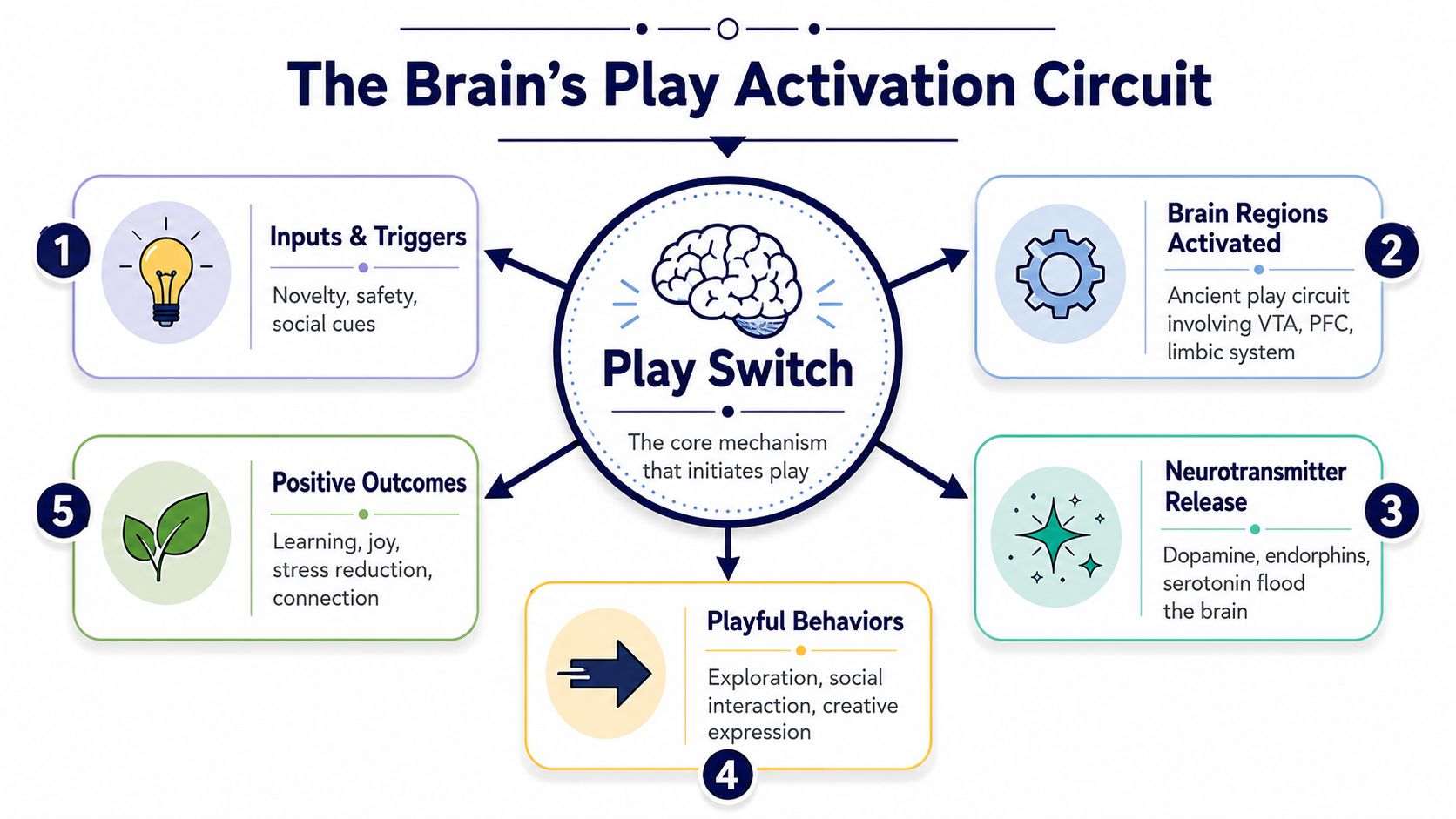
One simple way to understand this is to think of play as having an ignition system. A well-designed activity gives the brain enough safety to relax, enough novelty to get interested, and enough social or sensory input to engage. When that combination is present, people often shift from observation into participation.
The play switch in plain English
The circuitry responsible sits in older brain systems built for survival, emotion, and movement, not in the parts responsible for deliberate thought. Researchers have identified a region in the periaqueductal gray that behaves almost like an ignition switch for play: once conditions are right, this circuit starts treating the moment as one worth engaging with instead of avoiding.
A neuroscience review explains that play is a neurobiological state modulated by coordinated activity between the prefrontal cortex, striatum, and amygdala, where dopamine acting within the striatum drives sensorimotor organization of play and anandamide release in the basolateral amygdala increases playfulness in this review on the neurobiology of play.
That sounds technical, but the practical meaning is simple. Play isn't one isolated brain spot lighting up on its own. Different regions involved in thinking, reward, movement and emotion start communicating.
What flips it on at work
A corporate team usually won't enter play because someone says, “Have fun.” The trigger tends to be more concrete:
| Workplace cue | What the brain may read |
|---|---|
| A clear but low-stakes challenge | Safe opportunity to try |
| Laughter or warm facilitation | Reduced social threat |
| Movement or hands-on activity | Permission to engage physically |
| Shared task with others | Social relevance and reward |
Practical rule: If an activity feels unsafe, confusing or exposing, the play switch often stays off.
That's why design matters so much in play based team building. The goal isn't random entertainment. It's creating the right conditions for participation.
Understanding the Feel-Good Chemistry of Play
Once that switch flips, what follows isn't just a change in mood. It's measurable neurochemistry, and it's why a team can leave a fifteen-minute activity noticeably more alert, more forthcoming, and more willing to take a risk than they were beforehand.
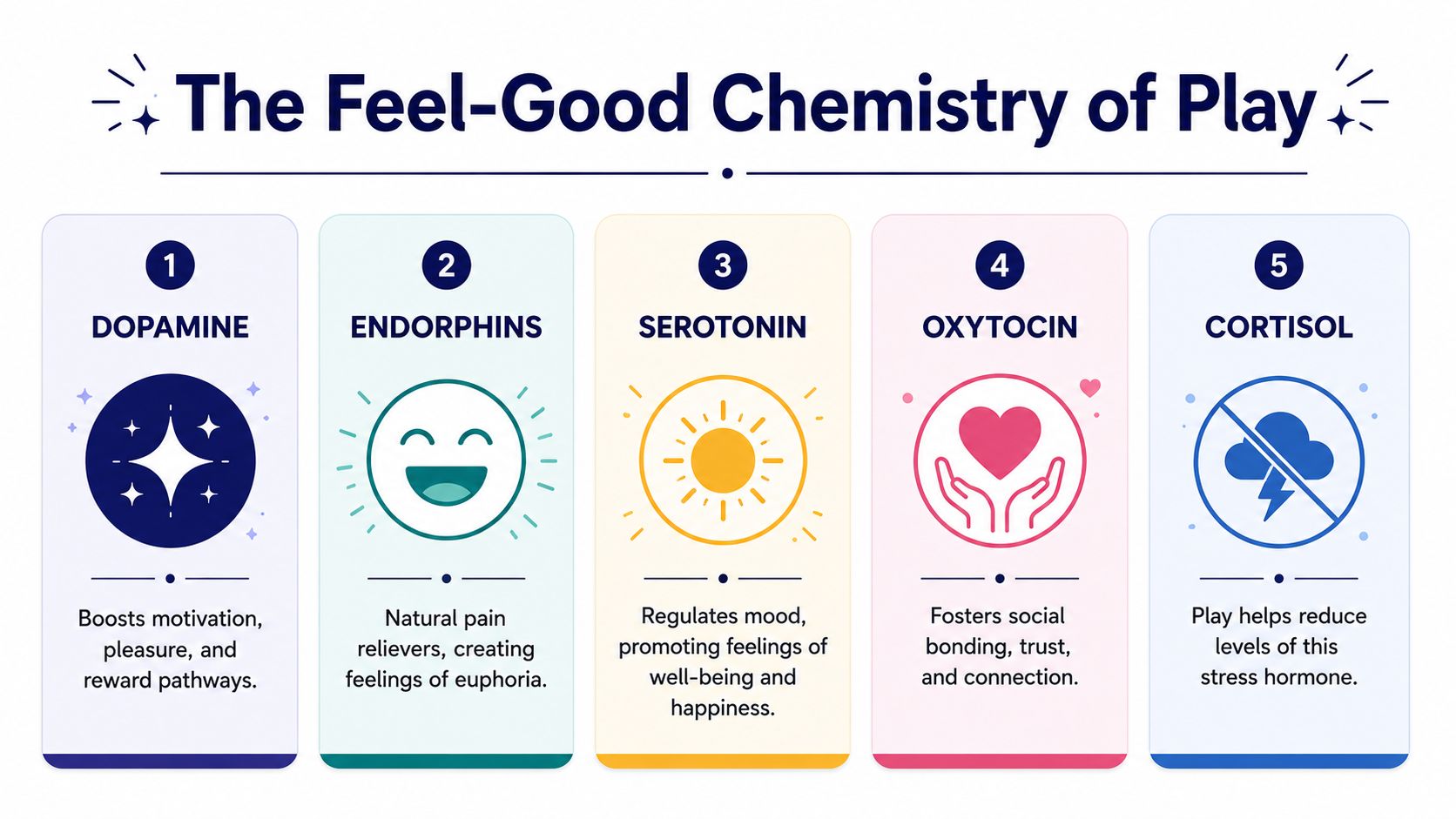
A simple guide to the chemistry
The main chemicals often discussed in the neuroscience of play are easier to understand if you picture them as parts of a workplace operating system.
Dopamine: helps drive motivation and anticipation. It supports the feeling of “stay with this, this matters.”
Oxytocin: is linked with bonding and interpersonal trust, which matters when teams need to cooperate quickly.
Serotonin: plays a role in mood stability and emotional balance.
Endorphins: are associated with pleasure and relief, especially when play includes laughter or movement.
Endocannabinoids: appear to help sustain a playful, flexible state.
These chemicals do not work in isolation. They interact, like different controls on the same dashboard. That helps explain why a well-designed playful activity can improve energy, lower social friction, and make learning stick more effectively than passive information alone.
Why stress chemistry matters at work
For most teams, the real constraint isn't a lack of knowledge. It's a nervous system parked in threat-detection mode. Under tension, the brain spends more energy scanning for risk and less on exploration, memory, and flexible thinking. Play interrupts that directly: team activities built around laughter and play have been shown to cut stress hormones by as much as 70 percent. Treat that figure as a strong directional signal rather than a guarantee in every context, but the pattern holds. Lower stress chemistry means clearer attention, easier communication, and fewer defensive reactions, which is exactly what lets the inner critic go quiet, the subject of the next section.
Chemistry helps explain memory, effort, and follow-through
People rarely remember the tenth slide in a deck. They remember the challenge that made them solve, move, decide, and respond together.
Emotion and reward help mark an experience as worth storing. Movement adds another layer of attention. Shared effort adds meaning. The result is not just a better mood for ten minutes. It can be stronger recall, faster engagement, and greater willingness to participate the next time.
For leaders trying to build new habits, the same principles show up in other behaviour research. These science-backed tips for positive change are useful because they connect reward systems with repeatable action, which is exactly what teams need when culture change has to become everyday behaviour.
If you want a practical example of how this biology translates into workplace energy and participation, why your team needs a dose of play explains the link in straightforward terms.
How Play Quiets the Inner Critic
Many teams don't struggle because people lack intelligence. They struggle because people are overly monitored, overly cautious, or too worried about getting it wrong in front of each other.
That's where the benefits of play become especially practical. The prefrontal cortex helps with planning, judgement and self-monitoring. Those functions are valuable, but when they become too dominant, people can get stuck in overthinking. In a well-designed playful activity, self-consciousness can ease. The inner critic doesn't disappear, but it may quieten enough for experimentation to begin.
Safe risk changes behaviour
At the same time, the amygdala helps detect threat. If a moment feels socially risky, the brain can move into defensiveness. People protect status, hold back ideas, and avoid uncertainty. Play can soften that threat response by creating a low-stakes environment where trying, missing and adjusting feel acceptable.
That's why exercises built around real challenge and collaboration do more than boost mood. They generate the psychological safety that lets teams surface diverse perspectives and drives genuine innovation.
What leaders usually notice first
Leaders often see the behavioural signs before they think about brain regions:
More voices in the room: quieter people contribute sooner.
Less fear of being wrong: ideas come out less polished, which is often useful.
Better recovery: mistakes become information rather than embarrassment.
More confidence: people test, refine and re-enter the conversation.
For professionals who want a broader, non-workplace resource on reducing self-doubt, the Acheloa Wellness guide to confidence offers a relevant perspective on how people can move through imposter feelings. In team settings, the same general principle applies. Lower the perceived threat, and participation often rises.
When people feel less judged, they become more available for learning.
This is also why poorly designed activities can backfire. If someone feels exposed, forced or mocked, the inner critic gets louder, not quieter. Good facilitation protects dignity while inviting stretch.
The Science of Connection Through Shared Experience
A team can't be told to trust each other and expect trust to appear. Connection usually grows through shared experience. That's where the social side of the science of play becomes useful.
When people play together, they start reading each other more closely. They notice pace, facial expressions, laughter, tone of voice and body language. This is often explained through ideas like mirror neurons and attunement. In plain English, people begin tuning into each other.
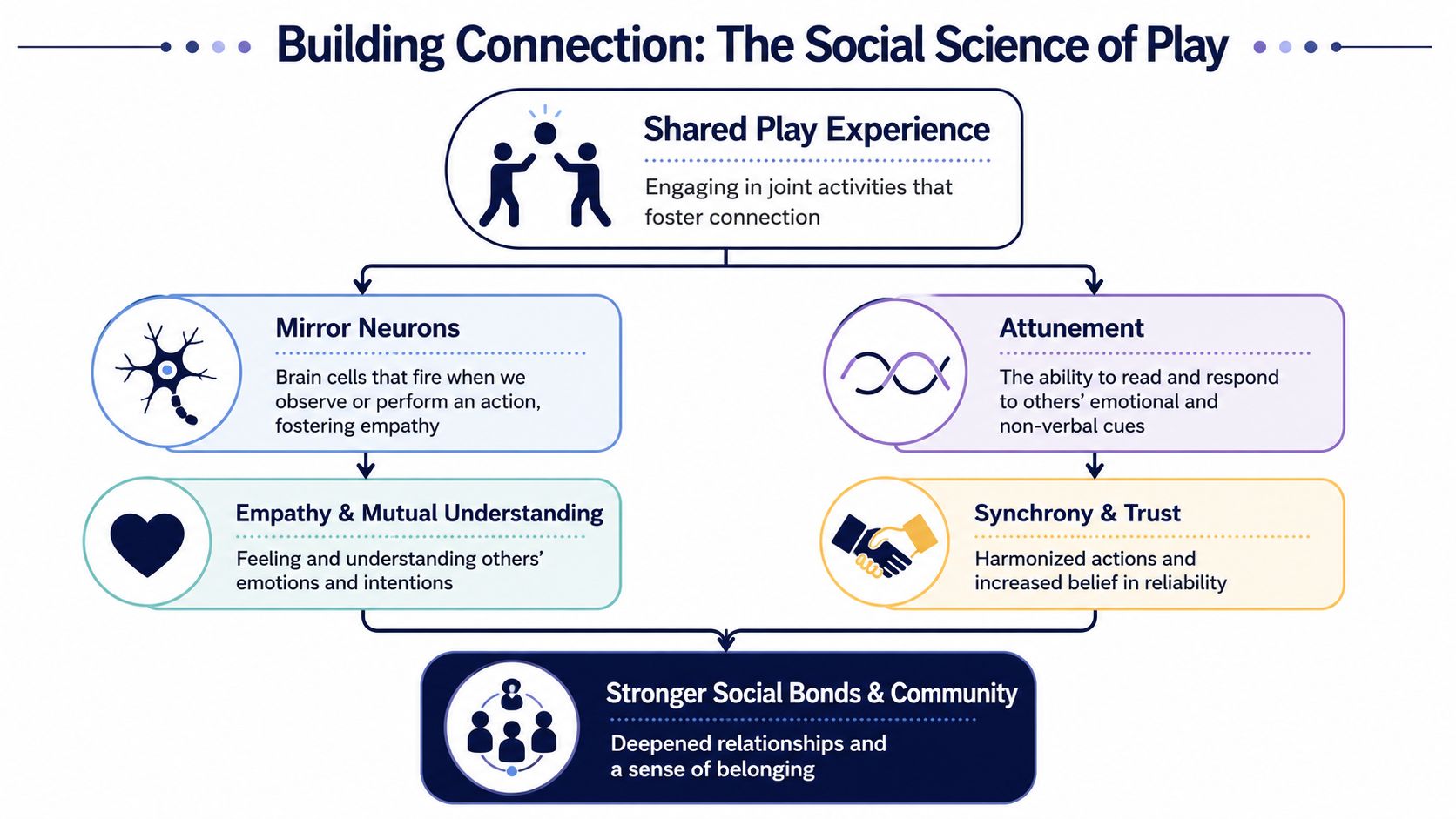
Attunement is the missing middle
Most workplace communication problems aren't caused by a total lack of information. They come from weak attunement. People miss cues. They misread tone. They push when the group needs space, or stay silent when a moment calls for initiative.
Shared play can help because it gives teams a live environment in which to practise reading and responding to one another. That might happen in a timed challenge, a collaborative build, or a conference activity that requires coordinated action.
Why connection forms faster in motion
Connection tends to deepen when people do something together, instead of discussing it. A practical example is a short, shared challenge that requires quick adaptation. People start noticing who steadies the group, who spots patterns, who encourages others and who brings humour when tension rises. That information is social, not just task-based.
Research also points in this direction. Employees who play regularly with colleagues feel more motivated and connected to their mission, driving higher engagement and productivity that cascades into culture change improvements like clarified communication channels and better meeting structures in this discussion of play at work.
For event organisers and People and Culture teams, this is why short, repeatable moments work so well. Micro-play in the workplace resets energy and rebuilds connection without needing a full-day offsite to do it. One moment like that is valuable on its own, but its real payoff shows up over time, in how repeated exposure actually reshapes the brain.
Connection isn't built by instruction alone. It's often built through shared rhythm, shared challenge and shared relief.
Building a More Flexible and Adaptable Brain
Everything so far describes what happens inside a single playful moment. The bigger payoff is what repeated exposure to those moments does to the brain over time, which is what neuroplasticity means in practice. It doesn't require a neuroscience degree to understand it. A simple analogy works better.

Think of the brain like a field of grass. The first time someone walks through it, the path is faint. The more often that route is used, the clearer it becomes. Experience helps build and strengthen pathways.
Why play helps learning stick
Play tends to stack novelty, feedback, movement, and emotion together, and that combination drives stronger learning, because the brain pays closer attention to what feels active and relevant. That's likely why a hands-on challenge lands harder than a passive presentation. Teams in a playful state test ideas, shift strategy, and recover from small failures more readily, and that's not a mood effect. It's practised flexibility, repeated until it becomes a habit.
What this looks like in organisations
For leaders, the real payoff of the play-and-brain connection is adaptability. Teams rarely need more information. They need a better capacity to respond when the original plan doesn't work.
A playful task can train that capacity by asking people to:
Try a route: start with one approach and assess it quickly.
Adjust under pressure: change direction without treating change as failure.
Notice patterns: learn from the group in real time.
Stay engaged: keep curiosity alive while solving a problem.
The link between BDNF and play is a useful next step for readers interested in how experience supports learning and brain adaptability without turning the topic into dense jargon.
Why Play Is Your Team's Missing Performance Infrastructure
Picture a team walking into a strategy session after three weeks of hard deadlines. The agenda is solid. The people are capable. Yet the conversation stays stiff, ideas stick close to the familiar, and small friction points escalate faster than they should. That's rarely a skill problem. More often, the team is missing the conditions covered above: a working switch, functioning chemistry, a quiet inner critic, real connection, and a brain that's been trained toward flexibility rather than rigidity. That's why play belongs in leadership design. In practical terms, it functions as performance infrastructure: a team can have strong process and clear goals, but if attention is scattered, stress is high, and trust is thin, performance drops in ways no workflow chart can fix.
What play can support in teams
Well-designed play, tied to a real work objective, helps create the conditions teams need to perform well:
Emotional regulation: people settle faster and react with less defensiveness.
Connection and empathy: shared experiences help colleagues read tone, intent, and nonverbal cues more accurately.
Curiosity and creativity: experimentation feels safer, so more ideas get tested.
Engagement and purpose: people participate instead of sitting back and observing.
Resilience: teams practise adjusting after mistakes and continuing without losing momentum.
Social competence and cognitive growth: people solve problems with each other, not just alongside each other.
Even short, purposeful activity can help. As noted earlier, brief periods of movement and open-ended interaction are often linked with better focus and readiness to learn. In workplace settings, that gives leaders a useful design principle. A well-timed energiser, challenge, or shared task can prepare the brain for better discussion, stronger recall, and more active contribution.
The key is relevance. Random fun can feel disconnected from the work. Purposeful play gives the team a low-risk way to practise the same capabilities they need in meetings, projects, and change efforts: listening, adapting, deciding, and recovering quickly.
What happens when play is missing
Teams rarely fail because one meeting was too serious. The pattern is slower than that. Without chances to experiment, move, and interact in more human ways, groups often become rigid. People speak with more caution. They protect their status. They rely on safe answers. Over time, adaptability drops.
You can see it in everyday signals. Brainstorms produce fewer original ideas. Cross-functional conversations become more transactional. New hires take longer to join the rhythm of the group. After setbacks, the team returns to task, but not with much energy or openness.
Guided play helps because it gives teams practice in flexibility before flexibility is tested in high-stakes work. That matters for leaders who need measurable outcomes, not just a lighter mood. Better collaboration, faster participation, clearer communication, and stronger recovery after pressure are all performance outcomes.
For leaders shaping behaviour more deliberately, the science-backed tips for positive change offer another useful lens on reward and motivation. In practice, organisations use several formats here, including facilitated team challenges, movement-based conference sessions, and structured play experiences. One example is Corporate Challenge Events, which delivers play based team building, workshops and facilitated programs designed to support connection, communication and team performance in corporate settings.
Corporate Challenge Events helps teams experience the science of play through play based team building, workshops and facilitated experiences that create serious fun with lasting impact.