
Promoting the strongest individual contributor into leadership often feels sensible. The evidence says it's usually a poor shortcut. Only 30% of top performers possess high leadership potential according to Korn Ferry's research on identifying future leaders, which means most organisations are still at risk of confusing current output with future leadership capacity.
That gap matters most in businesses that need leaders to steady teams through change, not just execute known processes. Performance reviews, interviews and manager recommendations still have a place, but they rarely capture how someone behaves when hierarchy fades, pressure rises and the path forward isn't obvious. That's where structured observation becomes powerful. In well-designed workplace simulations and play-based team environments, people reveal how they influence, include, adapt and make decisions in ways that formal assessment often misses.
Table of Contents
- Why Top Performers Are Not Always Future Leaders
- Key Behaviours That Signal Leadership Potential
- How to Observe Leadership Potential in Action
- Designing Activities to Assess Future Leaders
- How to Analyse Talent Data and Avoid Bias
- Creating Development Pathways for Future Leaders
Why Top Performers Are Not Always Future Leaders

The most common succession mistake is treating strong performance as proof of leadership readiness. It isn't. A top performer often succeeds because the role rewards precision, technical mastery, speed or reliability. Leadership asks for something different. It asks a person to create clarity for others, regulate pressure, earn trust and move a group through uncertainty.
That difference is easy to miss in annual reviews because most review systems still focus on what a person delivered, not how they expanded the capability of people around them. The result is a pipeline full of dependable specialists and a shortage of people who can lead teams across ambiguity.
Performance is visible, potential is often latent
A high performer usually has clear scorecards. Targets are hit. Work is organised. Expertise is obvious. Leadership potential can sit beneath the surface for years because it shows up in moments that standard reporting doesn't capture, such as how someone handles a conflicting stakeholder, brings a quieter colleague into a decision, or steadies a team when the plan breaks.
The distinction becomes sharper when organisations compare the work of a manager with the work of a leader. The two overlap, but they aren't identical. A useful workplace lens appears in this explanation of the difference between a leader and a manager, especially for HR teams trying to decide whether a person is ready to guide others rather than coordinate tasks.
Practical rule: Past success in a stable role should be treated as one data point, not a verdict on future leadership capacity.
Technical excellence can hide people limitations
The challenge isn't that top performers lack value. Many are critical to business results. The challenge is that leadership roles magnify weaknesses that individual roles can conceal. Someone can be brilliant at solving problems personally and still struggle to develop others, share ownership or build commitment across a mixed team.
A simple comparison helps.
| Focus area | Strong individual performer | Emerging future leader |
|---|---|---|
| Problem solving | Solves directly | Draws others into the solution |
| Ownership | Holds standards personally | Creates shared accountability |
| Communication | Gives updates clearly | Builds alignment and confidence |
| Pressure response | Pushes harder alone | Regulates group energy and focus |
Organisations that want to improve how to identify future leaders need more than promotion logic. They need observation methods that reveal whether a person can shift from personal contribution to collective performance. Without that shift, succession plans look tidy on paper and fragile in practice.
Key Behaviours That Signal Leadership Potential
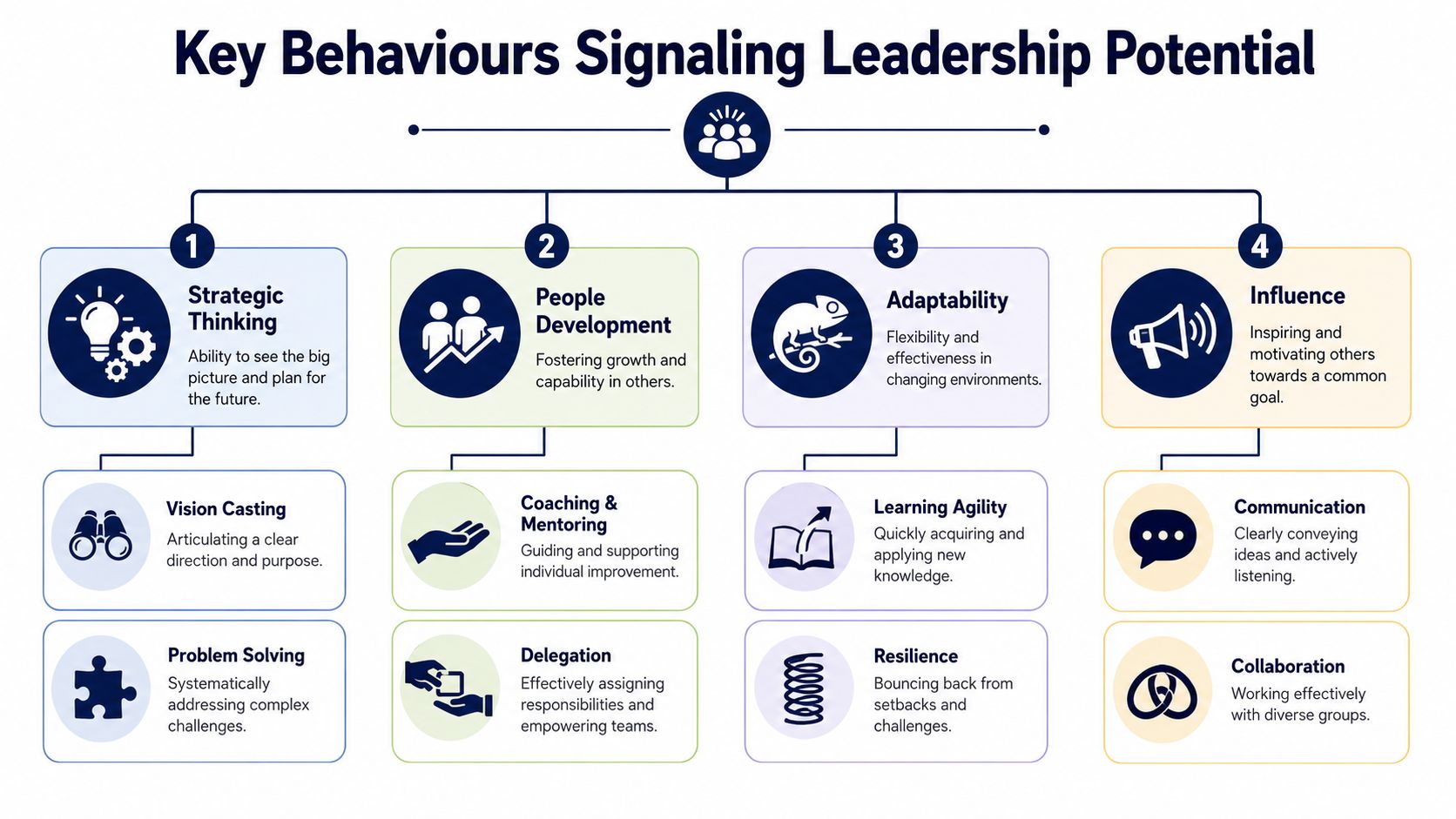
Leadership potential becomes easier to assess when HR teams stop looking for charisma and start looking for repeated behaviour. Titles, confidence and polished communication can all create a strong first impression. They don't tell a reliable story on their own. Observable actions do.
Australian research points to one signal above the rest. Enabling people is the single most impactful leadership behaviour for driving staff engagement, and employees who consistently enable others by delegating meaningful tasks, inviting feedback and creating psychological safety are the most likely to succeed in leadership roles, as outlined in this Australian leadership development analysis.
Empowering behaviour beats control
The strongest emerging leaders don't try to look indispensable. They make other people more capable. That is a very different pattern from the high performer who jumps in, rescues work and keeps control because it feels efficient.
A practical test is whether the person expands ownership when the stakes rise.
- Delegation with trust: They hand over work that matters, not just admin or low-risk tasks.
- Feedback-seeking behaviour: They ask others what they're missing before locking in a decision.
- Psychological safety: They make it easier for colleagues to speak early, disagree respectfully and raise risk.
- Shared visibility: They credit contributors in front of peers and senior leaders.
The emotional discipline behind these behaviours matters too. People who can read a room, regulate their own responses and adjust their approach to different personalities are far easier to back for broader leadership, making emotional intelligence at work a useful lens rather than a vague concept.
What to watch for in real situations
Potential shows up most clearly in ordinary moments. A meeting runs off track. A project owner becomes defensive. A new team member hesitates to speak. Emerging leaders tend to improve the quality of the interaction without needing formal authority.
Some behaviours are especially telling:
- Influence without title: They can move a group toward action through reasoning, credibility and inclusion rather than positional power.
- Adaptability under pressure: When the brief changes, they don't freeze or blame. They reframe and keep others focused.
- Curiosity about the system: They ask how decisions affect adjacent teams, customers or delivery risk.
- Coaching instinct: They correct in a way that builds confidence instead of shrinking it.
The clearest signal of potential is often what a person does when success depends on other people, not on their own effort alone.
It also helps to note what isn't a reliable signal. Fast talking isn't influence. Constant visibility isn't strategic thinking. Being the loudest in a workshop isn't leadership presence. In many assessments, the strongest candidate is the person who asks the best question, not the one who dominates the airtime.
For HR and People & Culture teams, that changes the brief. The job isn't to identify the most polished personality. It's to identify the person whose behaviour lifts team performance in a repeatable way. That standard is much harder to fake and far more useful when deciding how to identify future leaders across the business.
How to Observe Leadership Potential in Action
Many organisations already have enough leadership data around them. They just don't treat day-to-day work as an observation environment. Potential is visible in project launches, planning sessions, client recovery work, cross-functional tension and handovers between teams. The issue is rarely access. It's discipline.
Where everyday work reveals potential
The best observers don't ask whether someone looked confident. They ask what the person did. In a project meeting, did they surface risk early? In a disagreement, did they clarify the issue or inflame it? In a time-pressured decision, did they shut others down or create enough structure for the team to contribute?
Useful observation settings include:
- Cross-functional projects: These expose how someone works without relying on line authority.
- Problem-solving workshops: These show whether the person can turn scattered input into direction.
- Stakeholder meetings: These reveal judgement, listening skill and composure under scrutiny.
- Change activity: These show whether the person helps others adapt or only protects their own patch.
A consistent template helps. Record the situation, the behaviour observed, the effect on the group and any evidence of follow-through. Without that structure, observation turns into impression.
Why novel environments expose hidden patterns
Formal work contexts still carry hierarchy, role familiarity and rehearsed behaviour. That's why novel environments are so useful. They strip away routine cues and put people in conditions where leadership habits become easier to spot. Structured team challenges, timed problem-solving tasks and play-based workplace activities often reveal who steadies the group, who includes others, who thinks systemically and who loses effectiveness when the script disappears.
That's one reason organisations continue to invest in experiential formats. The broader corporate events sector that includes adventure-based and play-based team building is projected to grow at a 7.5% CAGR, according to team building exercise market data. Investment has grown because many businesses now treat these environments as practical development and assessment tools, not just morale events.
A novel setting doesn't replace workplace assessment. It removes some of the camouflage that workplace hierarchy creates.
The strongest design principle is simple. Don't watch for who wins the activity. Watch for how people help the group function. Some of the most revealing moments come when a participant shifts role midstream, changes strategy after failure, or notices that the team's process is breaking down.
That lens also helps assess team contribution styles. A framework such as Belbin team roles in workplace teams can support observers who want to understand whether a person's influence comes through shaping, coordinating, evaluating, implementing or supporting behaviour. Used carefully, that kind of lens adds precision without reducing people to labels.
Designing Activities to Assess Future Leaders
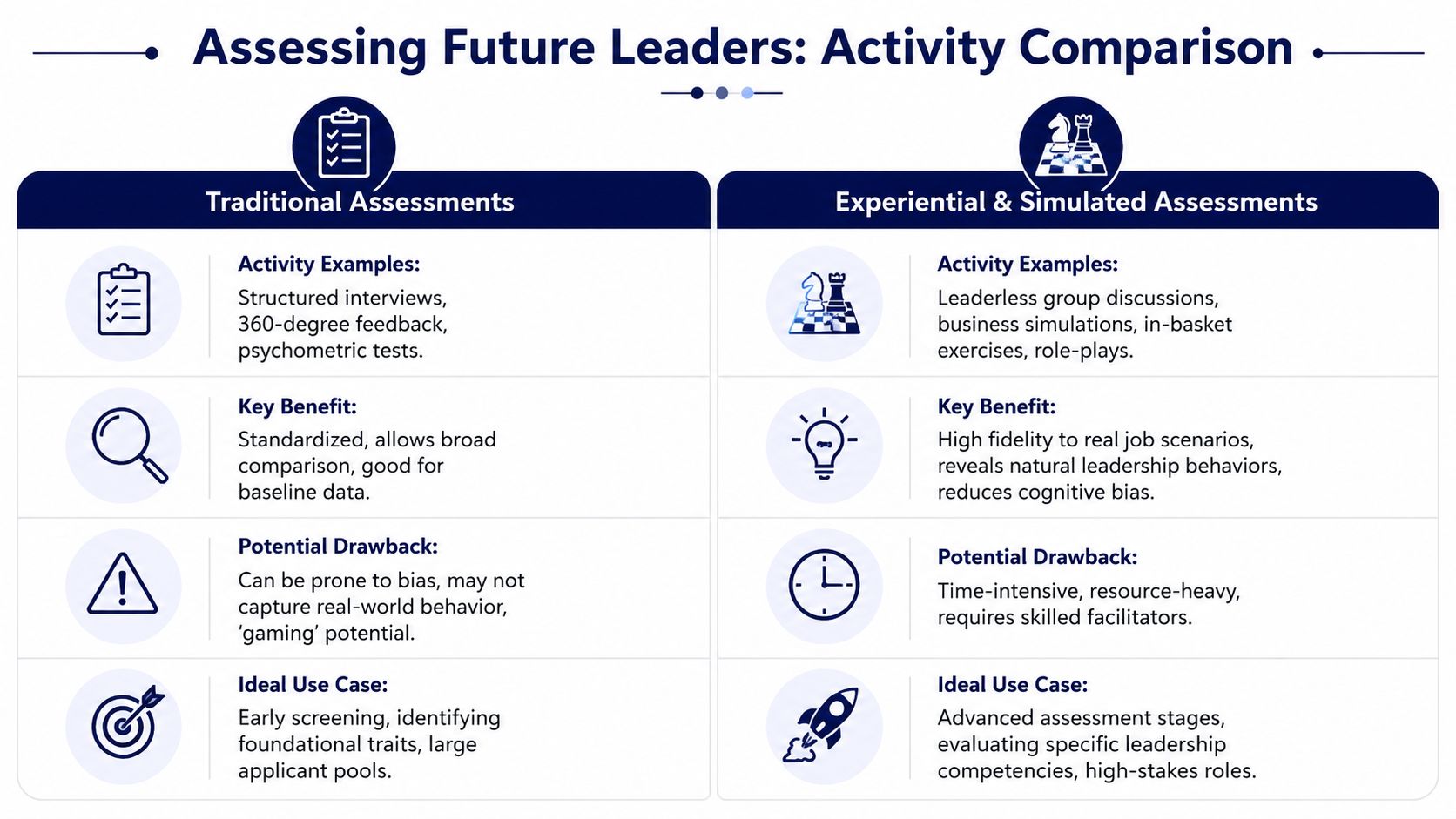
The strongest assessment design combines structured methods with live observation. Interviews and psychometrics can establish a baseline. Simulations, group challenges and applied exercises show what a person does with that capacity in motion. Organisations don't need to choose one camp. They need to know what each method is good at, and where each one falls short.
Traditional methods and what they reveal
Traditional assessment remains useful when consistency matters across a large talent pool. Structured interviews can test judgement, motivation and self-awareness. Psychometric tools can highlight likely preferences, derailers or communication patterns. A well-run 360 process can reveal whether a person's reputation is stronger upward, downward or sideways.
These methods work best when the organisation needs broad comparison and a common language for evaluation. They work poorly when used alone.
| Method | Best use | Common risk |
|---|---|---|
| Structured interview | Evidence of judgement and reflection | Rehearsed answers |
| 360-degree feedback | Reputation across stakeholder groups | Political distortion |
| Psychometric assessment | Pattern insight and discussion prompts | Over-interpretation |
| Manager nomination | Context on readiness and aspiration | Bias and favouritism |
For distributed teams, assessment design also needs to account for location and interaction quality. Teams dealing with hybrid coordination issues often need better simulation design, not just better surveys. A useful outside perspective on solving remote team connection challenges can help event organisers and HR teams think more carefully about the difference between participation and real collaboration.
Experiential methods and what they add
Experiential methods reveal behaviour under live conditions. A leaderless group discussion shows whether someone creates structure without grabbing control. A business simulation exposes trade-offs, prioritisation and influence. An in-basket exercise can test judgement when information is incomplete. Role-plays show how a person handles resistance, ambiguity and emotion in real time.
Play-based formats add another layer because they put people into unfamiliar tasks where old status markers carry less weight. A charity build activity, timed challenge or collaborative problem-solving event can show who notices quality issues, who allocates scarce resources well, and who keeps the team engaged when pressure rises. Those signals are especially useful when a business wants to identify hidden leadership potential beyond polished presentation style.
Behavioural profiling can sharpen this process when used as an interpretive tool rather than a label. This overview of how behavioural profiling can transform your team offers a practical way to think about combining observed behaviour with structured insight.
Good assessment activities create productive friction. They force choices, reveal habits and make collaboration visible.
Interview prompts that test evidence
Even strong live exercises should be paired with behaviour-based questions. Hypotheticals invite ideal answers. Evidence-based prompts pull for real examples.
Useful prompts include:
- Ownership under pressure: Tell us about a time a plan changed late and the team lost confidence. What did you do first?
- Developing others: Describe a situation where someone less experienced took on meaningful responsibility because you created the conditions for it.
- Conflict handling: Share an example of disagreement across teams. How did you keep progress moving without forcing compliance?
- Learning agility: Explain a time you realised your first approach wasn't working. What changed in your thinking?
Answers should be assessed for specificity, not polish. Strong candidates usually name the context, the trade-off, the action and the lesson. Weak candidates stay abstract, heroic or oddly vague.
How to Analyse Talent Data and Avoid Bias
Observation is valuable only if the organisation can interpret it fairly. Many succession processes fail at this point. Plenty of evidence is collected, but the final decision still follows reputation, visibility or the strongest manager voice in the room. That approach feels efficient and produces a talent map that people lose confidence in.
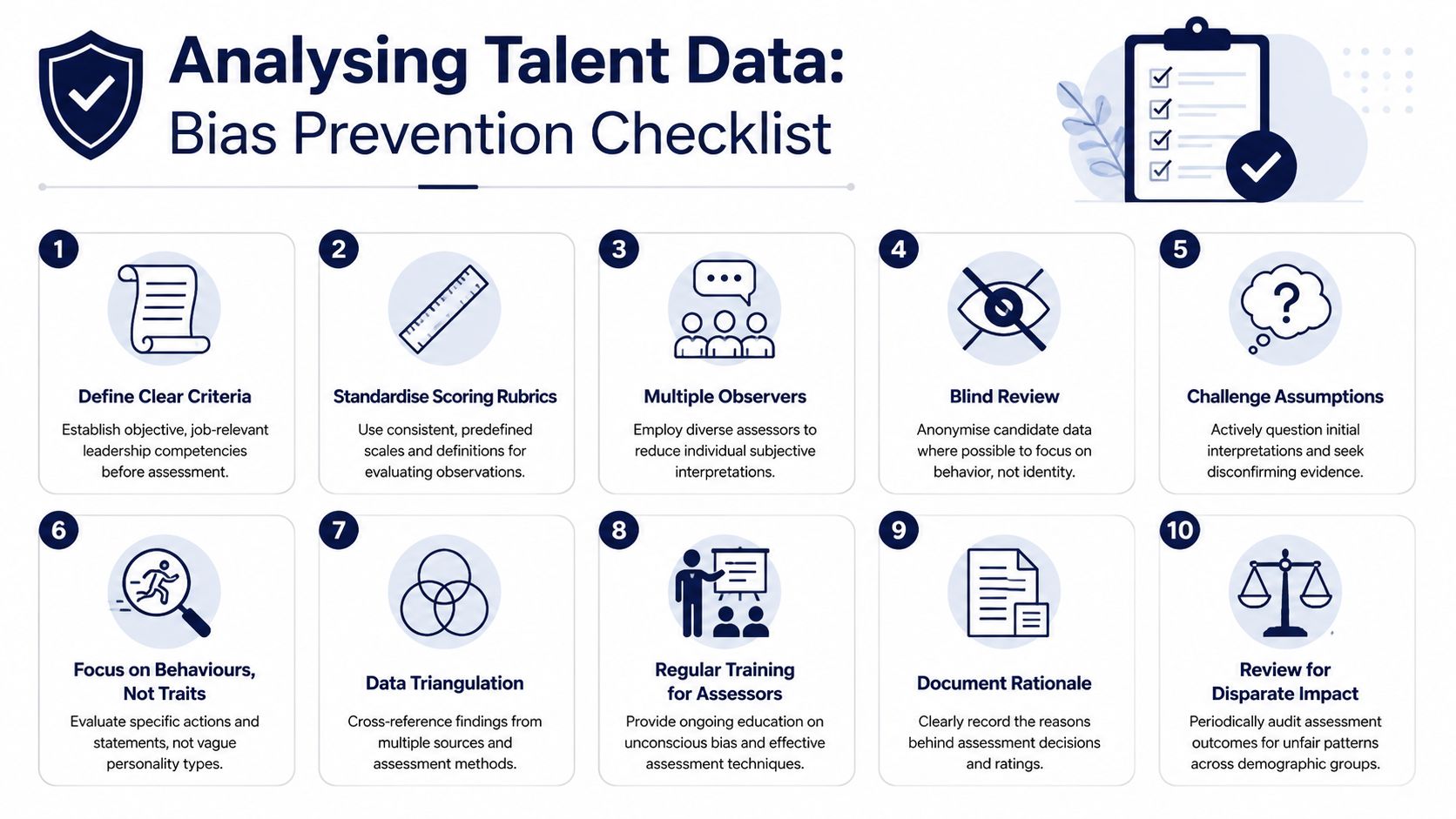
The more defensible route is a disciplined calibration method. The most reliable approach uses a five-step calibration framework that includes role-based criteria, manager training to separate potential from performance, multiple data sources, cross-functional calibration sessions and DEIB checkpoints, as outlined in this framework for identifying high-potential employees.
A disciplined calibration process
A strong calibration meeting doesn't start with names. It starts with criteria. Define the future role first, including the conditions that role will face, the leadership behaviours it requires and the capability gaps the business expects over the next few years.
Then compare people against that future need, not against the comfort of their current role.
A practical scoring model can use three evidence buckets:
- Observed behaviour: What the person did in live work and assessment settings
- Pattern consistency: Whether the same strengths appear across contexts and observers
- Growth trajectory: Whether the person shows learning agility, not just stable competence
This is also where emerging tools and AI-assisted analysis can help if used carefully. Teams exploring candidate pattern analysis may find value in Cyndra's perspective on building 10x teams with AI enrichment, particularly when the goal is to enrich judgement rather than outsource it.
For organisations weighing tools, this comparison of psychometric testing versus behavioural profiling is useful because it shows why no single instrument should dominate succession decisions.
Bias traps that distort succession decisions
Most bias in talent review looks reasonable in the moment. A manager backs the person they know best. A loud participant gets labelled high potential after one workshop. A polished presenter gets more credit than a quieter colleague who consistently improves team decisions.
Common distortions include:
- Halo effect: One strength colours the entire judgement
- Confirmation bias: Assessors only notice behaviour that supports their first impression
- Similarity bias: Leaders favour candidates who feel familiar in style or background
- Nomination bias: Manager preference becomes the gateway to opportunity
Good talent analysis focuses on evidence that can be described, challenged and compared, not on confidence that can't be examined.
Cross-functional calibration is what protects the process. It forces leaders to justify ratings with observed examples and helps the business spot inconsistencies between departments. Without it, succession planning becomes a local popularity exercise dressed up as strategy.
Creating Development Pathways for Future Leaders
Identification without follow-through creates cynicism fast. Once a business signals that someone has potential, that person will expect movement, challenge or support. If nothing happens, motivation usually drains before capability does.
Development pathways should reflect the kind of leadership the organisation needs. Some people need stretch leadership assignments. Others need coaching, mentoring, stakeholder exposure or time leading a cross-functional initiative without formal authority. The best pathway is the one that builds missing capability, not the one that looks most prestigious.
Different people need different pathways
Australian organisations often make a second succession mistake after identification. They assume the next step must be people management. That doesn't match how many high-potential employees want to grow. More recent career data suggests interest in formal management paths is limited, with only 12% of employees aiming for formal management roles, while many prioritise impact, skills development and flexibility instead, according to LinkedIn's career development analysis. In Australia, a lack of career growth opportunities is also a major barrier to advancement, especially for individual contributors, as noted in ADP's Australian workplace research. That broader pattern supports the need for leadership pathways that extend beyond line management, which is also reflected in this discussion of overlooked leadership pathways.
That means a mature pipeline needs at least two development tracks:
- People leadership track: Team leadership assignments, coaching practice, performance conversations and broader decision-making accountability
- Expert leadership track: Strategic projects, advisory influence, internal mentoring, client-facing complexity and enterprise problem-solving
A broader organisational view helps here. Teams formalising bench strength often benefit from a practical succession planning guide that maps critical roles, risk and internal readiness more clearly.
Development must follow identification quickly
Once someone enters a future leader pool, the organisation should define what they need to prove next. Vague promises don't build leaders. Specific experiences do.
A workable development sequence often includes:
- Targeted stretch work tied to a missing capability, such as leading across functions or influencing senior stakeholders.
- Feedback loops that include manager input, peer reaction and self-reflection after the assignment.
- Formal development support through mentoring, workshops or structured programmes.
- Review points where progress is reassessed against future-role criteria, not general potential language.
The process also needs transparency. Employees should know whether they are being developed for people leadership, specialist influence or a broader enterprise role. Without that clarity, strong talent either stalls or leaves.
For teams ready to build these pathways more deliberately, a practical leadership development plan gives useful structure for turning potential into a repeatable program of growth.
Corporate Challenge Events helps Australian organisations turn team days, conferences and offsites into structured opportunities to observe collaboration, adaptability and emerging leadership behaviour in action. For HR teams, People & Culture leaders, executive assistants and event organisers who want more than a morale boost, Corporate Challenge Events offers play-based programs designed to strengthen workplace culture while revealing how people lead when the environment is dynamic, social and real.