
Most advice on organisational development starts in the wrong place. It starts with training calendars, competency frameworks, or another workshop. Leaders then expect behaviour to shift because people attended something useful.
That's rarely how organisational change works.
Organisational development is not standard L&D with a broader label. L&D builds individual capability. Organisational development works on the whole system: culture, leadership habits, role clarity, communication patterns, decision quality, and the organisation's capacity to keep adapting. In Australian practice, it's defined as planned, systemic interventions targeting an organisation's ongoing life to achieve sustained performance through values, culture and structures that improve adaptability, with a four-phase roadmap of entering and contracting, diagnosis, planning and evaluation, as outlined by Merit Solutions' organisational development overview.
That distinction changes how leaders should design improvement efforts. If the problem is cross-functional friction, low trust, inconsistent leadership behaviour or change fatigue, another content-heavy program won't fix it by itself. The system has to change, and people have to practise new ways of working together in real time. That's where structured play becomes useful. Not as entertainment, and not as a reward, but as a practical method for making team habits visible, discussable and repeatable.
Table of Contents
What Is Organisational Development Really
A common mistake is treating organisational development as a rebrand of training, engagement, or general HR support. It isn't. L&D improves what individuals know and can do. Organisational development improves how the organisation functions as a system.
That means OD looks at the patterns underneath performance. It examines whether leaders reinforce the right behaviours, whether teams trust each other enough to speak up, whether structures support collaboration, and whether the culture helps people adapt when markets, technology or customer expectations shift. Leaders trying to build stronger teams often benefit from reviewing what shapes team effectiveness, including practical factors discussed in what makes a good team.
OD works at system level
When leaders need a quick rule of thumb, this one usually helps:
| Focus area | Standard L&D | Organisational development |
|---|---|---|
| Primary unit of change | Individual | Team, leadership system, organisation |
| Typical question | What skills are missing? | What in the system is producing this result? |
| Common tools | Training, workshops, e-learning | Diagnosis, role redesign, leadership alignment, facilitated team experiences, follow-through |
| Success test | Did people learn it? | Did work habits and outcomes change? |
Culture sits at the centre of that difference. Teams don't operate in a vacuum. They're shaped by norms, assumptions and unwritten rules, which is why leaders doing OD work need a sharper grasp of understanding cultural factors before they jump to solutions.
Practical rule: If the issue keeps coming back after training, the problem probably isn't knowledge alone. It's likely behavioural reinforcement, team dynamics, or the way work is organised.
What OD is trying to change
OD is built for ongoing adaptation, not isolated fixes. That makes it especially relevant when a business is integrating new leaders, rebuilding trust after rapid growth, or trying to shift from siloed work to more shared accountability.
The question isn't whether people enjoyed an initiative. It's whether the organisation now works better. If the answer is yes, the intervention was developmental. If the answer is no, it was probably activity without enough system design behind it.
Understanding Key OD Models and Processes
Many OD programs fail for a simple reason. Leaders run an intervention before they have properly defined the issue, so the activity gets attention but the system stays the same.
The strongest OD work uses a clear model to frame the problem, then a practical process to shift behaviour.
Structured play does not replace diagnosis, planning or leadership alignment. Its role is different. It gives teams a way to see patterns under pressure, which can reveal behaviour that surveys, self-reporting and post-program feedback often miss.
Two established approaches are particularly useful.
Lewin’s model focuses on unfreezing, changing and refreezing. It is helpful when a business needs to break an entrenched habit, such as passive decision-making, siloed reporting lines or a leadership style that keeps too much control with one person. In modern workplaces, the final stage is less about locking in a fixed state and more about establishing a better operating rhythm that can hold under pressure.
Action Research is also useful for leadership teams. It follows a cycle of diagnosis, action, reflection and adjustment. That matters because OD rarely works as a one-off event. Teams need to test a change, examine what happened and refine their next step.
For leaders, the model matters less than using one consistently. The real test is whether it sharpens diagnosis and changes work habits.
A practical OD process can be framed in six moves: diagnose, define, choose, create, debrief and embed.
Diagnose the challenge
Start with the business pattern. Missed handovers, slow decisions, leader overreach, weak peer accountability and low trust require different responses. Good diagnosis also looks at communication flow, because breakdowns there often reinforce the behaviour leaders say they want to change. Teams reviewing that side of OD can borrow useful ideas from internal communication strategies for marketers, then adapt them to internal alignment rather than campaign delivery.Define the behavioural shift
“Improve culture” is too vague to manage. Name the behaviour the business needs more of, such as escalating risks earlier, giving direct peer feedback, making decisions at the right level, or running cleaner cross-functional meetings.Choose the intervention
Traditional OD models and play-based design work well together. If the issue is trust under pressure, a live team challenge can reveal avoidance, dominance or unclear coordination in minutes. If the issue is strategic alignment, a facilitated planning process may be the better tool. The trade-off is simple. Workshops can build insight without stress-testing behaviour. Play-based interventions expose real habits quickly, but only if they are designed and debriefed with discipline.Create the experience
The activity has to fit the team's maturity and the business context. A newly merged leadership group needs a different design from an established executive team with chronic conflict. Poor design produces noise. Good design produces evidence.Debrief with precision
The debrief is where OD either becomes useful or stays superficial. Ask what happened, what pattern it reflects at work, what the cost is, and what has to change in meetings, decisions or leadership routines.Embed the change
Insight fades fast without reinforcement. Assign owners, adjust team rituals, revisit commitments and build the new behaviour into the way work gets reviewed.
Good OD work changes the language people use in real time. Teams start noticing their own system. They say, “We escalated too late,” “We waited for the leader again,” or “We split into functions instead of solving the problem together.”
That shift matters. It shows the team is no longer treating behaviour as a personality issue. They are seeing the structure, pressure points and habits that keep producing the same result.
The Measurable Impact of OD on Business Performance
Treating organisational development as a culture initiative can be an expensive mistake.
OD affects execution, retention, manager quality and the speed at which teams recover from pressure. Those are operating issues, not soft ones.
When OD is weak, the cost tends to show up in avoidable friction. Decisions move slowly. Difficult conversations get delayed. Priorities compete instead of align. Capable people spend too much energy managing confusion, chasing clarity or working around poor communication.
The cost is rarely contained in one department. It appears in slower delivery, patchy retention, inconsistent customer experience and leaders who are carrying too much because the team around them is not operating clearly enough.
Where OD shows up in business results
The clearest effect often shows up in how managers lead under pressure.
Poor OD can look like decisions bouncing between functions, unclear ownership, inconsistent expectations and leaders reacting only once a problem becomes urgent.
Leadership development matters here, but the trade-off is often misunderstood.
Sending managers to training can build awareness. It does not automatically change how they run meetings, handle conflict, set expectations or coordinate across silos.
OD produces stronger results when leadership development is tied to live business habits, clear behaviour standards and follow-through in the flow of work.
Play-based design adds something useful to that process.
A well-run simulation, team challenge or structured problem-solving exercise lets leaders observe behaviour in real time rather than in theory. They can see who over-controls, who withdraws, who shares information too late, who creates clarity and who helps the group adapt when the original plan stops working.
That observation is not a final diagnosis of a person or team. It is a useful starting point for a more honest conversation about how the group operates together.
What leaders should take from the data
The business case is easier to read through recurring risk than through abstract culture language.
| Business issue | What poor OD often looks like | What stronger OD targets |
|---|---|---|
| Turnover volatility | Leaders react after resignations rise | Leadership capability and team conditions are addressed earlier |
| Low engagement | Perks and one-off events | Behaviour, communication, role clarity and cultural norms |
| Change fatigue | Repeated launches with weak follow-through | Better pacing, clearer ownership, reinforced habits |
| Leadership inconsistency | Different standards across managers | Shared expectations and repeatable leader behaviours |
For leadership teams setting workforce priorities, broader shifts in employee expectations, manager load and team cohesion also matter. Workplace trends shaping retention and leadership in 2026 give useful context for deciding where OD effort should go first.
A practical test is simple.
If an OD initiative cannot be linked to fewer avoidable exits, stronger cross-functional behaviour, faster decisions or better manager consistency, it is probably too vague.
The financial case follows quickly. Replacing experience, carrying vacancies, onboarding new hires and repairing team trust all drain margin.
OD earns investment when it changes the behaviour that keeps creating those costs.
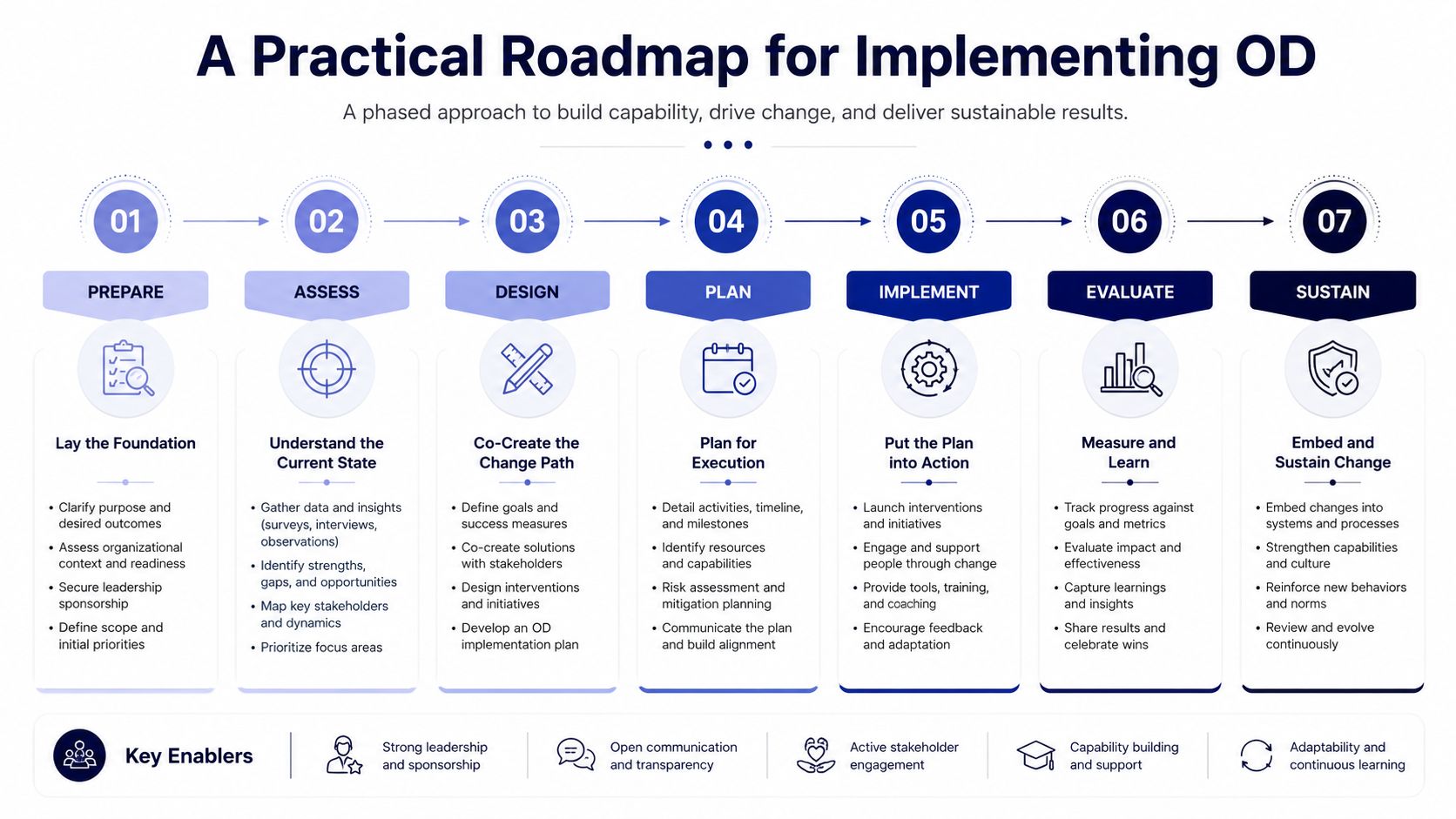
A Practical Roadmap for Implementing OD
A practical OD plan starts with a business problem that leaders can name without jargon. “Our managers avoid hard conversations.” “Projects stall because functions protect their turf.” “The team looks busy but energy is flat.” Those are workable starting points because they point to observable behaviour.
Start with diagnosis before design
Most OD programs go off course because leaders decide on the format too early. They book an offsite, a conference session or a team challenge before they've agreed on the organisational issue.
A stronger sequence looks like this:
Name the friction clearly: Is it low trust, cross-functional tension, weak accountability, poor recognition, or a hybrid team that no longer feels connected?
Check where the issue lives: Some problems sit inside one team. Others sit between teams. Others begin with leadership behaviour.
Define what “better” looks like: The outcome needs to be behavioural, not aspirational.
Teams are far more likely to engage when leaders explain why the initiative exists, how success will be judged, and what follow-through will look like. For teams refining that side of the rollout, these internal communication strategies for marketers are a useful reference because the principles apply well beyond marketing teams.
Match the intervention to the problem
Not every intervention should look the same. Culture workshops, profiling sessions, charity team building and high-energy challenge formats each solve different problems.
A practical matching guide:
| Organisational challenge | Better-fit intervention | Why it works |
|---|---|---|
| Inconsistent team behaviour | Culture framework such as FISH! | Gives teams a shared language for daily habits |
| Working style friction | DOPE or Belbin | Helps people interpret difference more accurately |
| Low energy and disconnection | Short play-based challenge | Rebuilds momentum and interaction quickly |
| Need for purpose and shared contribution | CSR team building | Connects collaboration to a tangible external outcome |
The point is not that one format is better than another.
The point is that the format should match the behaviour the team needs to explore.
Build in milestones and follow-through
A strong program has checkpoints. Without them, even a well-facilitated session can fade into good intentions.
Common milestones include:
Baseline check: A short climate survey or structured pre-conversation.
Intervention delivery: The workshop, challenge, or facilitated session itself.
Immediate commitments: Agreed team and leader actions before people leave the room.
Six to eight week review: A repeat check on team climate and behaviour.
Thirty, sixty or ninety day follow-through: Useful where the change is larger or leadership habits need reinforcement.
Leader checkpoint: If nobody owns the follow-up, the intervention was a moment, not an OD program.
What doesn't work
A few patterns reliably weaken results:
Choosing energy over relevance: A lively activity can still be the wrong tool.
Leaving leaders out: If managers don't model the new behaviour, teams notice quickly.
Debriefing too lightly: The activity is only the start. The learning sits in the reflection.
Measuring nothing: Teams need some way to see whether behaviour changed.
The practical standard is simple. Diagnose the issue. Pick the right tool. Debrief openly. Reinforce what the team agreed to do next.
The Missing Link in OD Play-Based Interventions
Traditional OD models are useful, but many of them lean heavily on planning, structure and process. That's necessary. It just isn't sufficient. Teams don't change because a framework exists on paper. They change when people experience new patterns together, notice what they do under pressure, and practise alternatives in a setting that is safe enough to be honest and demanding enough to feel real.
That's where play-based interventions have a distinctive role.
Why standard OD can miss the behavioural layer
Many OD roadmaps focus on strategy, governance, capability and workforce planning.
Those are all important. But they do not always create the conditions for immediate behavioural insight.
Trust, communication and adaptability are not built through policy alone. They are practised socially.
A team can agree that it needs better communication, then still hold key information back when deadlines tighten. Leaders can say they value contribution, then continue to make decisions before others have had the chance to contribute.
Structured play gives people a chance to see those gaps in real time
What play changes in the room
Play shouldn't be framed as childish or optional. In workplace settings, structured play gives teams a faster route to visible behaviour. People reveal how they share information, who dominates decisions, who hangs back, how conflict surfaces, and whether the group notices contribution across different styles.
A well-designed challenge does three things at once:
Reduces scripted behaviour: People stop performing the polished version of teamwork.
Creates shared evidence: The team can point to what happened, not what it assumes happened.
Makes reflection easier: It's often simpler to discuss behaviour after a shared activity than in a generic culture conversation.
A related leadership principle appears in permission to play is a leadership skill. The key point is that leaders influence whether teams feel safe enough to engage fully, experiment and learn.
Teams often talk more honestly after a shared challenge because the behaviour is visible to everyone. There's less room for abstraction and less need for blame.
The workplace health connection
There's also a wellbeing dimension. In a four-month workplace pedometer-based Global Corporate Challenge® program, psychological distress decreased significantly among participants, and the reduction was sustained eight months after the program ended, according to the published study on workplace physical engagement and mental health.
That doesn't mean play solves every organisational problem. It does show that structured, active engagement can influence the conditions in which people work, connect and cope. For OD, that makes play a practical lever for behavioural change, not a distraction from serious work.
How Play Drives Real OD Outcomes Examples in Action
Play gets dismissed when leaders treat it as a morale activity. In OD, its value is much more specific. A well-designed play-based intervention lets people reveal habits under real social pressure, then gives leaders something concrete to measure and change.
The question is not whether play is engaging. The question is which behaviour the organisation needs to shift, and which format will make that behaviour visible quickly enough to diagnose and improve it.
Culture reset through a shared language
A culture program such as FISH! Philosophy can work well when the problem is behavioural inconsistency.
Teams may say they value respect, service or accountability, but day-to-day interactions tell a different story.
Culture change stalls when people cannot describe the expected behaviour in simple terms.
The four practices, Be There, Make Their Day, Choose Your Attitude and Play, give teams practical language they can use in meetings, service moments and peer feedback.
The OD value comes from repetition. People begin to recognise the behaviours in real work, call them out and choose them more deliberately.
Simple models are sometimes criticised for lacking depth. In practice, they can outperform more complex frameworks because teams can remember and apply them.
Pressure tests for communication and role clarity
Formats such as Survivor are useful when a leadership team needs a live test of decision-making, communication and role clarity. The pressure is controlled, but the behaviour is real. People see who dominates airtime, who gathers input, who notices exclusion, and who keeps the group focused when the original plan stops working.
Play Offs serves a different purpose. It suits teams that need a shorter format with broad participation and a lower barrier to entry. The session is less intense, but it still produces useful evidence about confidence, collaboration and problem-solving.
Many traditional OD methods rely on self-report. Play adds observed behaviour. That closes an important gap between what teams say they do and what they do together. The commercial case for that approach is outlined in this discussion of the ROI of play in workplace performance.
The activity is not the outcome. The outcome is the behaviour leaders can observe, debrief and reinforce back at work.
Purpose-led programs for teams that need reconnection
CSR formats such as Bikes for Tykes, LEGO Legends and Out of the Box can be effective when teams need to rebuild connection across functions or after periods of strain.
Shared purpose changes the emotional quality of the work.
People stop protecting turf for a moment and start coordinating around something tangible that matters beyond their own workload.
That shift can be useful in OD.
Traditional models can do a good job of diagnosing systems, roles and capability gaps. Structured play can help change the state in the room, reduce defensiveness and create a shared experience that makes new behaviour easier to try.
The experience still needs to be connected to a clear business issue, such as collaboration, communication, culture drift or team connection.
What effective measurement looks like
Measurement should match the problem being solved.
For culture work: track team climate, recognition, accountability and confidence in day-to-day leadership behaviour
For challenge-based formats: assess participation patterns, communication under pressure, role-sharing and follow-through after the session
For CSR programs: review cross-team interaction, shared purpose and the quality of collaboration during delivery
For communication workshops: measure feedback quality, behavioural awareness and whether agreed actions show up in meetings and handovers
A short baseline before the intervention, followed by a check-in six to eight weeks later, usually gives leaders more useful evidence than generic benchmarking. The aim is not to prove that people enjoyed the session. The aim is to see whether the team worked differently afterwards.
Your Next Steps in Organisational Development
Organisational development usually stalls when leaders treat it as a program to schedule rather than a business problem to solve.
Start with the friction. Where is performance breaking down: decision-making, cross-functional trust, frontline leadership, accountability or change fatigue?
Define the behaviour that needs to shift, then examine what in the system may be rewarding the current pattern.
That diagnosis matters more than the format you choose.
If organisational development is on the agenda, Corporate Challenge Events can help translate culture goals, leadership challenges and team performance issues into structured play-based experiences that support real workplace behaviour change.