
Leadership capability sits closer to business infrastructure than employee perk. In Australia, the corporate leadership training market is projected to grow from USD $1,561.6 million in 2025 to USD $2,923.8 million by 2032 according to Fortune Business Insights. That level of projected investment tells a clear story. Organisations aren't treating leadership development as a nice extra. They're treating it as a response to pressure on retention, performance and execution.
The urgency becomes sharper when leadership systems are missing altogether. The same source notes that approximately 36% of Australian and global organisations lack a formal leadership development strategy, while 21% operate without any leadership programs whatsoever. In practice, that leaves culture, decision-making quality and team performance to chance.
That's why leadership training is imperative. It builds the everyday conditions that let teams perform well under pressure: clarity, trust, adaptability, accountability and the ability to stay connected in changing environments. For workplace leaders, HR teams, People & Culture specialists, executive assistants and event organisers, the core question isn't whether leadership development sounds valuable. It's whether the organisation can afford inconsistent leadership when managers shape engagement, retention and output every day.
Table of Contents
The Shift from Management to Modern Leadership

Traditional management focused on control. Modern leadership focuses on creating the conditions for people to think clearly, work well together and adapt quickly. That distinction matters more in hybrid workplaces, cross-functional projects and roles where influence counts for more than formal authority.
Management controls tasks while leadership shapes conditions
Managers can allocate work, monitor deadlines and enforce process. Leaders still need to do those things, but they also need to regulate team energy, create psychological safety and make sure people understand why the work matters. Without that second layer, teams may stay busy while becoming less collaborative, less candid and less resilient.
A useful way to frame the difference is through behaviour. The practical distinction between the two roles becomes clearer in this guide on the difference between a leader and a manager. In most organisations, people need both. What they can't rely on is management alone.
Modern leadership is behavioural, not positional
Leadership training matters because these capabilities aren't fixed personality traits. They can be taught, practised and strengthened. Following structured leadership training, employees in Australian and global contexts demonstrated a 25% improvement in learning capabilities and a 20% enhancement in overall job performance, with broader company performance also improving according to Flair's summary of leadership statistics.
Those outcomes line up with what many organisations already feel on the ground. Teams perform better when leaders know how to:
Set clear expectations: ambiguity drains confidence, especially across hybrid and matrix structures.
Respond well under pressure: composure from a leader often shapes composure in the team.
Invite contribution: innovation usually starts when people believe they can speak without being dismissed.
Build trust through consistency: not charisma, but predictable behaviour.
Practical rule: Leadership training should build observable habits, not just insight. If participants leave with language but no new behaviour, the program was too theoretical.
The shift from management to leadership is also a shift from authority to influence. That's one reason organisations now look beyond classroom instruction and towards formats that let people practise communication, decision-making and collaboration in real time. Leadership lives in moments, not slides.
The Measurable Impact on Business Performance
Organisations with strong leadership benches are better positioned to meet future challenges. DDI’s Global Leadership Forecast found that companies with strong benches were 10 times more likely to report high-quality leadership, six times more likely to be capable of engaging and retaining top talent, and three times more likely to be among financially top-performing organisations., according to DDI's Global Leadership Forecast. Leadership quality is rarely confined to an annual culture report. It shows up in the everyday operating rhythm of a business: how confidently teams make decisions, how well functions work together, and whether capable people see enough reason to stay and grow.
Retention and performance start with the team environment
Poor leadership rarely shows up first as a training problem. It shows up as rework, delayed decisions, avoidable conflict and good people disengaging. In Australian organisations, those costs are often hidden inside project overruns, sick leave, recruitment load and stalled cross-functional work.
That link is behavioural, but it is also biological. Leaders shape the conditions that either settle or agitate a team's threat response. Under pressure, a team reads tone, clarity, fairness and follow-through very quickly. If those signals are inconsistent, cognitive load rises and collaboration gets worse. If those signals are steady, people think more clearly, contribute earlier and recover faster after setbacks.
Gallup found that managers account for 70% of the variance in team engagement, according to its analysis of the manager's role in employee engagement. That is a commercial issue, not a soft one. Engagement influences discretionary effort, customer experience, error rates and the willingness to solve problems without being chased.
A fuller view of that link is covered in this resource on understanding employee engagement.
Why good programs produce better transfer
The strongest programs improve performance because they change behaviour in live social conditions. That is where experiential and play-based learning has an edge over lecture-heavy formats. Leaders do not build judgement, regulation or influence by hearing a model once. They build it by practising under mild pressure, getting feedback, adjusting, and trying again.
Put people into a well-designed simulation or team challenge and their default patterns become visible within minutes. Who dominates. Who goes quiet. Who brings others in. Who loses clarity when stakes rise. That gives facilitators and participants something useful to work with, because the lesson is attached to felt experience rather than abstract theory.
There is solid evidence behind that design choice. Research on active learning and retrieval practice shows that people are more likely to retain and use new knowledge when they actively recall it, discuss it, practise it and apply it to realistic situations, rather than only receiving information passively.
That does not make passive instruction useless. It means information is more likely to stick when people have an opportunity to participate, reflect and put the skill into context.
The budget case improves when HR speaks in operating terms
Leadership proposals get approved faster when HR translates them into business language. Reduced regrettable attrition. Faster ramp-up for new leaders. Better decision quality across matrix teams. Lower friction in hybrid coordination. More consistent client handling when pressure rises.
Teams preparing that case can borrow structure from resources on how to learn to win deals with proposals, especially when they need to tie program design to outcomes, ownership and follow-through.
The point is simple. Leadership training earns its place when it improves how people perform together. The best programs do that by working with how adults learn and how teams function under stress. For modern Australian workplaces, experiential and play-based formats are often the fastest route to that result because they build capability in the room, not just awareness on the page.
Solving Critical Organisational Challenges
The organisations asking why leadership training is important usually aren't asking in the abstract. They're dealing with stalled collaboration, conflict between functions, low initiative or teams that seem present but detached. Leadership development works best when it is aimed at a live organisational problem, not a generic capability wishlist.
Low morale rarely starts with workload alone
A team can handle demanding work when the environment feels fair, clear and connected. Morale usually drops when leaders send mixed signals, avoid hard conversations or let recognition disappear. In that setting, employees often stop contributing beyond the minimum because the social contract feels weak.
Training can help leaders correct that by building stronger habits around communication, feedback and team rhythm. In Australia, effective team-building challenges need to be explicitly matched to organisational goals such as improving communication, boosting morale or encouraging creative thinking, with ROI measured through pre- and post-event engagement surveys and productivity metrics.
If morale is low because people feel unheard, a generic offsite won't fix it. Leaders need experiences that make them practise listening, role clarity and follow-through.
Hybrid friction needs trained leadership habits
Hybrid work exposes weak leadership fast. Teams can't rely on hallway correction, informal reassurance or easy context-sharing. If the leader doesn't create clarity deliberately, confusion spreads. If conflict surfaces, avoidance tends to harden into resentment.
In this context, targeted development is useful:
For unclear communication: train leaders to set expectations, confirm decisions and check understanding.
For collaboration breakdowns: use facilitated experiences where leaders need to coordinate across roles in real time.
For recurring tension: build conflict capability before issues become interpersonal narratives.
A practical extension of that work is conflict resolution training, particularly when the issue isn't one dramatic dispute but a pattern of unresolved friction.
Teams don't need leaders who talk about collaboration. They need leaders who can create it under pressure.
Leadership development earns its place when it solves a problem staff already feel. That's often the difference between a program people remember and one they fail to embrace.
How Experiential Training Develops Real Leaders
A large share of leadership training fails at the point of transfer. People can explain the model in the room, then revert to old habits the first time a deadline slips, a stakeholder pushes back, or a team member shuts down. That gap exists because leadership is behavioural, social and physiological. It improves through practice under conditions that create real attention, emotion and consequence.
Experiential training works because it engages the same systems leaders use every day: threat assessment, emotional regulation, working memory, social awareness and decision-making under pressure. For Australian organisations dealing with hybrid teams, flatter structures and faster change, that matters. If a program keeps people passive, the brain treats it as information. If a program requires action, feedback and adjustment, the brain is more likely to retain the behaviour and use it later at work.
That is why play-based learning, used properly, is effective in serious corporate settings.
The value is not novelty. The value is design. A well-run challenge creates enough pressure to surface default leadership patterns without the political risk of a live business failure. Participants see who over-controls, who withdraws, who listens well, who creates clarity and who creates noise. Good facilitation then turns those moments into practical insight about team performance, trust and accountability.
Play also changes group dynamics in useful ways. It lowers self-protection, increases participation and gives facilitators more observable behaviour to work with. Instead of asking leaders how they would handle ambiguity, the activity creates ambiguity and shows what they do in practice. That gives HR and L&D teams a stronger basis for development than self-report alone.
Purpose-built leadership development training uses this approach to build capability people can apply in meetings, project work and day-to-day team leadership.
Live tasks expose real habits: leaders reveal how they communicate, delegate, prioritise and respond when the plan changes.
Shared experience improves recall: teams remember a felt moment of confusion, trust or poor coordination more clearly than a slide deck.
Structured debrief creates transfer: facilitators connect what happened in the activity to workplace decisions, relationships and performance expectations.
Practice builds regulation: repeated cycles of action and reflection help leaders stay steadier under pressure, which directly affects how safe and focused the team feels.
For HR teams, delivery matters as much as content. Classroom sessions can introduce concepts, but behaviour change usually needs spaced practice, live application and reinforcement over time. Teams planning that kind of structure may find value in guidance on implementing blended learning, especially when the goal is better transfer back into the workplace.
Strong experiential programs treat play as a method for serious learning. Used well, it helps leaders build judgement, self-awareness and the relational skill that lifts team performance.
A Guide for HR Choosing and Implementing a Program
Leadership development often fails at the buying stage. HR selects a polished workshop, attendance is strong, feedback forms look fine, and six months later manager behaviour has barely shifted. The problem is rarely content alone. The problem is fit, practice, and transfer.
For HR, program selection is a performance decision. Poor leadership shows up in missed priorities, avoidable turnover, slow decisions, conflict avoidance, and teams that stay guarded instead of contributing fully. In neurobiological terms, leaders shape whether people feel safe enough to think clearly, speak up, and coordinate under pressure. That makes the brief much sharper. Choose a program based on the behaviour the business needs to see more often.
Start with the pressure point in the business
Begin with the operating problem, then work back to the leadership behaviour that would improve it.
A practical sequence looks like this:
Name the business issue clearly. It may be inconsistent people management, weak cross-functional collaboration, poor change communication, or a drop in discretionary effort after restructure.
Define the few leader behaviours that would change that outcome. Examples include setting clearer priorities, giving direct feedback, running better one-on-ones, or handling tension early.
Test the delivery method against the skill. Relational skills need live practice. A knowledge module can support the work, but it will not build judgment under pressure.
Set measures before procurement. Decide what HR, line leaders, and executives will count as progress.
A useful planning tool is a leadership development plan for organisational capability building, particularly when HR needs to align timing, sponsorship, and expected outcomes across the business.
Compare formats by what they can actually change
Different formats do different jobs. The mistake is expecting one format to do all of them.
| Format Type | Best For | Key Considerations |
|---|---|---|
| Workshops | Shared language, core frameworks, leadership expectations | Good for alignment. Limited on behaviour change unless paired with practice and follow-up. |
| Experiential offsites | Communication, trust, collaboration, adaptive leadership | Strong option for surfacing real habits quickly. Debrief quality determines whether insight transfers to work. |
| Coaching | Individual behaviour change, self-awareness, role-specific support | Useful for targeted development. Harder to scale if used on its own. |
| Digital modules | Foundational concepts, consistency, pre-work, reinforcement | Efficient and easy to distribute. Weak for conflict, influence, and other live interpersonal skills without practice. |
| Blended programs | Organisations that need scale and application | Usually the strongest choice when sequencing is deliberate and managers reinforce the work on the job. |
For Australian organisations, experiential and play-based methods deserve serious consideration, especially for people leaders working in hybrid, high-change environments. They are not a break from real work. They recreate the social and cognitive conditions of real work. Participants have to read signals, make decisions with incomplete information, regulate themselves, and work with others in real time. That is closer to leadership than passively absorbing a model on a slide.
Implementation decides whether the investment sticks
Even a well-designed program will underperform if the workplace blocks application. HR should treat implementation as part of the intervention, not an admin task after the contract is signed.
Look for these conditions:
Visible sponsorship from senior leaders and direct managers. People need backing to try new behaviours in meetings, feedback conversations, and decision forums.
Clear participant selection. Readiness matters. High-potential staff, frontline managers, and new leaders need different levels of stretch and support.
Measures beyond satisfaction scores. Track behavioural indicators, team climate, retention signals, internal mobility, or manager effectiveness data already used in the business.
Reinforcement after formal sessions. Peer learning groups, manager check-ins, practice tasks, and short follow-up modules improve retention and use.
Facilitation that can handle resistance. Strong facilitators do more than run activities. They link behaviour in the room to business consequences outside it.
One trade-off is worth stating plainly. Off-the-shelf programs are faster to buy and easier to compare. Customized programs usually produce stronger transfer when the organisation has a specific cultural or operational issue to address. HR does not always need full custom design, but it does need enough contextual fit for participants to recognise their own workplace in the learning.
Selection test: If a provider cannot explain what participants will do differently in the first two weeks after training, and how that change will be reinforced, HR is buying exposure rather than behaviour change.
Common Questions About Leadership Training
Leadership training attracts the same objections in many organisations. Some are budget-related. Others come from bad prior experiences. Most can be resolved by looking closely at who the training is for, how it is designed and whether the organisation is serious about transfer.
Is leadership training only for senior staff
No. One of the most common mistakes is reserving leadership development for executives. Leadership shows up wherever someone influences work, culture or decision-making. Team leaders, project leads and emerging managers often shape daily employee experience more directly than senior executives do.
That broader view also helps succession. Organisations build stronger pipelines when they develop leadership behaviours before promotion, not after someone has already struggled in the role.
Why do some leadership programs fail
Poor fit is a major reason. Another is forced participation. Australian research highlighted by The Conversation shows that leadership training often fails when organisations mandate it for disinterested staff. Employees who voluntarily self-nominate are more driven to learn, while unmotivated participation leads to wasted resources and low engagement.
That finding has practical implications:
Don't confuse attendance with readiness: the right participant matters as much as the right content.
Screen for motivation: interest, role relevance and manager support all affect transfer.
Avoid one-size-fits-all design: frontline leaders, middle managers and executives usually need different development experiences.
Some organisations are also exploring more human-centred leadership models that account for stress regulation and relational safety. For teams interested in that perspective, these nervous system friendly leadership insights offer a useful complementary lens.
How do teams get executive buy-in
Executive support usually improves when the proposal is framed around business risk, not training enthusiasm. Link the request to retention, manager consistency, culture execution and the cost of unresolved leadership issues. Then show how the program will be measured and reinforced.
A weak proposal says leaders need development because learning is valuable. A stronger one says inconsistent leadership is affecting engagement, collaboration and performance, and the program is designed to change specific behaviours tied to those outcomes.
Leadership training works when organisations treat it seriously. It fails when it is mandatory for the wrong people, detached from business goals or delivered as inspiration without reinforcement.
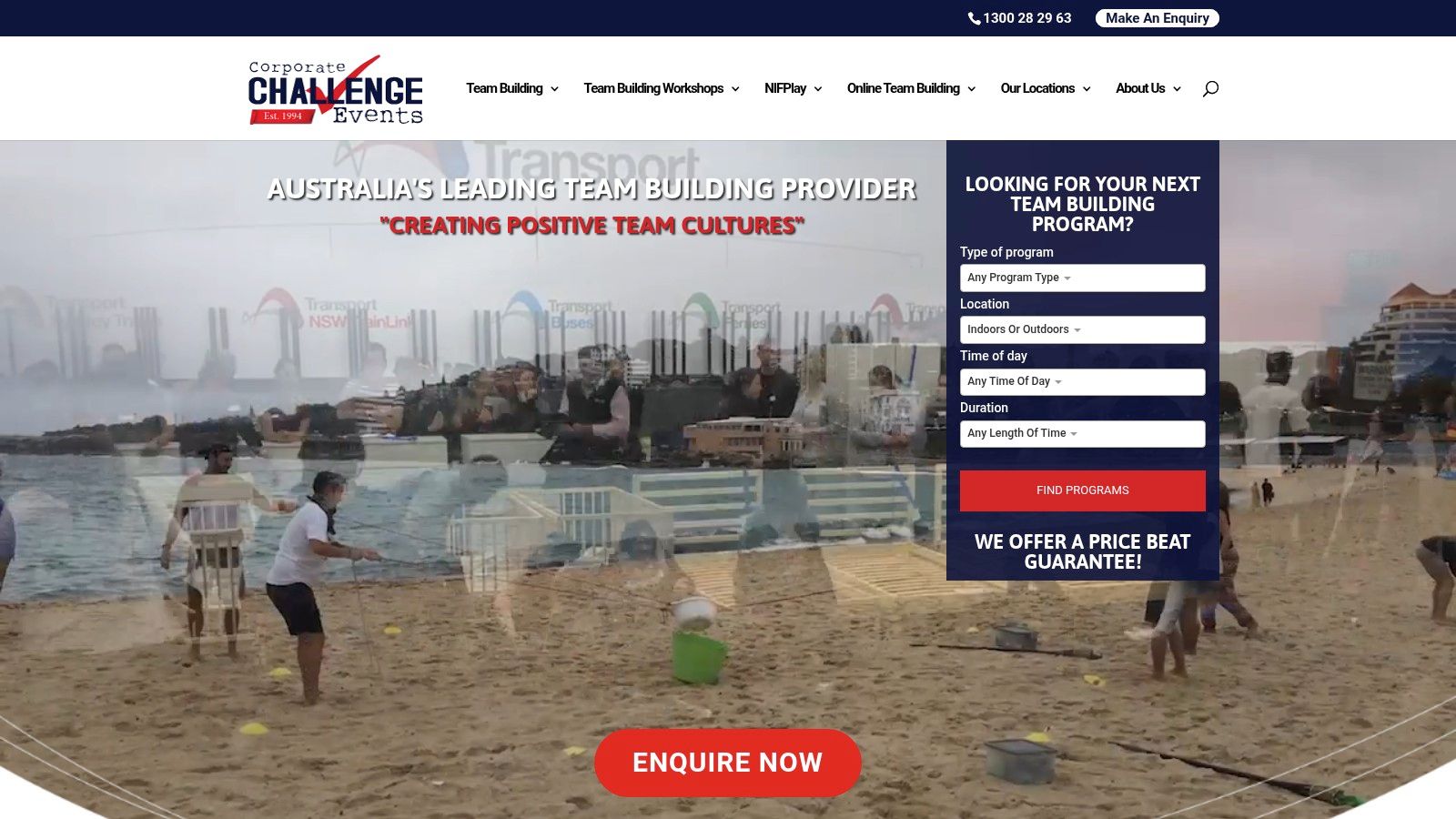
Corporate teams that want leadership development to feel practical, energising and transferable can explore Corporate Challenge Events. Its play-based programs help organisations turn conferences, offsites, team days and culture initiatives into experiences that strengthen trust, communication, collaboration and performance in ways people can carry back into work.