The calendar invite lands, the team chat lights up and the same joke appears again because everyone knows what might be coming. Another awkward icebreaker. Another trust fall. Another request to share a “fun fact” with the room, as if every employee has been waiting all week for an opportunity to perform their personality in front of their colleagues.
The problem is not that people dislike connection or fun. They dislike activities that feel forced, expose them without consent or reward whoever is most comfortable being loud. As this guide to team building games that do not feel forced or awkward explores, the best experiences create participation without manufacturing discomfort.
Good team building gives people a worthwhile task to complete together. Conversation, laughter and cooperation emerge naturally because the group has something meaningful to solve, build or achieve. Nobody has to perform instant closeness. The structure creates the conditions for connection, while giving different personalities and strengths a genuine way to contribute.
Table of Contents
Why Most Team Building Gets an Eye Roll
The eye roll usually starts before the event does. A manager announces “something fun,” people look at the calendar, and the group chat fills with jokes about awkward pairings, name tags and being forced to wear something ridiculous. That reaction isn't cynicism for its own sake, it's a memory bank of events that asked adults to perform enthusiasm on command.
The real problem is being put on display
Employees usually don't dislike connection. They dislike being singled out, judged for how energetic they are, or pushed into talking about themselves before they're ready. That's why the worst offenders are so easy to name, forced personal disclosures, trust falls, competitive humiliation, and activities that hand the loudest person the microphone while everyone else watches.
The more useful test is simple. If the activity creates a shared challenge, gives people clear instructions and lets different personalities contribute in different ways, it feels far less forced. That is the point of well-designed team building activities that are not awkward, and it's why the best programs look closer to structured collaboration than novelty theatre. Why one-size-fits-all engagement strategies fail
What the eye roll is really protecting
Humour is often a defence against social risk. People do not know whether they will be singled out, asked to perform, pushed into sharing something personal or placed in an activity that does not suit them. Making a joke about team building first gives them some control over that uncertainty.
That is not resistance to connection. It is resistance to exposure.
Practical rule: if an activity only works for people who enjoy performing, it is probably the wrong choice for a mixed workplace group.
The answer is not to remove fun. It is to design participation more thoughtfully. As this collection of team building activities demonstrates, different exercises suit different purposes, group sizes and participation styles. The organiser’s job is to choose a format that gives people a clear task, a useful role and enough structure to feel comfortable contributing.
Planners should think like designers, not entertainers. Success is not simply whether people laughed or looked busy. It is whether the activity helped a broad mix of participants communicate, contribute and work together without feeling pressured to perform a version of themselves for the room.
What Makes Team Building Feel Awkward
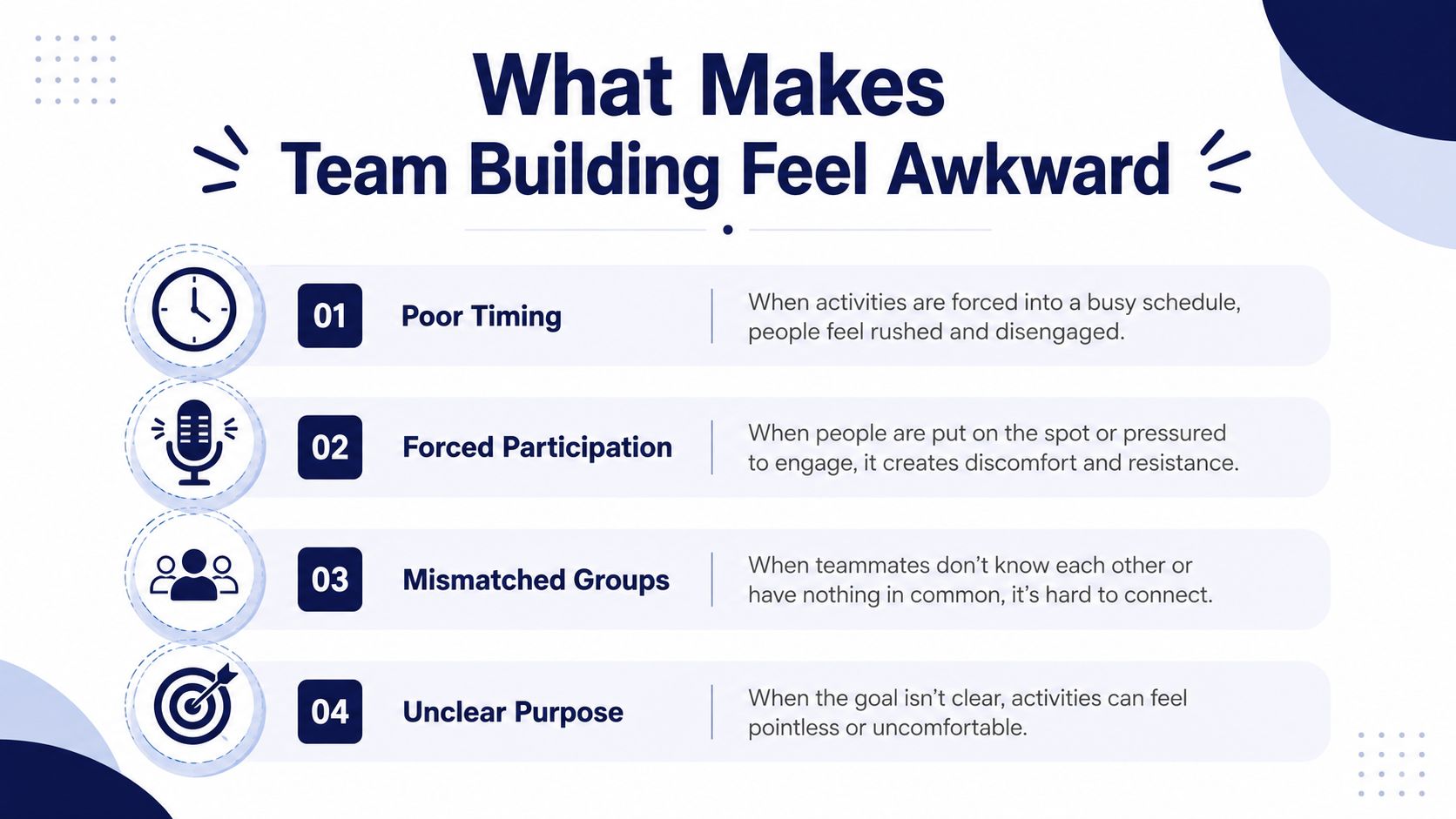
Awkwardness rarely comes from the activity alone, it comes from the design choices underneath it. Forced personal sharing, for example, can turn a simple session into a roomful of people wondering how much of themselves they're expected to reveal. A conference energiser that begins with “tell us something no one knows about you” sounds light, until half the room starts mentally drafting their exit strategy.
The usual design mistakes
Individual performances are another reliable source of cringe. Karaoke on demand, costume tasks, public elimination games and “judge's choice” formats all create a spotlight that some people will enjoy and many won't. The same is true for anything that depends on excessive physical contact, because not every employee is comfortable with touch, proximity or movement-based tasks in a mixed group.
Forced disclosure: A facilitator asking for personal stories before trust exists.
Extrovert bias: Formats that reward the fastest speaker instead of the strongest team.
Public embarrassment: Silly costumes, humiliation-based scoring or elimination rounds.
Unclear rules: People drift, hesitate and disengage when they can't tell what winning looks like.
Games also fall flat when they feel childish rather than playful. Adults can absolutely enjoy lightness, but they usually want the activity to respect their intelligence and time. A room full of capable professionals does not need a primary-school vibe, it needs a clear objective, a fair structure and a reason to care.
The best diagnostic is whether people can contribute through thinking, building, organising, solving or encouraging. If the only obvious way to participate is to be loud, funny or physically bold, the event will suit a narrow slice of the group and alienate the rest.
10 Team Building Activities Worth Booking
The fastest way to choose well is to match the activity to the outcome. Some teams need onboarding support, some need hybrid reconnection, some want a CSR result they can see, and others need a strategic reset after change.
That is why it helps to think beyond a single activity and consider the wider event experience. This guide to work social events offers useful inspiration for different workplace formats, but the final choice should still come back to the team’s needs, the purpose of the day and how people are most likely to participate.
The best option is not simply the one that sounds the most fun. It is the one that gives the group the right kind of experience at the right time.
| Activity | Best For | Group Size Fit | Workplace Outcome |
|---|---|---|---|
| Safe Crack | New teams, analysts, mixed-thinking groups | Small to medium | Faster rapport through shared problem-solving |
| LEGO Legends | Onboarding, culture-building, creative teams | Small to large | Collaboration, storytelling and shared ownership |
| Minute to Win It | Conference energisers, mixed departments | Large groups | Fast participation without long spotlight time |
| Bikes for Tykes | CSR days, values-led organisations | Medium to large | Team contribution with a tangible community result |
| Give a Dog a Home | Rescue-focused CSR, values and morale | Small to medium | Purpose-driven teamwork and shared completion |
| City Scramble | Hybrid reconnection, offsites, city events | Medium to large | Conversation through movement and challenge |
| Corporate Chef | Culture reset, relationship-building | Small to medium | Shared planning, coordination and celebration |
| Out of the Box | CSR with surprise reveal | Medium to large | Engagement through mystery and meaning |
| Risk Reward | Strategy reset, leadership groups | Small to medium | Decision-making and commercial thinking |
| Play Offs | Conference breakouts, broad participation | Medium to large | Balanced participation across multiple skills |
1. Safe Crack
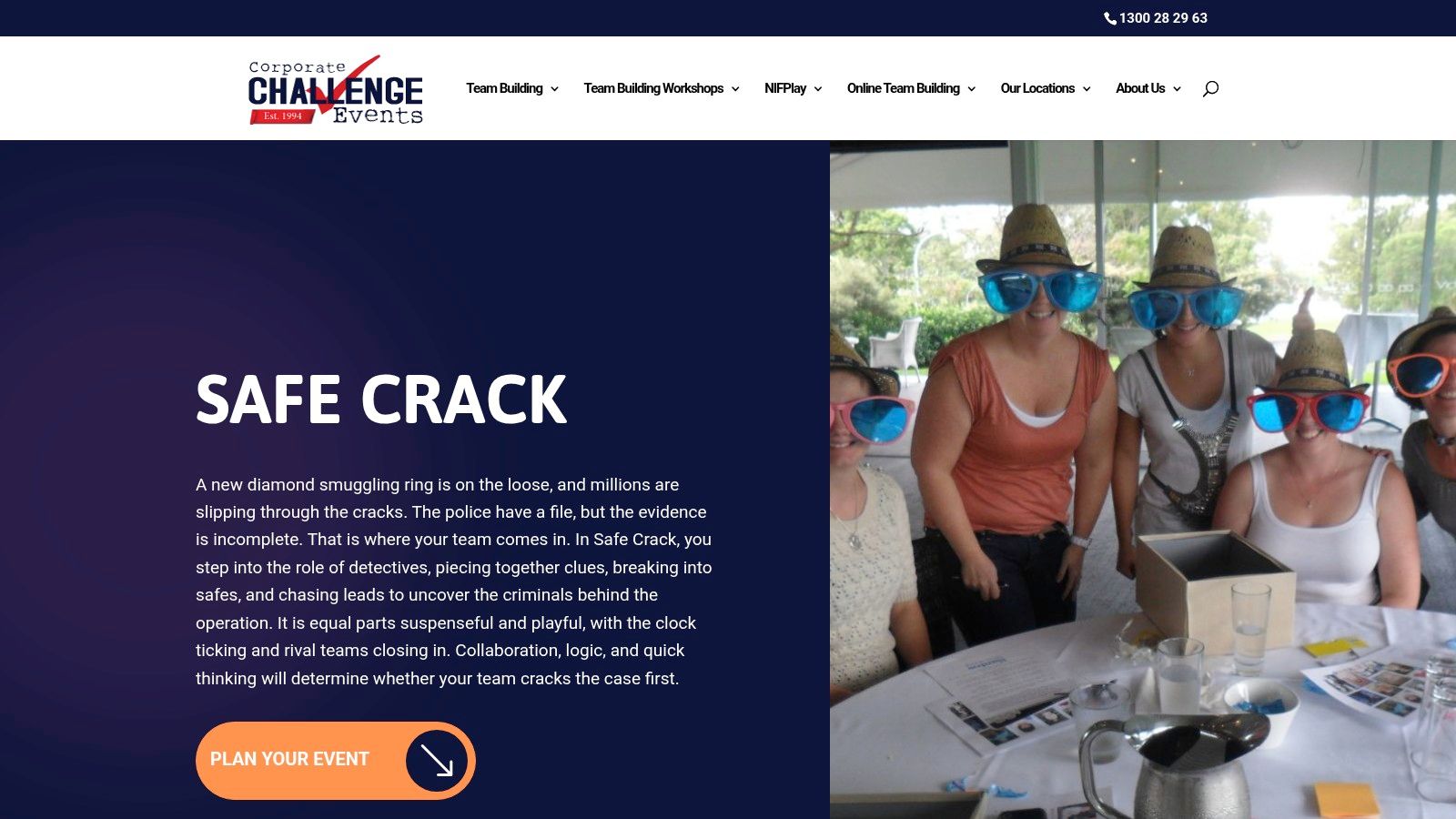
Safe Crack turns teams into detectives investigating a fictional diamond-smuggling ring. People examine evidence, follow leads, solve puzzles and race to break into the safe before rival teams do. That format works because every conversation has a job to do, so nobody has to manufacture banter just to keep the room moving.
It suits analytical thinkers, careful listeners and organised people who prefer substance over spectacle. It's also a strong onboarding option, because new starters can contribute quickly without needing to know the office social map first. Safe Crack program details
2. LEGO Legends
LEGO Legends gives teams bricks through a series of challenges, then asks them to build a sculpture around a company-selected theme. The finished piece becomes a prompt for a presentation, which means the activity gives people a practical object to focus on rather than a forced social script.
It works well for teams that need a common language after change or growth. Planning, construction, creative decisions and storytelling all have a place, so different personality types can contribute without competing for airtime. The charitable element, where LEGO sets are donated to children through a partner, also gives the event a wider purpose. LEGO Legends program details
3. Minute to Win It
Minute to Win It keeps the energy moving through short challenges using everyday items like cups, balls, straws and spoons. Teams choose the person best suited to each round, which means a quiet person can shine on one task while someone else takes the next.
The appeal is speed without pressure. No single participant has to stay in the spotlight long enough to feel trapped, and the group doesn't need a theatrical streak to stay engaged. Minute to Win It program details
4. Bikes for Tykes
Bikes for Tykes mixes playful problem-solving with a concrete community outcome. Teams complete challenges to earn bicycle parts, then assemble brand-new bikes that are donated to children in need. The event feels purposeful because the work ends in something visible and useful, not just applause.
Planners who need a CSR activity will like the balance of contribution roles. Some participants tackle challenges, others assemble, check quality, organise materials or keep the team on track. When children or charity representatives attend the final presentation, the finish lands with genuine weight. Bikes for Tykes program details
5. Give a Dog a Home
Give a Dog a Home asks teams to design, construct and decorate custom kennels for rescue organisations. That hands-on structure creates natural roles for builders, planners, decorators and detail-focused contributors, without turning the session into a public personality test.
The arrival of rescue representatives and dogs gives the event a memorable end that feels earned rather than staged. It's a good fit for organisations that want a team day with a charity outcome and a clear emotional payoff. Give a Dog a Home program details
6. City Scramble
City Scramble sends teams through a city or event location, moving between landmarks while completing creative, interactive and problem-solving tasks. Because people are walking, deciding and reacting together, the conversation starts to feel organic instead of forced.
That makes it useful for hybrid groups that need to reconnect outside a meeting room. The program can be adapted to the location, pace and fitness level of the group, and no one needs local knowledge before they arrive. City Scramble program details
7. Corporate Chef
Corporate Chef gives teams a complete dining experience to plan, prepare and present. Depending on the format, participants might select ingredients, design a menu, decorate the table, cook, plate and present to judges before sitting down together for the shared meal.
Food creates familiar roles fast. People who prefer to organise, decorate, cook or support can all find a place, and the meal itself becomes a natural end point instead of an awkward afterthought. Corporate Chef program details
8. Out of the Box
Out of the Box starts with mystery. Teams complete challenges to earn items without knowing the final purpose, then discover that the items are being packed into Good Boxes for people experiencing homelessness, with room for handwritten messages of support.
The reveal changes the emotional tone of the room in a good way. The activity begins as a competition and ends as a shared act of empathy, which gives teams a memory that feels bigger than the scorecard. Out of the Box program details
9. Risk Reward
Risk Reward has teams create fictional companies and complete challenges to grow their corporate fortunes. Every decision carries a different level of difficulty, risk and possible return, so the conversation stays focused on choices instead of on who can dominate the room.
That makes it a strong option for groups that prefer strategy to physicality. The fictional business setting keeps people engaged without exposing anyone's actual workplace performance to public scrutiny. Risk Reward program details
10. Play Offs
Play Offs rotates teams through professionally facilitated challenges that test communication, strategy, coordination, problem-solving and trust. The event is built with the coordinator, which helps match the tasks to the group's goals, location and preferred level of physicality.
The strength of the format is variety. Different skills win different rounds, so the same loud or athletic participants don't dominate every moment, and that usually keeps the atmosphere far less tense. Play Offs program details
The best shortlist for planners is not “what looks fun on paper,” it's “what lets people participate without dread.”
How to Run Team Building Without the Cringe
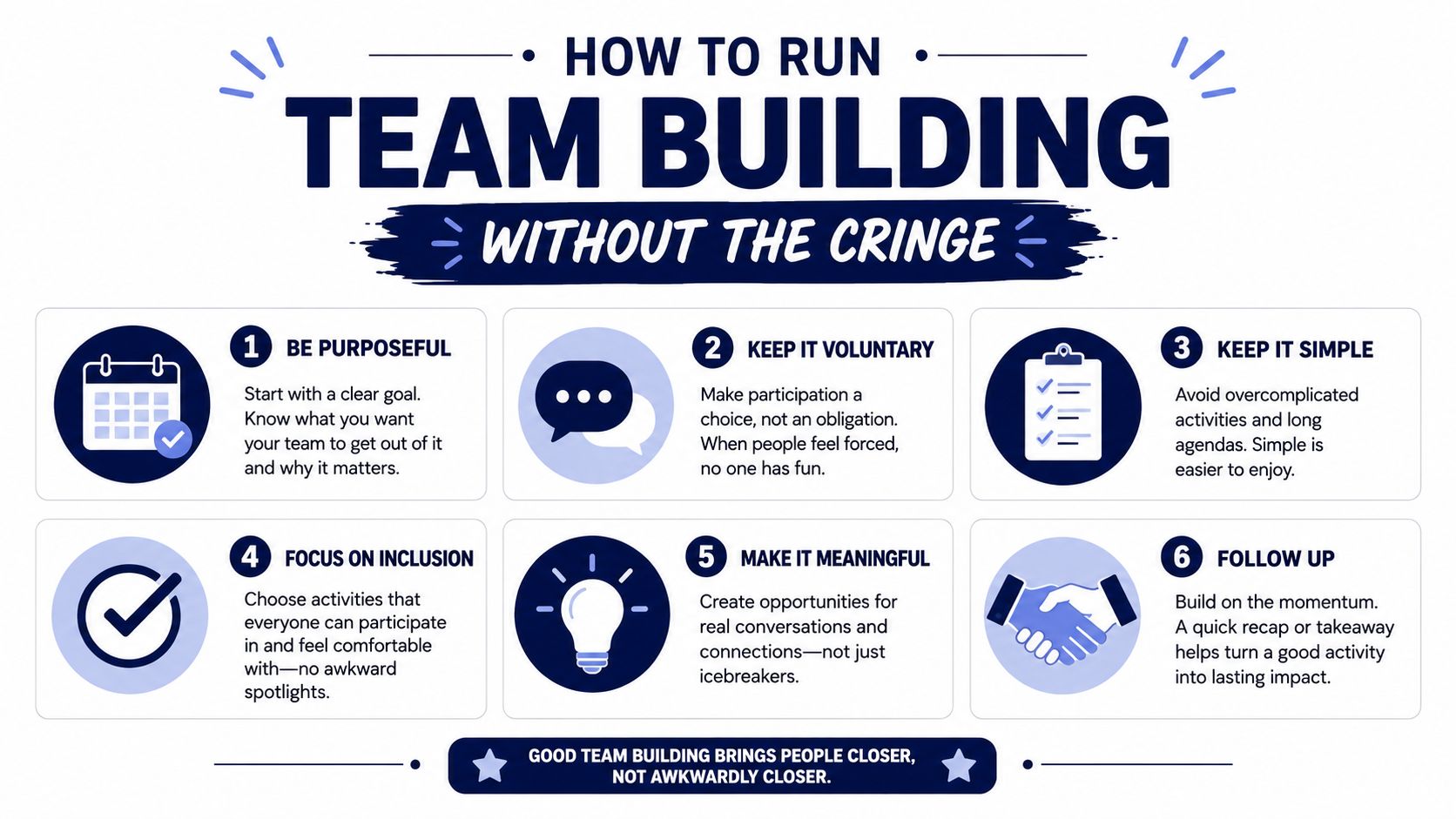
The most awkward events usually fail before the first activity starts. People arrive with no context, no sense of why they're there and no clue what kind of participation is expected, so even a decent format can feel clumsy. A clear pre-event message fixes more than people expect, because it lowers uncertainty before the room is full.
The practical checklist
Tell people what to expect: Share the location, timing, clothing needs and the style of participation, so nobody spends the morning guessing.
Use small mixed teams: Mixed roles reduce hierarchy and give quieter people a better entry point into the task.
Build in different ways to contribute: Planning, timing, building, presenting, encouraging and organising should all matter.
Avoid personal disclosure: Let the activity create connection through doing, not through oversharing.
Plan for access needs: Physical ability, cultural background, sensory comfort and accessibility should shape the format before the invitation goes out.
Use a facilitator who can read the room: An experienced host knows when to speed up, slow down or reframe instructions before the vibe turns flat.
Australian teams also need this approach because hybrid work has changed how trust is built. A brief pre-event note, plus a short structured debrief at the end, turns a one-off activity into something people can connect back to work. Play in the workplace
A good debrief does not need to be long. It only needs to ask what helped the team work well, what got in the way and what should carry back into daily collaboration. That's enough to make the event feel like part of workplace culture rather than an isolated day out.
What About Introverts and Quiet Contributors
The introvert question gets handled badly in a lot of planning meetings. The assumption is often that quieter people won't like team building, when the issue is usually that they dislike vague instructions, public performance and being cornered into fast social improvisation. That is a design issue, not a personality flaw.
Quiet contributors usually want structure
Many people, including introverts, work better when they have time to think, a clear role and a smaller group to contribute to. They don't need to be put on the spot to add value, and they often prefer practical tasks over performative ones. That's why formats with defined outputs usually land better than open-ended social games.
Safe Crack: Gives people a problem to solve, not a script to perform.
LEGO Legends: Lets contributors build, plan and explain without social pressure.
Bikes for Tykes: Creates room for task-based participation and a shared purpose.
Out of the Box: Rewards steady contribution while the charity reveal gives the event meaning.
Risk Reward: Supports thinkers who prefer decision-making to improv-style participation.
Teams planning for neurodiverse colleagues often benefit from the same structure. Clear expectations, role choice and reduced sensory pressure make the experience easier for a wider mix of people, which is why team-building for neurodiverse teams deserves more attention than it usually gets.
A useful planning lens also comes from considering the logistics around the activity. People participate more comfortably when they know where they are going, how the day will flow and what will be expected of them once they arrive.
For offsites and corporate outings, transport can shape that experience more than planners realise. This guide to planning a corporate outing highlights the value of coordinated group travel, particularly when teams are moving between offices, venues or activities. Reliable transport reduces delays, keeps the group together and removes one more source of uncertainty from the day.
The same principle applies to the activity itself. Clear instructions, manageable pacing and defined roles help participants settle in quickly, while vague logistics and unclear expectations can make even a good program feel awkward.
Choosing the Right Activity for Your Team
The right activity depends less on personality type and more on the business problem sitting underneath the event. New hires need different support from hybrid teams, and a charity day should not be judged by the same criteria as a strategy reset. That's where a lot of generic listicles miss the mark, because they catalogue ideas without tying them to actual workplace outcomes.
The Best Team Building Does Not Force Connection
A room full of polite silence usually means the activity was designed badly, not that the people in it are difficult. Good team building gives people a clear task, a fair role and a reason to cooperate. Connection happens because the structure supports it, not because anyone is asked to perform enthusiasm on cue.
That matters in workplaces where people may be split across locations, adjusting to change or simply out of practice at spending meaningful time together. HR leaders usually need more than a quick morale boost. They need an experience that supports onboarding, reconnection, leadership development, CSR or culture without creating unnecessary social pressure.
The balance is simple. If the format is too loose, quieter people can withdraw and the group loses direction. If it is too scripted, the experience feels forced. The strongest activities sit in the middle, with enough structure to reduce awkwardness and enough flexibility for different people to contribute in their own way.
The best team building does not manufacture connection. It creates the conditions for it.
Corporate Challenge Events designs and facilitates team building activities that are not awkward for Australian workplaces, including creative challenges, charity team building, conference energisers and offsite experiences. For HR, People & Culture and event organisers who want something structured, inclusive and commercially sensible, visit Corporate Challenge Events to discuss an activity that suits your group size, accessibility needs and event goals.