
Why do employees hate team building? Often, they do not. What they dislike is being pushed into an experience that feels forced, embarrassing, irrelevant or designed for only one kind of participant. The problem is rarely play itself. It is how the activity has been designed, the context in which it occurs and whether people have any genuine choice in how they participate.
Team events also do not happen in a vacuum. Only 16% of Australian employees were fully engaged at work in ADP’s 2025 People at Work research, down from 18% the previous year. When people already feel disconnected from their workplace, asking them to perform enthusiasm for an afternoon is unlikely to create meaningful engagement (ADP’s workplace engagement analysis).
When a leader concludes, “My team hates team building,” they may be overlooking useful information. Avoiding the spotlight, resisting competition or holding back during physical activities can signal a mismatch between the experience and how different people enter play. The response is not to push harder. It is to understand what is creating the reluctance and design a better way in.
Table of Contents
- 1. Activity design often favours one way of playing
- 2. Forced public performance can turn fun into exposure
- 3. Excessive competition makes some people check out
- 4. Employees disengage when the purpose feels vague
- 5. Accessibility gaps can make participation genuinely difficult
- 6. Lack of real choice changes the whole psychological contract
- 7. Previous bad experiences make people cautious for good reason
- 8. The wrong activity for the team in front of you will always feel off
- 9. Different play styles can share one experience without forcing sameness
- Reluctance Is Information, Not a Character Flaw
1. Activity design often favours one way of playing
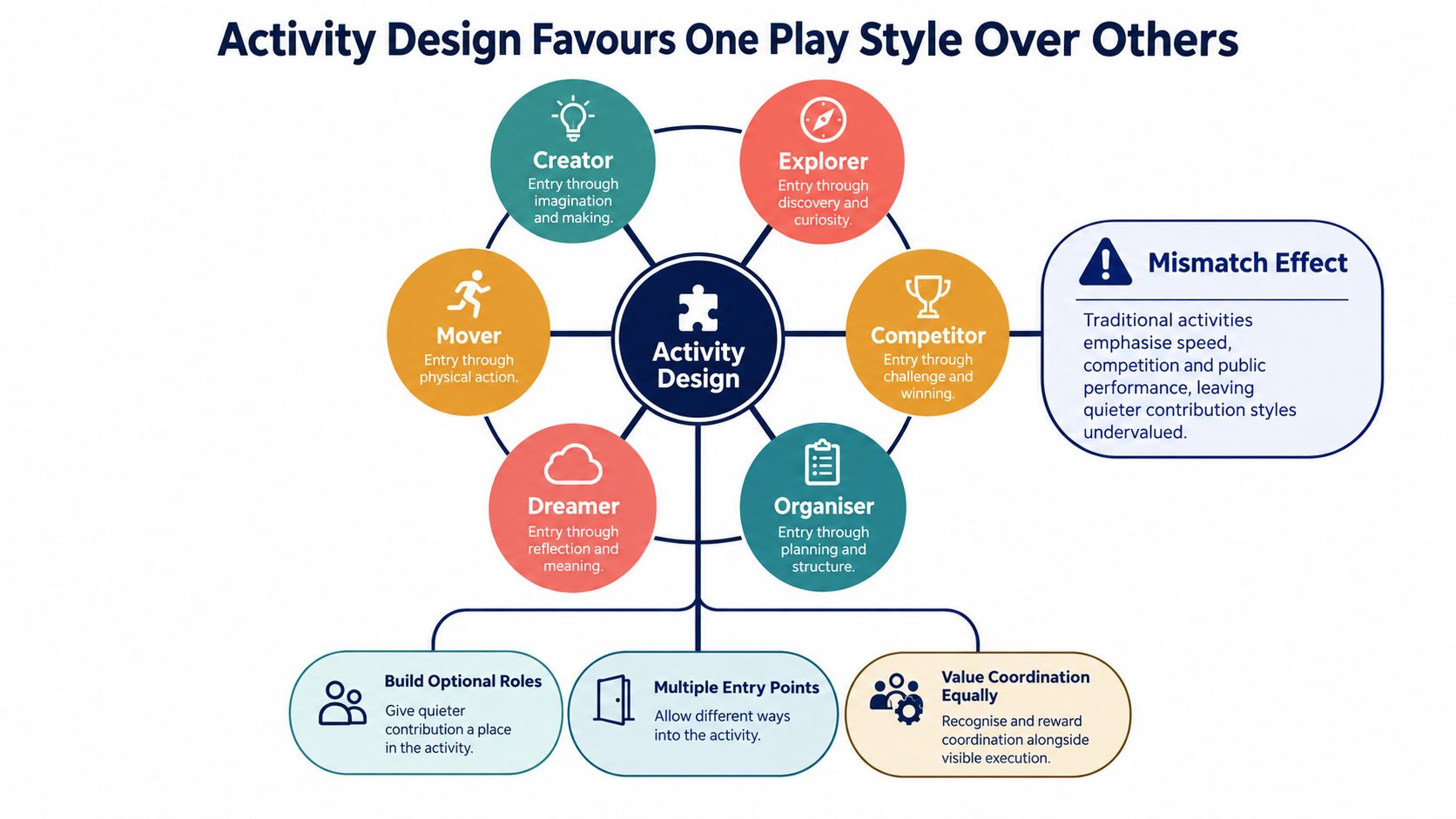
Many traditional team-building activities favour speed, physical movement, competition and visible performance. Those elements can create energy, but they can also send an unintended message: the people who move fastest, speak first or attract the most attention are the ones contributing most.
That overlooks the person who spots the flaw in the plan, organises the materials, asks the question that changes the team’s approach or quietly helps everyone stay involved. These contributions may be less visible, but they are often essential to the result.
Consider the difference between a basic relay race and a facilitated team challenge with planning, problem-solving, practical tasks and defined roles. The relay offers a narrow route to success. The broader challenge gives people more ways to contribute while still working towards a shared outcome.
The Free Play Styles quiz can help individuals and leaders recognise that people are drawn into play in different ways. It is not about labelling employees or deciding who should do what. It provides a starting point for designing experiences that value more than the loudest or fastest contribution.
2. Forced public performance can turn fun into exposure
Being asked to perform in front of colleagues is not the same as being invited to play. Karaoke, spontaneous presentations, role play and personal sharing may be enjoyable for some people, but deeply uncomfortable for others. The pressure increases when declining would draw even more attention than participating.
From the organiser’s perspective, the activity may look harmless. From the employee’s perspective, it may involve the risk of embarrassment in front of managers and peers. That difference in experience can explain why someone withdraws, jokes their way out of a task or avoids attending altogether.
A stronger design does not remove all visibility. It creates choices around it. People might present as a pair, contribute to a group response, take responsibility for planning or select a role before the activity begins. Psychological safety in the workplace should shape the experience from the beginning, particularly when activities involve personal disclosure, performance or public feedback.
The aim is not to protect everyone from a moment of discomfort. Growth can be uncomfortable. The difference is whether people feel supported to stretch or pressured to perform.
3. Excessive competition makes some people check out
Competition is not inherently bad. A fair challenge can create focus, laughter and a shared sense of momentum. For employees with a strong Competitor Play Style, it may be one of the quickest ways to become absorbed in an experience.
Problems arise when winning becomes the only meaningful outcome. Public scoreboards, uneven teams or constant attention on the strongest performers can make everyone else feel as though they are being evaluated. Instead of experimenting and engaging, people begin protecting themselves from visible failure.
Facilitation makes a significant difference here. Competitive formats such as Play Offs and Mini Olympics can still recognise strategy, cooperation, creativity and team spirit alongside the final score. The challenge remains real, but success is not reduced to one winning team or one type of ability.
Before choosing a heavily competitive format, consider how the team currently responds to pressure. Healthy rivalry may energise a secure, established group. For a team already dealing with tension, hierarchy or low trust, the same format may reinforce the dynamics leaders are trying to change.
4. Employees disengage when the purpose feels vague
Employees are more likely to resist a team event when they cannot understand why it is happening. A generic invitation promising “an afternoon of fun” may land poorly if the team is under pressure, going through change or carrying unresolved conflict.
The purpose does not need to be a heavy learning objective. Reconnecting after a demanding period, welcoming new colleagues or simply sharing an enjoyable experience can all be worthwhile. What matters is that the reason is honest and the activity suits it.
Purpose-led charity programs such as Bikes for Tykes, Toys for Tykes and Give a Dog a Home can work well when teams want their collaboration to produce a tangible outcome beyond the event itself. The shared task has an immediate reason, while the experience still creates space for communication and connection.
Rather than asking which activity looks the most exciting, leaders can begin with a more useful question: what does this team need from the time together? This guide to choosing team building that aligns with business objectives can help connect the format with the intended outcome without forcing a workplace lesson onto every moment.
5. Accessibility gaps can make participation genuinely difficult
Sometimes reluctance is not reluctance at all. A person may be managing a mobility restriction, chronic pain, fatigue, sensory sensitivity, anxiety or another access need that has not been considered in the activity design. If the physical requirements are unclear or the environment is overwhelming, holding back may be the safest available choice.
Attendance alone does not make an experience inclusive. Someone who can enter the venue but cannot participate meaningfully is still being excluded. Accessibility needs to include the venue, transport, bathrooms, sound levels, lighting, communication, rest areas and the demands of the activity itself.
Clear information before the event allows people to make informed decisions and request adjustments privately. During the experience, varied roles can create meaningful options for movement, planning, observation, problem-solving and hands-on contribution. This is particularly important when planning team building for neurodiverse teams, where noise, uncertainty, rapid transitions or ambiguous instructions can affect participation.
Inclusive design does not reduce the experience for everyone else. Clearer instructions, flexible roles and more than one way to contribute generally make an activity stronger for the whole group.
6. Lack of real choice changes the whole psychological contract
Play relies on a degree of freedom. When an activity feels compulsory, or declining carries a visible social cost, employees may experience it as another workplace demand rather than an opportunity to connect.
Not every organisation can make every team event optional. There may be a legitimate reason for bringing everyone together. Meaningful choice can still exist within the experience through different roles, varying levels of visibility, alternatives to highly physical tasks and the ability to step back without being mocked or questioned publicly.
Communication before the event is equally important. Tell people what the experience involves, what clothing or physical movement may be required and whether there will be performance, competition or personal sharing. A surprise may be entertaining when it adds delight. It is less successful when it removes someone’s ability to prepare for an uncomfortable situation.
Leaders also set the tone. If they treat every hesitation as negativity, employees learn that participation is being measured as loyalty. If they listen and make reasonable adjustments, people are more likely to trust the invitation.
7. Previous bad experiences make people cautious for good reason
One poorly designed team event can shape how the next invitation is received. Employees remember being embarrassed, left on the sidelines, forced to share something personal or told they should have enjoyed an activity that made them uncomfortable.
Renaming the next event will not erase that history. Leaders need to acknowledge what did not work and explain what will be different. That might include a clearer purpose, professional facilitation, advance information, accessible roles or a format chosen in response to employee feedback.
An evidence-led understanding of play can also help shift the conversation away from forced fun. Through our partnership with the National Institute for Play, CCE approaches play as a natural human capacity that supports connection, curiosity and engagement. It cannot be manufactured by demanding enthusiasm. The conditions have to invite it.
Trust is rebuilt through what people experience, not what the invitation promises. A well-facilitated event can begin changing expectations, but only if the organisation follows through on the choices and safeguards it communicated beforehand.
8. The wrong activity for the team in front of you will always feel off
An activity can be well designed and still be wrong for the team in front of you. A newly formed group may need simple opportunities to learn about one another. A team navigating conflict may need structured cooperation and careful facilitation. A distributed team meeting in person for the first time may benefit from connection before competition.
Team history, working patterns, group size, location, accessibility and current pressure all influence what will land well. So does the organisation’s real objective. An activity chosen to reward employees will feel different from one designed to explore communication or support a change process.
This is why copying another company’s event rarely guarantees the same result. The format needs to fit the people, not simply the available time slot or the organiser’s personal preference. A good provider should ask what is happening within the team before recommending what the team should do.
Matching the activity to the team does not mean removing every challenge. It means choosing the right kind of challenge and creating the conditions in which people can engage with it constructively.
9. Different play styles can share one experience without forcing sameness
The six Play Styles provide a useful lens for understanding why the same activity can produce very different reactions. Creators are drawn to making and generating ideas. Explorers enjoy discovery and following curiosity. Competitors engage through goals, comparison and fair challenge. Organisers bring people, resources and experiences together. Dreamers may enter through imagination, observation and reflection. Movers connect through physical action and embodied experience.
These are not fixed job types, and people are not limited to one style. They are preferences that can overlap, change with context and appear differently from one person to another. Their value in team building is not to divide people into categories. It is to remind organisers that participation does not look the same for everyone.
A well-designed experience can invite several Play Styles at once. A challenge might include a physical task, a story or theme, strategic decisions, creative construction, resource coordination and a shared goal. People are still part of one experience, but they are not all required to enter it through the same door.
Programs such as LEGO Legends and other play-based team-building experiences naturally allow for creative thinking, planning, practical construction and collaboration. The facilitator can strengthen that mix by recognising different contributions, rotating responsibilities and preventing one style from dominating every decision.
Reluctance Is Information, Not a Character Flaw
When employees resist team building, the easiest response is to blame attitude. The more useful response is to examine the conditions surrounding the experience.
Before choosing an activity, ask:
-
Is the purpose clear and credible?
-
Can people contribute without being fast, loud or publicly performative?
-
Have physical, sensory and other access needs been considered from the beginning?
-
Is there meaningful choice in how people participate?
-
Does the format suit this team’s current needs and history?
No activity will become every employee’s favourite, and that is not the standard leaders need to chase. A strong team experience creates enough safety, relevance and variety for different people to find a meaningful way into it.
Corporate Challenge Events designs play-based team building that gives different people genuine ways to contribute, not just louder ones. Visit Corporate Challenge Events to explore activities and programs that support culture, collaboration and engagement with evidence-led play.