
A leadership team has just announced a restructure. One person starts asking sharp questions. Another goes quiet. A third wants more detail before committing to anything. Someone else tries to take control of the process. In most workplaces, those reactions get labelled as attitude, resistance, or poor team fit.
The SCARF model offers a better explanation. It helps leaders understand why pressure affects people differently, and why the same meeting, briefing, feedback conversation, or team activity can feel energising to one person and threatening to another. For People & Culture teams, team leaders, EAs, and internal organisers, that makes the model especially useful during change, offsites, conferences, and team building.
Table of Contents
What Is the SCARF Model
The David Rock SCARF model gives leaders a practical way to read social behaviour at work. Dr. David Rock introduced the model in 2008 through the NeuroLeadership Institute, identifying five social domains the brain scans for danger or reward: Status, Certainty, Autonomy, Relatedness, and Fairness. The model also explains that social experiences can trigger the same approach or avoid responses associated with primary survival needs, as outlined in this SCARF model overview.
That's why the SCARF model workplace lens has stayed useful for leaders dealing with change, feedback, performance conversations, and team dynamics. It helps decode reactions that otherwise seem irrational.
A team member who shuts down in a meeting may not lack ideas. A colleague who resists a new process may not dislike change itself. Often, the underlying issue sits in one of the five domains. Leaders already working to strengthen self-awareness and people skills often find that the SCARF model sits well alongside emotional intelligence at work.
Practical rule: When behaviour changes under pressure, the first question isn't “What's wrong with this person?” It's “What feels unsafe here?”
Why Pressure Changes How People Show Up
Pressure narrows behaviour. Under strain, people often protect themselves before they contribute. That's why team communication can change so quickly in moments that feel high stakes.
Brain scan technology confirms that social experiences involving the five SCARF areas trigger specific neural responses in the brain's threat and reward circuits. Perceived threats to areas such as Status or Fairness can spark fight or flight reactions much like physical danger, as described in this SCARF model PDF.
In the workplace, that can look ordinary on the surface. A decision gets questioned. A workshop participant stops talking. A previously collaborative team becomes guarded. The behaviour may look personal, but the trigger is often social and highly predictable.
Leaders who understand group dynamics in teams are usually better placed to spot the pattern early. Instead of pushing harder, they adjust the conditions so people can think, speak, and participate without feeling exposed.
The Five SCARF Domains Explained
The five domains explain why one team member needs more context, another needs more choice, and another needs reassurance that the process is fair. They also help leaders avoid treating all disengagement as the same problem.
A contemporary dataset of over 15,000 SCARF assessment responses from 2024 to 2025 found a shift in what people value most. Fairness now ranks as the top domain, Autonomy has moved from the bottom in 2012 to a close second, and Certainty has fallen to the bottom, according to the NeuroLeadership Institute's SCARF in 2025 update.
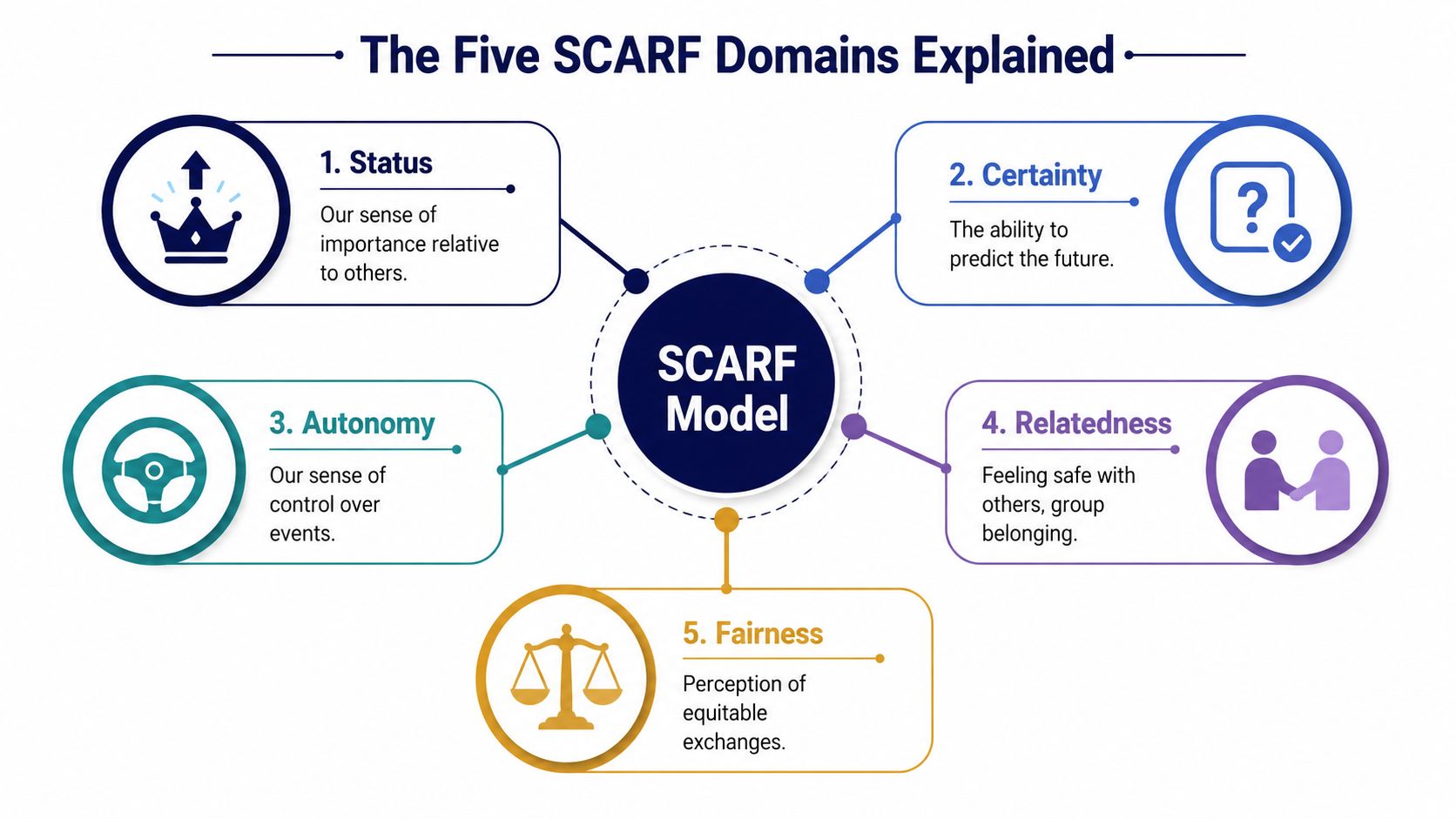
Status
Status is a person's sense of importance relative to others. In a workplace, it isn't just about title. It's about whether people feel respected, listened to, and recognised for their contribution.
A threat to status might come from public correction, being talked over, or having expertise dismissed. A reward comes when a leader acknowledges capability before offering challenge.
Certainty
Certainty is the ability to predict what's coming next. Teams don't need every answer, but they do need enough clarity to orient themselves.
Threats show up when communication is vague, priorities keep shifting, or changes are announced without process. Certainty improves when leaders explain what's known, what isn't known yet, and what happens next.
Autonomy
Autonomy is the sense of control over events. It doesn't require total freedom. It requires room to influence how work gets done.
This domain is often threatened by micromanagement, rigid instructions, or decisions made without input. It's strengthened when people have choices about timing, method, or how they contribute to a task.
Relatedness
Relatedness is about feeling safe with others. It shapes whether people feel like insiders, outsiders, or potential targets.
New team structures, hybrid work, and unfamiliar groups can all challenge relatedness. Shared experience, predictable facilitation, and collaborative tasks help create social safety faster.
Fairness
Fairness is the perception that decisions and exchanges are equitable. Teams notice when rules shift, information is withheld, or some people seem to get special treatment.
Fairness often drives the strongest reactions because people don't only judge outcomes. They judge process. Transparent reasoning, consistent expectations, and visible criteria all help.
What SCARF Threats Look Like Inside Teams
SCARF threats rarely announce themselves clearly. They tend to show up as behaviour that leaders can see, but not always interpret well.
In one team, a manager introduces a new workflow without much consultation. A few people nod, then drag their feet for weeks. That may look like poor buy-in, but it often reflects an Autonomy threat. In another team, a workshop participant stays silent after a more senior colleague dismisses an idea early. That's often a Status issue, not a lack of engagement.
Common signs include the following:
Silence in meetings when people don't feel safe contributing
Defensiveness when feedback threatens status or fairness
Over-control when uncertainty is high
Withdrawal when relatedness is weak
Resistance to change when people feel decisions are being done to them, not with them
Conflict and mistrust when fairness concerns linger
Teams don't become difficult for no reason. They usually become protective before they become unproductive.
How Leaders Can Reduce Threat and Increase Reward
Leaders can't remove pressure from every workplace moment. They can design those moments better. That includes meetings, project launches, performance conversations, restructures, conference breakouts, and team building.
While results vary by team and context, SCARF is widely used as a practical framework for reducing social threat in conversations about change, feedback, decision-making, and collaboration, as discussed in this Australian SCARF article. That makes the model useful well beyond theory.
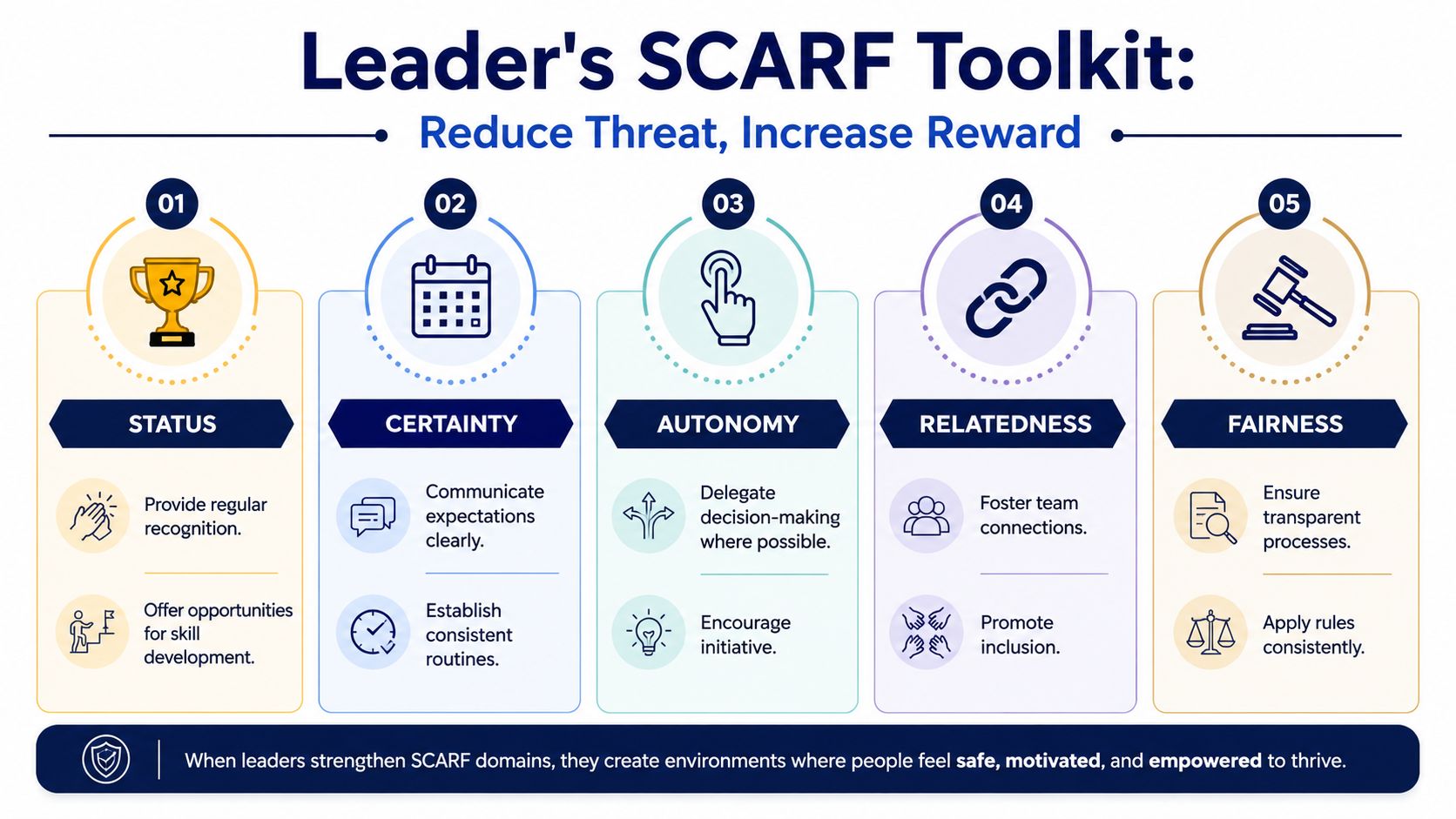
Simple leadership moves for each domain
For Status: recognise strengths before discussing gaps. Public praise can help when it feels genuine, while private correction often protects dignity better than public critique.
For Certainty: give agendas, explain purpose, and clarify what success looks like. Teams usually cope better with tough news than vague news.
For Autonomy: offer bounded choice. A leader can define the outcome while allowing flexibility in method, ownership, or sequencing.
For Relatedness: create repeated moments of safe interaction. People trust faster when they solve something together, not just sit in the same room.
For Fairness: explain how decisions were made. Even unpopular calls are easier to accept when the process is visible and consistent.
What better design looks like
A well-run leader doesn't just ask for participation. That leader creates the conditions that make participation feel possible. In practice, that might mean circulating context before a meeting, inviting input before locking a plan, or making decision criteria visible to everyone in the room.
It also means recognising that permission to contribute is often a leadership behaviour, not a personality trait in the team. That's one reason permission to play as a leadership skill has become such a useful idea for culture-focused leaders.
How Play Based Team Building Supports Psychological Safety
Play based team building works best when it's structured with intent. In a corporate setting, play isn't there to distract from work. It helps teams rehearse trust, communication, shared problem-solving, and recovery from mistakes in a lower-risk environment.

Why structured play works at work
Well-designed activities can support each SCARF domain in practical ways. They can reduce status pressure by mixing roles and lowering hierarchy. They can increase certainty through clear rules and facilitation. They can protect autonomy by giving people options in how to participate. They can strengthen fairness through transparent scoring, roles, and expectations.
That's why play at work is better understood as performance infrastructure than as a nice extra. It gives teams a controlled setting to practise safer participation.
Relatedness needs a practical answer
Post-pandemic, workplace relatedness remains a major challenge for many organisations. Data on hybrid work in Australia consistently shows that a significant majority of managers and employees report a decline in team connection, with many citing workplace isolation and communication silos as primary collaboration hurdles. As outlined in the Australian Sports Commission’s overview of the SCARF Model. When team members experience a relatedness deficit, the brain can perceive the social isolation as a threat, triggering a defensive fight, flight, or freeze response that makes it difficult to collaborate and perform at our best
Using SCARF to Choose the Right Team Activity
The right activity depends less on what looks entertaining and more on what the team needs most. A program that works well for one group may create unnecessary friction for another if it triggers the wrong domain.
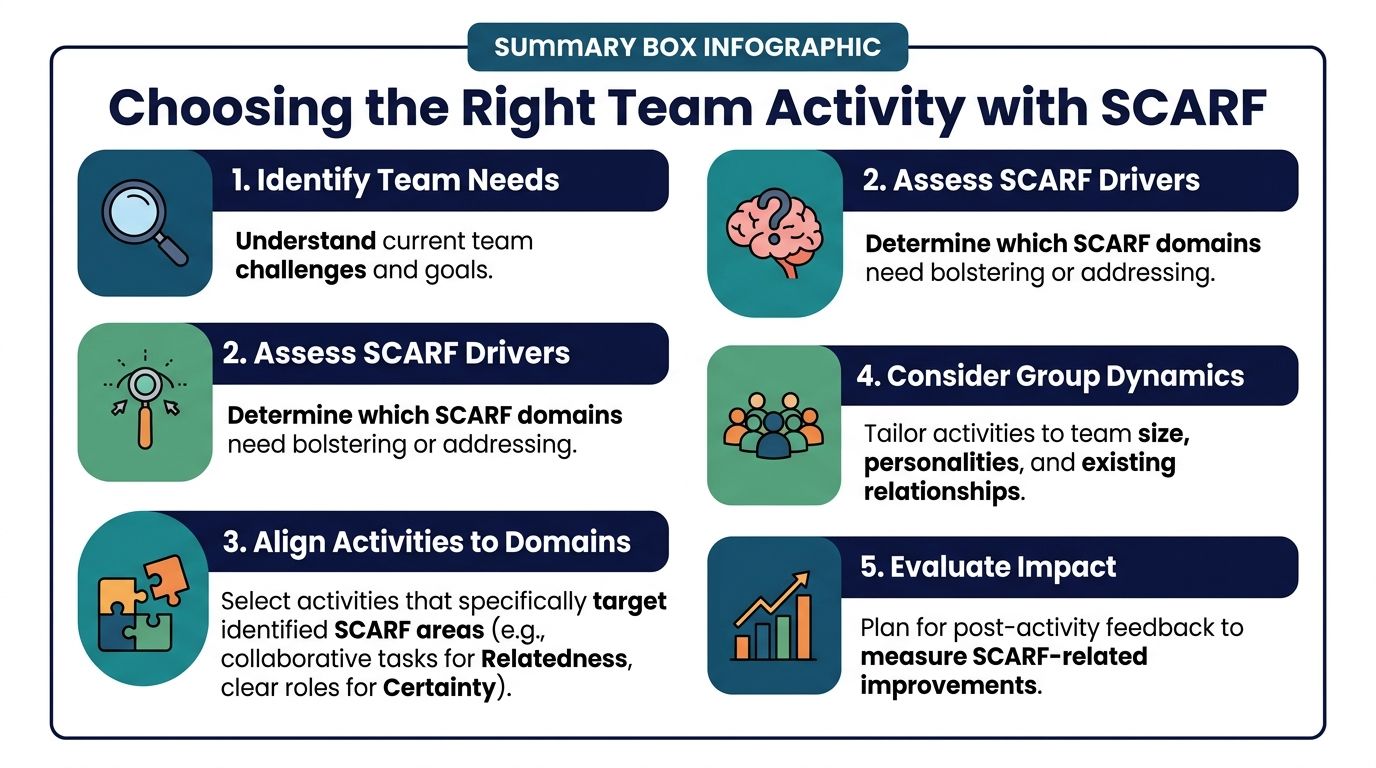
Match the activity to the pressure point
A simple planning lens helps:
| Team issue | Likely SCARF domain | Better activity design |
|---|---|---|
| People feel judged or overshadowed | Status | Choose mixed-role activities with low hierarchy and multiple ways to contribute |
| Teams are anxious about change | Certainty | Use clearly facilitated programs with simple rules and visible structure |
| People dislike being directed | Autonomy | Offer choices in roles, pace, or problem-solving method |
| Colleagues feel disconnected | Relatedness | Prioritise collaborative challenges that create shared experience |
| People question process or favouritism | Fairness | Make rules, judging, timing, and outcomes transparent from the start |
A quick planning lens for organisers
For EAs, People & Culture teams, and internal event organisers, the question isn't only “What activity should the team do?” It's also “What social risk needs reducing first?”
A sales team after a restructure may need certainty and fairness more than competition. A newly merged department may need relatedness before strategy. A senior leadership group may benefit from activities that reduce status pressure and encourage contribution outside formal rank.
That's why a thoughtful selection process matters. Organisers comparing formats, facilitation styles, and team objectives can use guidance on choosing the right team building activity for a team to line the experience up with actual workplace culture goals.
The best team activity doesn't force energy. It creates conditions where people can bring energy without feeling exposed.
Your Takeaway Building Safer Teams
People rarely resist connection for the sake of it. They resist feeling unsafe, exposed, sidelined, or controlled. The SCARF model workplace lens helps leaders name those pressures before they turn into silence, friction, or disengagement.
That's what makes the David Rock SCARF model so practical for modern leadership. It gives teams a shared language for understanding team dynamics and gives organisers a better way to design group experiences. When leaders understand what people experience as threat or safety, they can create team moments that lower defensiveness and increase participation.
Corporate Challenge Events designs play based team building experiences that help teams build trust, connection and positive team culture through structured, purposeful play.