
The brief often lands on a People & Culture desk the same way. Leadership wants a team event that lifts morale, supports CSR, and won't be dismissed as a nice afternoon with no business value. The challenge isn't finding charity team building activities in Brisbane. The challenge is choosing one that creates a genuine team outcome, a credible community contribution, and a report senior leaders can stand behind.
That's where many Brisbane events fall short. They're easy to book, easy to explain, and much harder to defend once budget scrutiny starts. A well-run charity event can strengthen communication, break down silos and create a shared sense of purpose, but only when the design connects the activity to the cause and the organiser measures both.
Table of Contents
Why Your Next Team Event Should Give Back
The pressure behind a simple brief
Most corporate event briefs sound straightforward at first. Run something engaging. Keep it professional. Make sure people want to attend. Then add the harder layer. The event also needs to support culture, reflect organisational values, and justify budget in a way a finance leader will accept.
That's why charity team building activities in Brisbane keep appearing on shortlists. They can solve several business needs at once. They give teams a shared task, create a visible outcome, and align neatly with CSR priorities that matter to boards, executives, and employees.
The risk is poor design. When the cause feels secondary to the activity itself, staff notice quickly and the event can come across as forced rather than meaningful. A stronger approach is to choose a format where the team challenge, the beneficiary story, and the post-event debrief all connect clearly, as outlined in Corporate Challenge charity team building insights.
Practical rule: If participants remember the game but can't explain the community outcome, the event was entertaining but strategically weak.
What authentic design looks like
Authentic charity events don't ask teams to choose between enjoyment and meaning. They connect the two. A bike build works because the challenge requires planning, role clarity, problem-solving and cooperation, while the final handover gives those behaviours a clear purpose. The same principle applies to hamper packing, furniture assembly, toy creation, or practical donation programs tied to a local need.
The strongest events also handle the story well. Staff should know who benefits, why the activity was chosen, and what success looks like beyond applause at the end. That's also where supporting materials can help. Teams organising fundraising add-ons or community partner visibility sometimes use resources like branded merchandise for nonprofits to support clearer event identity without turning the day into a generic branded activation.
A serious charity event also needs a debrief. Without one, even a good activity can feel disconnected from daily work. With one, planners can tie behaviour on the day back to collaboration, communication and culture outcomes. That's the difference between a pleasant CSR moment and a credible workplace intervention, which is why articles on the real impact of charity team building are increasingly useful for internal stakeholders building a business case.
For HR teams: charity formats can create shared purpose across functions that rarely work together.
For executive assistants and organisers: they package culture, engagement and CSR into one event line item.
For senior leaders: they offer a visible example of values in action, not just values on a wall.
Exploring Charity Team Building Formats in Brisbane
A Brisbane leadership team books a charity event to lift morale after a hard quarter. The room enjoys it, the photos look good, and the donation lands well. Two days later, the executive sponsor asks a harder question. What did the business get from it besides a positive afternoon?
That question should shape the format choice from the start. Charity team building is not one category. Different formats test different behaviours, suit different venues, and produce different kinds of evidence for senior stakeholders. The right choice depends on whether the brief is about cross-functional problem-solving, conference energy, inclusion, speed, or a visible community outcome that can be reported internally.
Construction-based challenges
Construction formats suit teams that need visible collaboration under time pressure. Groups complete challenges, earn parts, and assemble a finished item for donation. Common Brisbane examples include Bikes 4 Tykes, Billy Carts, and furniture builds linked to community support programs.
These events create strong theatre, but they also expose real team habits. Quality control matters. Instructions get missed. Stronger teams usually appoint informal coordinators early, divide labour clearly, and protect time for testing before handover. That makes construction programs useful when the organiser wants to observe execution, not just participation.
They also come with practical trade-offs. Build activities need more floor space, more bump-in time, and closer safety oversight than simpler formats. Organisers running these programs in hotels, offices, or mixed-use venues should confirm load-in access, waste removal, and tool controls early. Teams needing Security risk assessment insights often use this same planning mindset for event safety, especially where equipment, movement, or large group rotations are involved.
Packing and kit-based programs
Packing formats are usually easier to run in conference rooms, offices, and tighter venues. They rely less on physical movement and more on coordination, sequencing, and accuracy. Typical examples include care packs, education kits, hygiene packs, and light-assembly donation programs.
For many Brisbane organisers, that simplicity is the advantage. Setup is faster. Noise is lower. Mixed mobility requirements are easier to accommodate. These programs also work well when the schedule only allows a short activation between business sessions.
The team outcome is different, though. Packing events rarely generate the same visual energy as a bike build or cart race. What they do show is process discipline. Teams that struggle with role clarity or handoff errors often reveal it quickly in this format.
A quieter format can produce better business insight when the goal is to test coordination, not create spectacle.
Creative contribution formats
Creative charity formats sit between a build challenge and a packing exercise. Teams customise, design, decorate, or contribute to a cause-linked output in a way that feels more expressive than operational. These activities often suit conference agendas where the organiser wants broad participation without asking every attendee to compete physically or manage tools.
They are useful for culture work, especially in groups with mixed seniority or lower appetite for overt competition. Staff who hold back in race-style activities often engage more readily when the task rewards ideas, care, and contribution quality.
The trade-off is measurement. Creative programs can feel warm and inclusive, but the internal business outcome needs to be defined carefully or the event risks being remembered only as a nice gesture. If leadership wants clearer evidence of team performance, planners often compare the mechanics of different Brisbane corporate team building activities before selecting a charity format that matches the room, audience, and reporting expectations.
Brisbane Charity Activity Format Comparison
| Activity Format | Primary Team Outcome | Ideal for Teams Needing… | Example Program |
|---|---|---|---|
| Construction-based | Problem-solving and collaboration under time pressure | stronger cross-functional teamwork and visible shared achievement | Bikes 4 Tykes |
| Packing and kit-based | Coordination, process discipline and role clarity | a lower-movement format that still feels purposeful | care packs or education kits |
| Creative contribution | Inclusive participation and culture expression | a conference-friendly activity with broad appeal | cause-linked creative workshops |
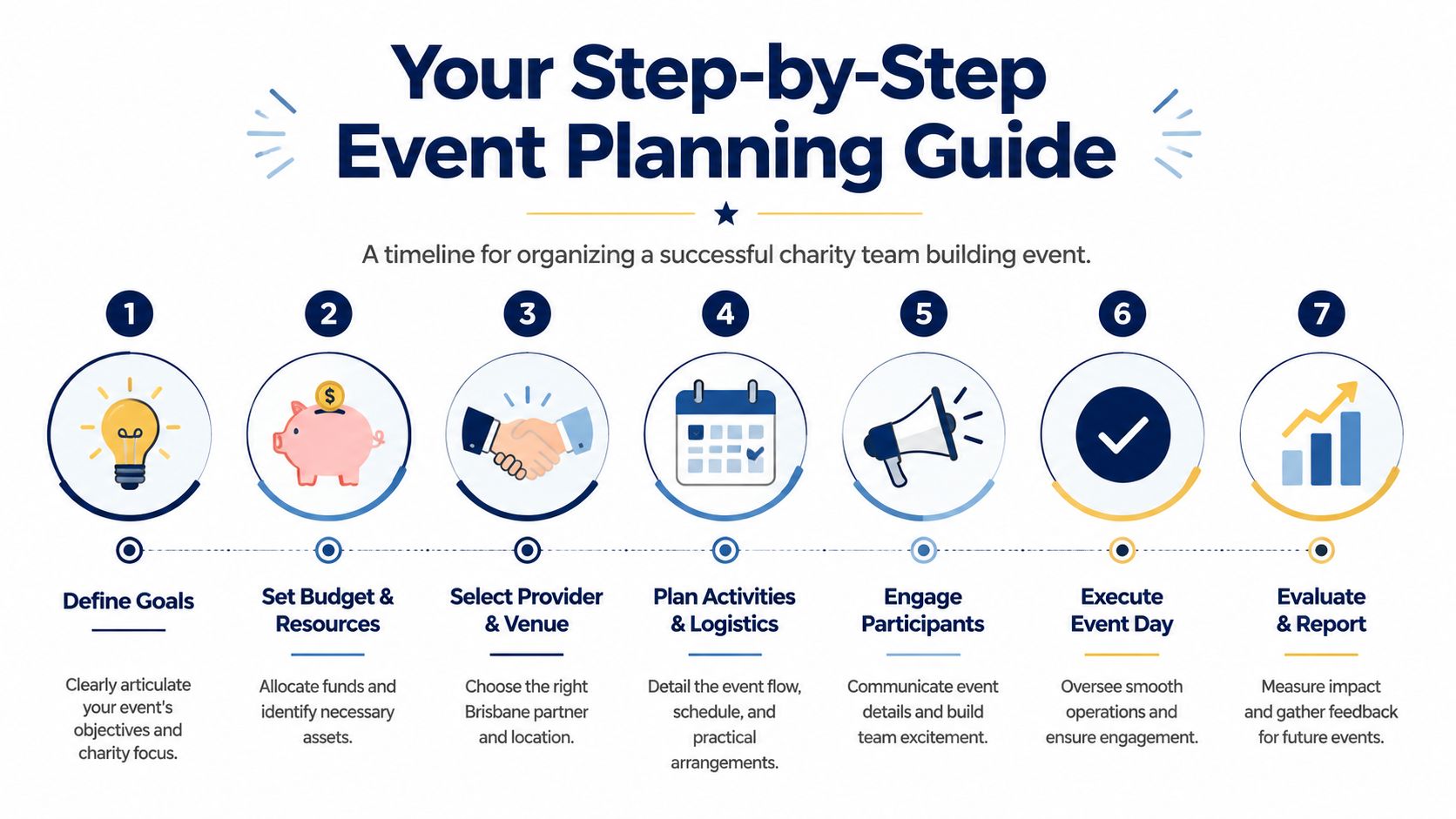
Your Step-by-Step Event Planning Guide
A Brisbane leadership team signs off on a charity event because it sounds positive, then asks two fair questions a week later. What will this do for our people, and how will we show it was worth the spend? Strong planning answers both before anyone books a room or orders materials.
Start with dual objectives
Set the brief in two parts. First, define the business result. That might be better cross-functional interaction, a stronger conference midpoint, a morale reset after a hard quarter, or a more deliberate mix of senior leaders and frontline staff. Then define the community result. Choose the cause, the form of contribution, and the standard of charity partnership that will feel credible internally.
This is the gap many organisers miss. A feel-good event can still underperform if leadership cannot connect it to team outcomes, and a tightly run team activity can still fall flat if the charity element feels tokenistic. The plan needs both.
Budget decisions become clearer once those two outcomes are written down. Office-based programs usually suit teams that want a shorter format and lower venue complexity. Fully hosted events suit groups that need catering, stronger production support, or a conference-style experience. The cost difference is real, but so is the difference in setup time, AV needs, transport planning, and facilitator coverage.
Shortlisting providers early helps. It gives procurement, HR, and internal sponsors something concrete to assess before the event starts absorbing venue and catering costs. A practical reference point is this guide to choosing a charity team building program, especially when approvals depend on more than enthusiasm.
Build the event around operational reality
The fastest way to lose value is to assume the room, run sheet, and charity handover will sort themselves out. They rarely do.
Construction formats need wider table spacing, unpacking zones, and a clean path for moving completed items. Packing programs are easier on space but still need disciplined flow if hundreds of components are being distributed, assembled, checked, and boxed. Creative formats reduce physical pressure on the venue, yet they often need tighter briefing so the purpose does not get lost in the activity.
Space planning should be tested against the actual mechanics of the program, not the venue brochure. I usually want floorplans, bump-in times, access points, and storage confirmed before the event is sold internally as simple. That is also the point to review manual handling, trip hazards, loading dock restrictions, and what happens if donated goods need temporary holding before collection. Teams can use ABCO Security risk assessment insights to structure that review properly.
A practical planning checklist keeps the event commercially and operationally sound:
Choose a date with energy in it: avoid quarter-end, peak delivery windows, and conference agendas that already leave people flat.
Write a one-page event brief: include team objective, charity objective, audience profile, budget range, and success measures.
Confirm the charity handover process: document who receives the items, where the handover happens, and whether photography or internal comms approval is needed.
Check venue constraints early: access hours, loading rules, noise limits, wet weather contingencies, and pack-down timing affect format choice.
Brief participants like adults: explain the cause, the reason this activity was selected, and what a good team outcome looks like.
One sentence in the staff comms can change participation rates. If the event is framed as forced fun, people brace for it. If it is framed as a structured activity with a clear team purpose and a real community outcome, resistance drops.
Finish with evidence, not just photos
The event is not finished when the donation is handed over. The final job is to document what happened and what it achieved.
Capture participant feedback while the experience is fresh. Get confirmation from the charity on what was delivered. Then produce a short internal report that covers attendance, the nature of the contribution, key engagement themes, and whether the event met the original business objective. For senior leaders, that closes the loop between CSR spend and team impact. For organisers, it creates a better benchmark for the next event.
That follow-through is what separates a pleasant afternoon from a program the business can justify repeating.
Selecting the Right Brisbane Provider and Venue
A provider can make a charity event feel smooth or fragile. The difference usually has less to do with the activity concept and more to do with facilitation depth, charity coordination, and how much operational responsibility the provider is prepared to carry.

What separates a partner from a supplier
Professional providers generally work to a clear event structure. In Brisbane, leading providers follow a standardised 3 to 4-hour methodology that includes briefing, group formation, the core task, and a handover to the partner charity, with post-event feedback capture as a distinguishing feature. That sounds simple, but it's one of the clearest ways to judge professionalism.
A supplier can deliver materials. A partner can manage flow, explain the cause, adapt to the room, handle handover moments and collect usable feedback. For corporate groups, that distinction matters more than a slightly lower quote.
One market option is Corporate Challenge Events, which runs conference and team event formats in Brisbane and can be assessed against the same criteria as any other provider. The key is not the brand name. It's whether the provider can show operational discipline and a credible link between play-based engagement and workplace outcomes.
Questions worth asking before signing
A strong provider conversation should move past “what activities are available?” and into event mechanics. Useful questions include:
How do you brief the supported charity? The quality of that story affects authenticity.
Who manages charity liaison? Corporate organisers need clarity on who coordinates beneficiaries, delivery and handover.
How do you facilitate mixed groups? Many events include executives, new starters, introverts and operational staff in the same room.
What feedback do you collect afterwards? Without this, ROI reporting becomes guesswork.
What changes if numbers shift? Group size changes are common in conference settings.
Venue decisions that affect delivery
The venue should support the format, not just impress stakeholders. A polished room with poor loading access, awkward columns or limited storage can undermine a build event quickly. Access matters. So does the ability to stage a handover with enough visibility and emotional weight.
For indoor Brisbane events, organisers should check practical conditions before approving a room:
| Venue Factor | Why it matters for charity events |
|---|---|
| Floor space | teams need room to move, collaborate and store materials safely |
| Access and loading | bikes, furniture or kits must arrive and leave without disruption |
| AV capability | the briefing and charity context need to be heard clearly |
| Breakout flexibility | teams work better when layouts can shift during the session |
| Accessibility | inclusion should be built into the format and the room itself |
The best Brisbane provider-venue combinations feel calm because someone has already accounted for the friction points. That's rarely visible in a proposal, but it becomes obvious on the day.
Measuring the Dual Impact of Corporate Giving
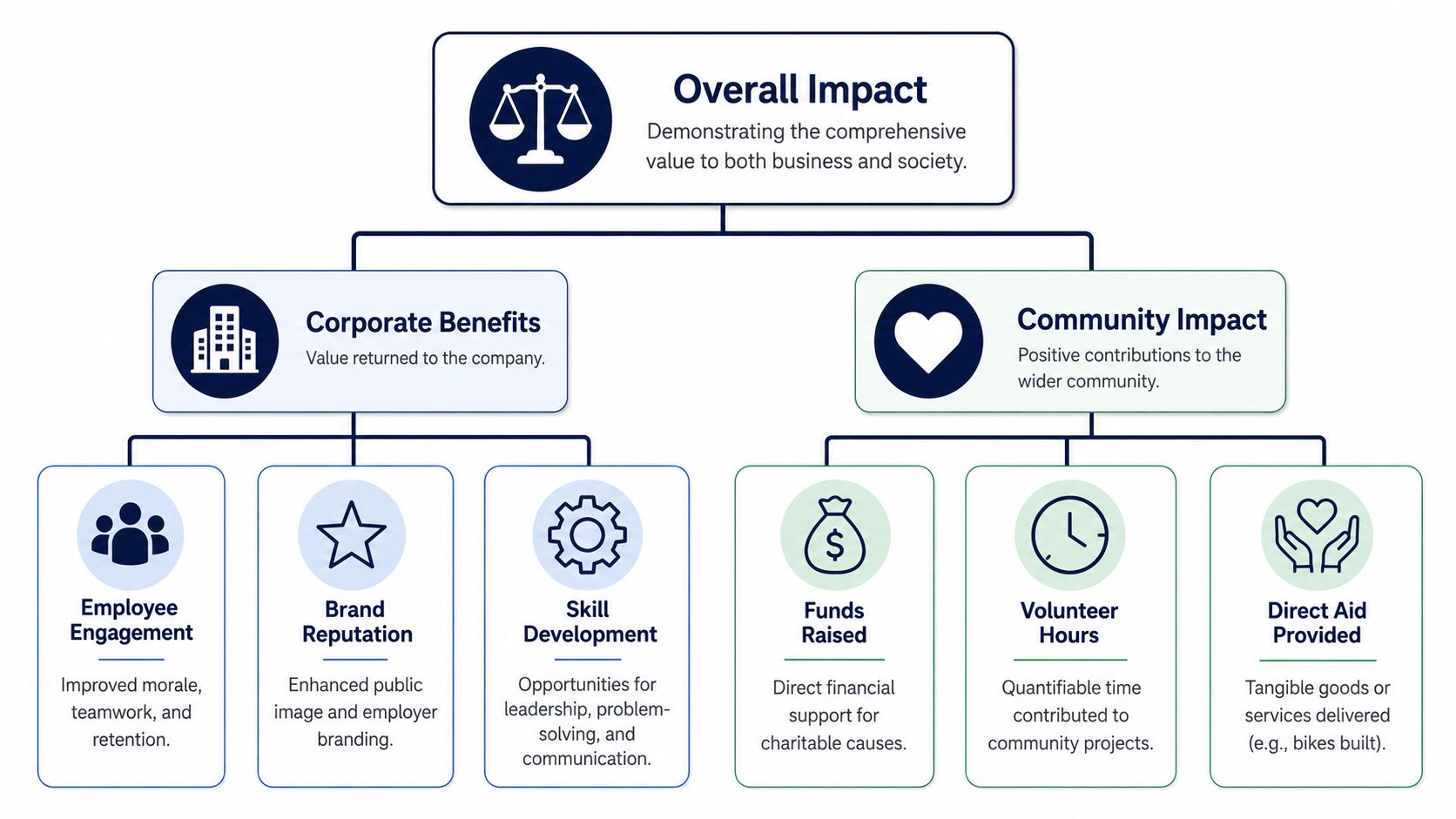
A Brisbane leadership team signs off on a charity team event, the room responds well, the donation is handed over, and then the CFO asks a fair question a week later. What changed inside the business, and what did the community receive for the spend?
That reporting gap is where many charity events lose momentum. If measurement starts after the event, the report usually collapses into photos, anecdotes, and a donation total. Senior leaders need more than that.
Measure the team outcome
Track internal impact with a short pre-event and post-event pulse. Keep it tight enough that people complete it, but specific enough that the results can guide future event choices.
Useful questions usually sit across four areas:
Connection: do participants feel more connected to colleagues outside their day-to-day team?
Communication: did the session reveal how the group shares information, solves problems, or works under time pressure?
Purpose: did the activity strengthen belief that the organisation contributes beyond revenue targets?
Engagement: did people leave with more energy, clarity, or willingness to participate in future cross-functional work?
Numbers on their own are not enough. Pair the pulse with a few manager observations from the day. Note whether quieter staff contributed more in practical build tasks, whether senior leaders mixed properly with the group, and whether teams self-organised or waited for direction. Those patterns help explain why one format performed better than another.
Measure the community contribution
Community impact should be counted in outputs that a leadership team can verify. For Brisbane organisers, that usually means recording the number of completed items, the receiving charity, the intended recipients, and the handover date.
That level of detail matters because not every charity format produces the same kind of value. A bike build gives a visible, countable result. A care-kit activation may support more recipients but need stronger explanation in the report. Furniture, solar light, and prosthetic-hand programs all carry different logistics, costs, and recipient outcomes. Good reporting makes those trade-offs clear instead of treating every donation activity as interchangeable.
Reporting advice: Count the items delivered, name the beneficiary, and record one or two specifics that show practical value. Skip vague language about “giving back” if you cannot tie it to an observable result.
Turn results into a budget-ready report
The final report should fit on one or two pages and answer three questions quickly. What happened in the room? What was delivered to the community? Should the business fund this format again?
A simple structure works well:
event objective and audience
attendance and participation rate
pre and post pulse summary
key observed team behaviours
items donated or aid assembled
beneficiary details and handover notes
recommendation for repeat, refine, or replace
This is also the point to connect the event to wider culture strategy. A practical explanation of the ROI of play in workplace culture and performance helps frame charity team building as a business intervention with community benefit, not just a social extra.
Teams that report both sides of the result get stronger budget conversations. Leadership can see the dual return clearly. The business gains evidence on engagement and collaboration, and the charity partner receives a documented, tangible contribution.
For organisations planning charity team building activities in Brisbane, Corporate Challenge Events offers play-based corporate programs that combine structured facilitation with practical community outcomes. Teams comparing providers can use the criteria above to assess fit, delivery style and reporting capability before locking in the next event.