
You have your result. What does it mean?
Your DOPE personality test results identify your dominant bird: Dove, Owl, Peacock or Eagle. This is the style your answers most closely align with, offering insight into how you prefer to communicate and work with others.
CCE’s free DOPE test gives you that individual result. The next step is understanding what it means in your working day, from the strengths you contribute to the support that helps you do your best work.
Understanding your DOPE personality test results
Dove
A dominant Dove result points towards a cooperative, considerate approach. You may pay close attention to how people are getting along and prefer working relationships built on trust. Listening, patience and dependable support are strengths associated with this bird.
At work, that could mean helping a new colleague settle in, checking how someone is coping with a change or bringing people from different departments together. You might notice that a colleague has stopped asking questions and offer a quiet opportunity to talk. Your contribution can be the care that helps someone participate confidently.
Colleagues may mistake your willingness to listen for agreement, or assume that because you are helpful, you always have capacity. You can make your position clear while keeping the cooperative tone you value: “I can help you work through the first part, but I can’t take on the whole task.”
The same approach can make feedback useful. For example: “I appreciate how much you put into the handover. Including the client’s outstanding questions would help me pick it up properly.” You can acknowledge someone’s effort and still explain what you need.
You may work particularly well where support is reciprocal and colleagues take your concerns seriously. Being able to disagree openly gives your care for the team a voice in how the work happens.
Owl
A dominant Owl result suggests a methodical, analytical approach, with a preference for clear information and accuracy. You may enjoy organising complex material, checking how things fit together and preparing thoroughly before starting.
For example, when reviewing a supplier brief, you might notice that the requested service and the quoted inclusions do not match. Asking for clarification protects the team from an avoidable misunderstanding. Colleagues can benefit from your ability to find the detail that changes the meaning.
That strength can also appear during a shared challenge, such as solving riddles as a group. You might spot a word that others have overlooked. Explaining why it matters gives everyone a way to build on your thinking.
At work, questions intended to improve accuracy can sometimes be heard as criticism. Explaining their purpose helps: “I’m checking which version we’re using so I can give the client the right information.”
You may find a written brief, access to source material and time to prepare particularly useful. When sharing complex information, start with what your colleague needs to understand, then provide the supporting detail. You could explain the key change in a procedure first and attach the full instructions. Agreeing on the depth required also helps others understand what your preparation involves.
Peacock
A dominant Peacock result is associated with an expressive, enthusiastic approach. You may enjoy talking with people, exploring possibilities and making an idea feel interesting to others. Building rapport and helping people engage are strengths you can bring to work.
You might make a client feel welcome, find a memorable way to explain a service or draw out ideas from colleagues who have different experiences. Your enthusiasm can help people see possibilities in work that has started to feel routine.
For example, if you work in marketing, you might enjoy gathering stories from colleagues and developing them into a campaign. A visible publishing plan, using a shared calendar or a tool for scheduling LinkedIn posts, can help carry those ideas through to publication.
Colleagues may hear an idea you are exploring aloud as something you have already committed to delivering. A simple distinction helps: “This is a possibility I’d like to explore. I haven’t checked the resources yet.”
You may appreciate opportunities to talk an idea through and receive a response. Asking “What would you add?” gives colleagues room to contribute too. A short written recap of what you have agreed can then support follow-through while preserving the energy and personal contact you enjoy.
Eagle
A dominant Eagle result points towards a direct, purposeful approach. You may prefer knowing what needs to be achieved and having the freedom to act. Taking initiative, setting priorities and giving clear direction are strengths associated with this bird.
For example, if a customer issue falls between two departments, you might take ownership of finding a resolution and clarify who needs to do what. Your willingness to act can be valuable when responsibility is unclear.
When delegating, use that clarity to explain the outcome and the authority someone has. “Please resolve the booking issue within this budget. You can choose the approach, and let me know if it needs approval beyond that.” This gives a colleague room to contribute their own expertise.
A short, direct message can sometimes leave others unsure about your intent. Adding a reason helps them understand the request: “Please call the client today so they have time to arrange transport.” You can stay concise and provide useful context.
Recognising a colleague’s specific contribution can be equally direct: “Your checks caught the address error before dispatch. Thank you.”
You may work best with a clear remit, agreed priorities and straightforward feedback. Knowing where you can act independently lets you put your initiative to good use without having to guess where your authority ends.
How to use your result with colleagues
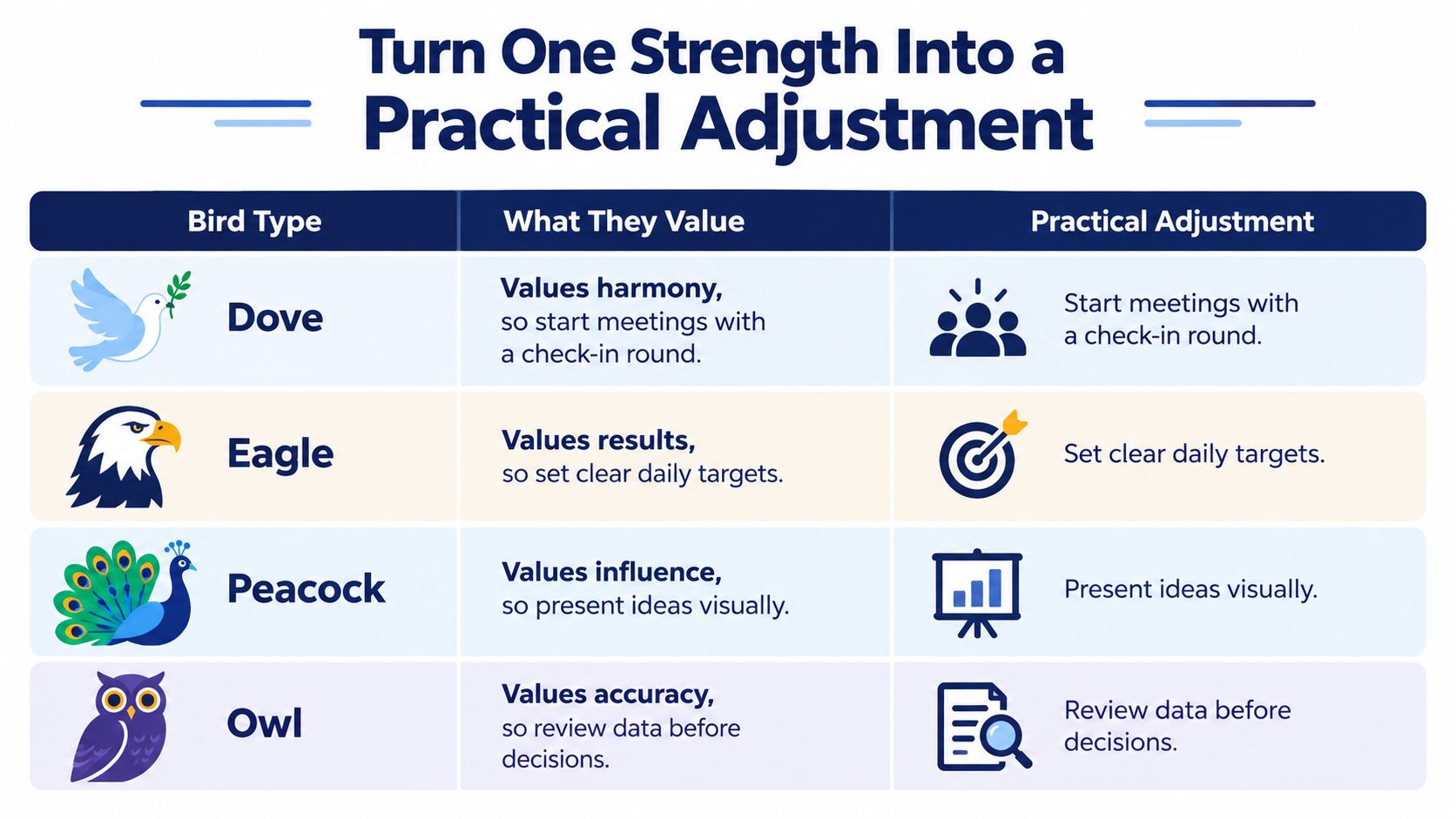
Choose a real situation where explaining how you work would help. You do not need colleagues to know their birds before having that conversation. Be specific about what makes a task easier and ask what helps them too.
For a new piece of work, you might say: “A written brief helps me check the requirements. Would a quick conversation be useful for you before we put it in writing?” You have explained a need and made room for theirs.
When asking for feedback, name what you want to understand: “Was there enough context in my handover for you to take over?” Their answer tells you more than assuming your preferred level of detail suits everyone. Our article on adapting communication with DOPE explores this further.
You can also offer a strength without taking over: “I’m happy to check the instructions. Which part would you like to handle?” Agree responsibilities based on interest, capacity and experience.
If you lead others, explain your own preferences as openly as you ask about theirs. Invite people to tell you when your approach makes work harder, and respond constructively when they do. That supports psychological safety at work, where people can ask questions or raise concerns without fear of being embarrassed or punished.
What your individual result cannot tell you about your team
Knowing your dominant bird does not reveal your colleagues’ preferences or explain every workplace difficulty. A brief reply might reflect a busy afternoon; a request for more information might reflect an incomplete brief.
Ask people about their approach rather than identifying their bird from behaviour. Keep work allocation grounded in skills, responsibilities and what people want to develop. Leaders can explore this further through our guidance on working with different personalities in a team. For broader background on the framework, read our guide to the four DOPE birds.
Explore further with DOPE for Teams
DOPE for Teams brings individual results together in a facilitated experience. Through interactive activities and discussion, colleagues can explore differences in how they approach a task, hear what helps each person contribute and identify practical ways to work together.
Delivered by Corporate Challenge Events, the one-hour interactive workshop is available online or in person across Australia and New Zealand. It gives your team dedicated time to discuss the preferences behind their results and agree how to use that understanding in their work.
Explore DOPE for Teams to bring that conversation to your team.