
It will come as no surprise that we saved Play until last in our four-part FISH! Philosophy series.
After all, we live, breathe and advocate for play every day. It sits at the heart of our purpose, the Power of Play, shapes the experiences we create for teams and underpins our exclusive partnership with the National Institute for Play.
So yes, we may be a little biased. But we also know Play is one of the most misunderstood ideas in the workplace.
Mention Play at work and people often picture games, prizes, ping-pong tables or an overly enthusiastic facilitator asking everyone to “loosen up”. That is not what the FISH! Philosophy means by Play.
Play is the curiosity that makes someone say, “Let’s try looking at this differently.”
It is the humour that releases tension during a difficult week. It is the freedom to test a rough idea before it is perfect. It is the energy that brings people back into a conversation they had mentally checked out of 20 minutes ago.
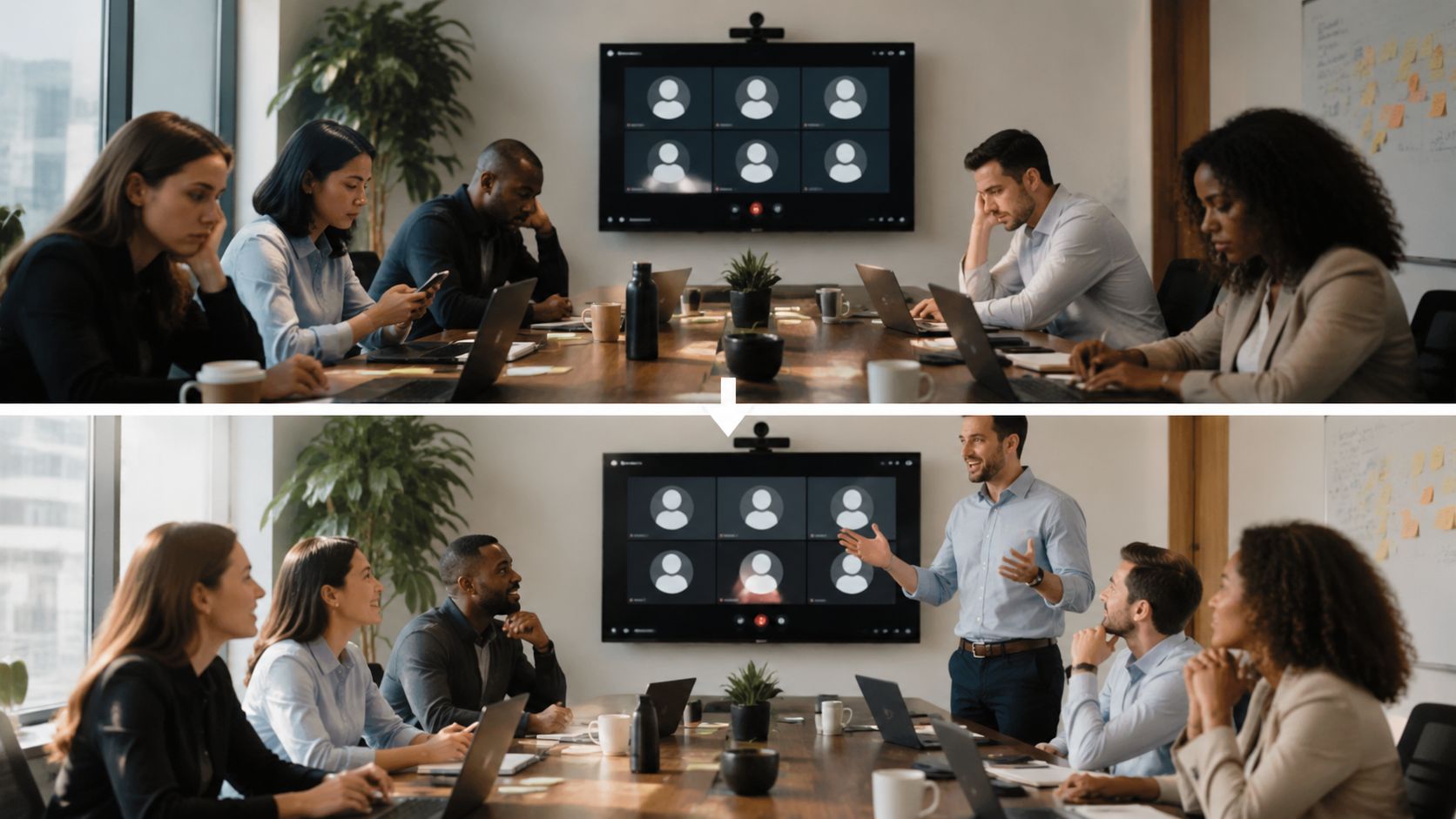
Picture a familiar Monday status meeting.
The same three people are talking. Everyone else appears to be listening while quietly answering messages. Updates are delivered, boxes are ticked and nobody leaves knowing much more than they did when they arrived.
Then the leader changes the prompt.
Instead of asking for another update, they invite the team to sketch the problem, describe it through a ridiculous metaphor or build a rough version of an idea before explaining it.
The room changes.
People sit forward. Different voices enter the conversation. The team stops defending what it already knows and starts exploring what might be possible.
That is Play at work.
It does not make the work less serious. It changes the way people engage with it.
Used poorly, workplace Play produces eye-rolls. Used with purpose, it can help people communicate more openly, think more creatively and feel more connected to the people around them.
We explore the evidence more deeply in the science behind play. In this final article, we are looking at what Play means within the FISH! Philosophy, what it definitely does not mean and how leaders can make it part of the everyday working experience.
What Play Means in the FISH! Philosophy
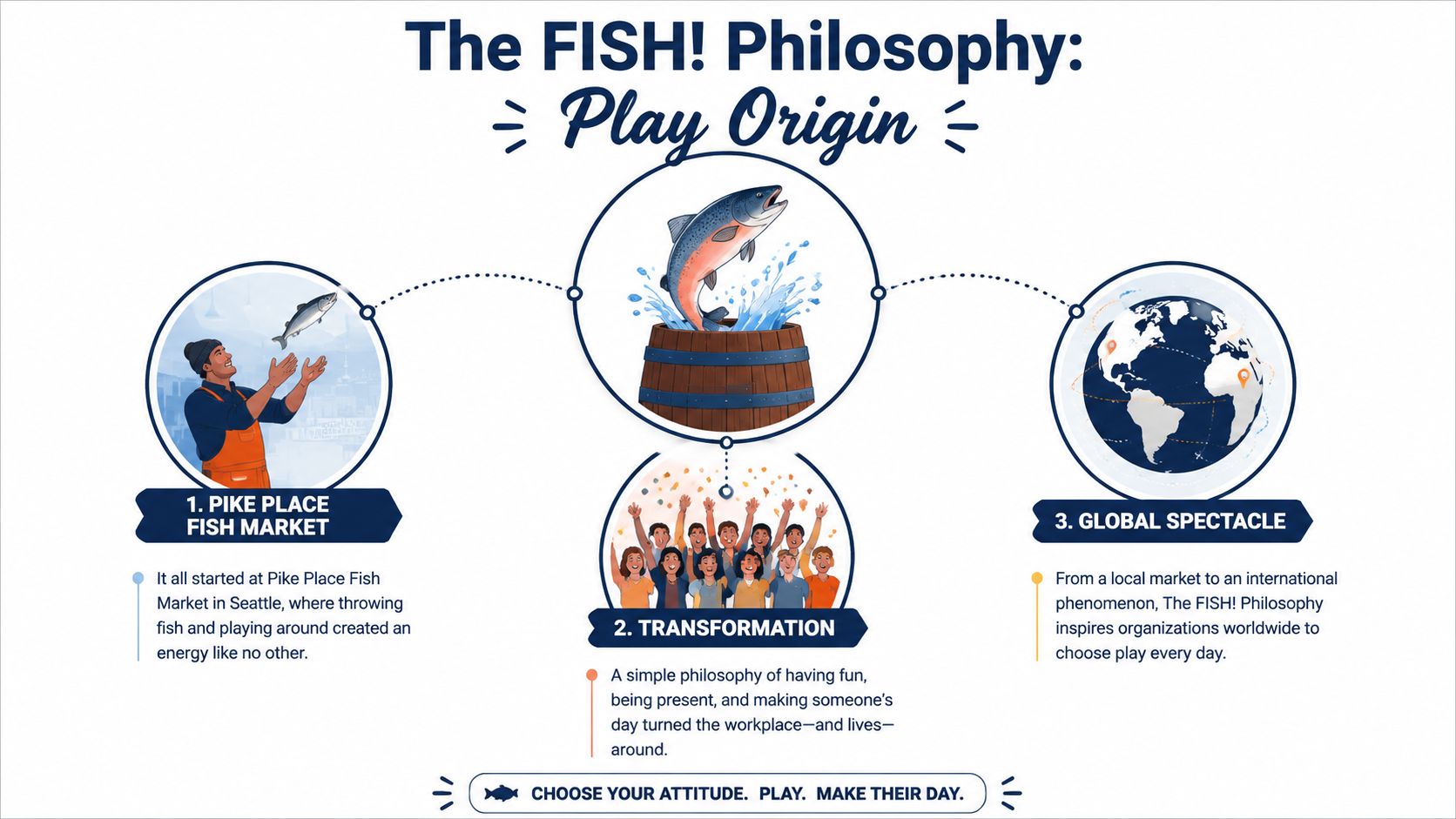
The story of FISH! began when filmmaker John Christensen visited Seattle’s Pike Place Fish Market in 1997.
The work he saw was cold, physical and repetitive, but the fishmongers brought energy, attention and personality to it. They threw fish, involved customers and found ways to make an ordinary transaction memorable.
That experience led to the FISH! film and four practices now used by teams around the world:
Be There: Give people your full attention.
Make Their Day: Find meaningful ways to improve someone else’s experience.
Choose Your Attitude: Take responsibility for how you respond, even when the situation itself is not your choice.
Play: Bring creativity, enthusiasm, curiosity and fun to what you do.
You can read more about how the four practices fit together in our introduction to the FISH! Philosophy.
The official FISH! description of Play is wonderfully simple:
“Tap into your natural way of being creative, enthusiastic and having fun. Play is the spirit that drives the curious mind, as in ‘Let’s play with that idea!’”
The last sentence matters.
Let’s play with that idea does not mean the work has stopped. It means judgement has been paused long enough for people to explore.
That might look like trying an unfinished idea, looking at a problem from an unexpected angle, sharing a laugh during a difficult day or finding a more engaging way to complete a familiar task.
The work is still real and the standards still matter. Play simply changes the energy and thinking people bring to it.
This is also what separates purposeful play from fun added for fun’s sake.
Purpose does not mean squeezing every spontaneous moment for a measurable return. It means understanding why a playful approach belongs in that particular moment and making sure it supports, rather than distracts from, the people and the work.
The practice also depends on the other three. Play without presence can become distraction. Play without generosity can feel self-centred. Play without intentional attitude can disappear as soon as pressure rises. Leaders looking for a concise explanation of the philosophy can use Corporate Challenge Events' overview of the FISH! Philosophy, while teams exploring the difference between entertainment and purposeful play can use that resource to sharpen their language.
Play Is a State Not an Activity
One of the most exciting things about Play is that it can show up almost anywhere.
It can happen during a team-building program, around a table, while solving a complex problem, in a quick exchange between colleagues or halfway through a meeting that suddenly takes an unexpected turn.
That is because Play is not defined by one particular activity. The National Institute for Play describes it as a biological state that arises when we are freely engaged, curious and absorbed in what we are doing.
You know the feeling when it happens. People become more animated. Conversation flows more easily. Ideas build on one another. Time moves quickly and the team becomes completely involved in the experience.
The activity is what helps open the door, but the state of Play is what happens when people step through it.
The National Institute for Play’s foundations of play explain that Play is shaped by both the person and the context. The same experience may bring out curiosity, humour, imagination, movement or problem-solving in different people. There is no single correct way to Play.
This is why variety matters when creating playful experiences for a team. Some people light up when there is movement and friendly competition. Others become absorbed in building, solving, imagining, performing or working alongside others towards a shared goal.
The aim is not to make everybody Play in exactly the same way. It is to create enough different entry points for people to discover how they naturally become curious, connected and involved.
When that happens, Play can bring new energy into the way a team works. It can help people:
contribute ideas before they are perfectly formed
approach familiar problems from a different direction
communicate with colleagues they do not usually work alongside
become more comfortable experimenting
build on one another’s thinking
reconnect with the enjoyment of achieving something together
These outcomes matter when only 21% of Australian employees are engaged at work, while 50% report experiencing stress and 14% report experiencing loneliness a lot of the previous day.
Play gives leaders a practical way to create more moments of energy, involvement and human connection within the working day. It is also one of the four practices explored through the FISH! Philosophy workshop, where teams learn how Play can become part of the way they communicate, collaborate and approach their work together.
Play at work is also receiving serious academic attention. An integrative review led by an Australian National University researcher brought together existing research to examine what workplace Play is, when people engage in it and how it can influence workplace outcomes.
The practical opportunity for leaders is to think beyond Play as a moment on the agenda. A well-designed activity can create the spark, but the real value comes when that curiosity and openness begin to influence what the team does next.
It could be the confidence to offer an unfinished idea, the willingness to try a different approach or the connection that makes working through the next challenge feel easier.
That is when Play becomes more than something a team does.
It becomes part of how the team works.
Our guide to what Play really means explores this state in more detail and explains why Play remains an important part of life and work at every age.
Why Play Is Difficult in the Modern Workplace
Most leaders are not against curiosity or creativity. They are simply working inside systems that reward speed, certainty and visible output.
When calendars are packed and every meeting is urgent, exploration can look inefficient.
When mistakes are remembered more readily than lessons, people learn to present polished answers rather than unfinished thinking.
When the most senior voice speaks first, everyone else quickly works out which ideas are safest to share.
Then there is the long shadow cast by forced fun.
Many employees have experienced an activity that was presented as playful but felt awkward, exposing or compulsory. That history matters. Asking someone to “loosen up” does not create Play. It usually creates another performance they have to manage.
Australian workplace wellbeing data reinforces why a superficial response is not enough.
SuperFriend’s 2026 study gathered responses from more than 12,000 employees across all 19 ABS-recognised industries. Connectedness was the strongest of its five workplace wellbeing domains, scoring 75.7 out of 100, while capability was the lowest at 62.
More than one in seven workers reported severe workplace psychological distress, and 25.2% described themselves as completely burnt out. You can explore the findings in this summary of Australia’s largest workplace wellbeing study.
Those figures are not an argument for adding compulsory games to an exhausted team’s calendar. They are a reminder that Play must sit alongside reasonable workloads, good work design, capable leadership and psychological safety.
Common barriers to workplace Play
| Barrier | Manifestation | Impact on team |
|---|---|---|
| Time pressure | Every interaction is compressed into updates and decisions | People stop exploring alternatives |
| Fear of mistakes | Employees wait for certainty before contributing | Early ideas remain hidden |
| Rigid meeting habits | The same agenda and format appear regardless of purpose | Attention and participation decline |
| Forced fun | People must join public games or perform enthusiasm | Resistance replaces connection |
| Output-only management | Leaders value visible activity over learning | Experimentation becomes risky |
The strongest response isn't to add more demands to an overloaded calendar. Start by changing one interaction that already exists. Our ideas for fitting Play into a busy workweek are designed around that principle.
What Play Looks Like in Practice
Play at work is often quieter than people expect.
It can be a project team building a rough prototype instead of debating an abstract idea for another hour.
It can be a facilitator asking people to sketch a customer problem before discussing it.
It can be a manager taking a recurring conversation outside, changing the pace and giving people room to think differently.
It might also sound like:
“Let’s play with this before we decide.”
“What would the deliberately terrible version look like?”
“If this problem were a relay race, where are we dropping the baton?”
“Can we build a rough version and see what we learn?”
“What would we try if the first attempt did not need to be perfect?”
These prompts work because they temporarily reduce the pressure to be right. They give an idea enough room to become visible before the team evaluates it.
Play can also make difficult conversations easier to enter.
Describing a broken process as an escape room with missing clues or a recipe with three competing chefs can help a team talk about system problems without immediately blaming an individual.
The metaphor does not replace evidence, accountability or a decision. It opens a different door into the conversation.
Small behaviours that invite curiosity
Sketching or building an idea: Visual thinking helps people contribute before they have a polished verbal explanation.
Testing a rough version: A bounded experiment turns uncertainty into something the team can inspect.
Changing the meeting format: A walking discussion, rotating facilitator or hands-on prompt can interrupt stale habits.
Using movement or visual prompts: Participants gain alternatives to speaking first or speaking at length.
Allowing appropriate humour: Humour can reduce tension when it doesn't target a person, identity or mistake.
Celebrating learning: Recognising what an unsuccessful experiment revealed reinforces exploration without pretending the result was successful.
Our collection of play-based learning activities for adults offers practical formats, but the activity is always the vehicle, not the destination.
Play is not mandatory fun, constant positivity or an excuse to avoid serious conversations. It doesn't remove accountability, repair an unreasonable workload by itself or require every employee to participate identically. Professionalism and Play aren't opposites. Professionalism establishes standards, while Play gives people more flexible and creative ways to meet them.
Turn Play Into a Team Habit
Leaders can embed Play without creating another recurring initiative. The practical rhythm is to use existing meetings and deliberately adjust one condition at a time.
Notice where energy or curiosity has become flat. Choose a routine interaction where people are disengaged, over-cautious or repeating information without learning.
Invite a different approach. Ask for a sketch, metaphor, prototype, movement-based discussion or alternative format. Explain that the purpose is to explore, not to perform.
Join the team rather than watching. A leader who stays outside the activity can make it feel like an assessment. Participation signals that experimentation applies to everyone.
Reflect on what changed. Ask which contributions became easier, what the team noticed and whether the method improved the conversation.
Repeat what felt genuine and useful. Keep the elements that support the work and drop those that create awkwardness, pressure or distraction.
The habit should remain small enough to survive a busy week. Before a familiar task or meeting, a leader can ask:
Useful habit: “What is one small change that would make people more curious or involved?”
Inclusion matters here. An invitation to Play should still be an invitation.
Give people options and consider what will work for remote, frontline, neurodiverse, mixed-age and culturally diverse teams. Check whether the format rewards extroversion, public humour, fast thinking or physical ability at the expense of other ways of contributing.
Our article on why permission to Play is a leadership skill explores this responsibility in more depth.
Real permission includes the freedom to engage in a way that feels safe and genuine.
The Four FISH! Practices Work Together
There is a reason Play belongs alongside the other three FISH! practices.
Play without Be There can become noise or distraction.
Play without Make Their Day can become fun for a few people at someone else’s expense.
Play without Choose Your Attitude can disappear the moment the work becomes difficult.
Together, the four practices create something much more useful.
People are present with one another. They consider the experience they are creating for others. They take responsibility for the energy they bring. And they remain curious enough to find new possibilities in familiar work.
Perhaps that is why Play was the right place to finish this series.
It is easy to think of Play as the lightest FISH! practice. In reality, it asks something quite brave of a team: to loosen its grip on certainty, make room for unfinished ideas and trust one another enough to explore.
The work does not become less serious. The team simply becomes more alive while doing it.
Corporate Challenge Events delivers an accredited FISH! Philosophy workshop that helps teams put all four practices into action. We also design play-based workplace culture, conference and team-building experiences that turn the ideas into something people can feel, discuss and carry back into everyday work.
To hear directly from the filmmaker who started it all, join us for More Than Flying Fish with John Christensen on Monday, 14 September at 11:00 am AEST.
Register for the free Play Lab session.
Leaders can start by changing one familiar interaction this week, then observe whether the team becomes more curious, connected and willing to experiment. Explore play-based team building, FISH! Philosophy workshops and customized workplace programs with Corporate Challenge Events to help teams communicate, connect and create with greater purpose.