Conference organisers rarely get ideal conditions. A room designed for presentations suddenly needs to support conference team building activities, hundreds of people must be included and a single session is expected to lift the energy of the entire agenda.
The popular choice is not always the right one. An activity can look impressive in a proposal and still fail because it takes too long to explain, needs more floor space than the venue can provide or suits only the most confident people in the room.
The better approach is to start with the job the session needs to do. When the activity matches the outcome, schedule, group size and venue, it becomes a useful part of the conference rather than entertainment squeezed between presentations.
Start With the Role the Activity Needs to Play
A conference activity works best when it has one clear purpose. That might be helping people meet colleagues from other departments, restoring energy after a long presentation block, improving communication, encouraging problem-solving or creating a shared experience across the organisation.
Trying to achieve everything at once usually produces a vague brief. Choose one primary outcome, then allow one or two secondary benefits to sit behind it.
For example, a session designed to connect people from different offices needs a different structure from one intended to practise decision-making. A social, high-energy format may suit the first group, while the second needs a challenge that makes planning and communication visible.
Organisers who are unsure whether they need an experience or a facilitated development session can begin by comparing a team activity with a workshop. The distinction helps narrow the format before program selection begins.
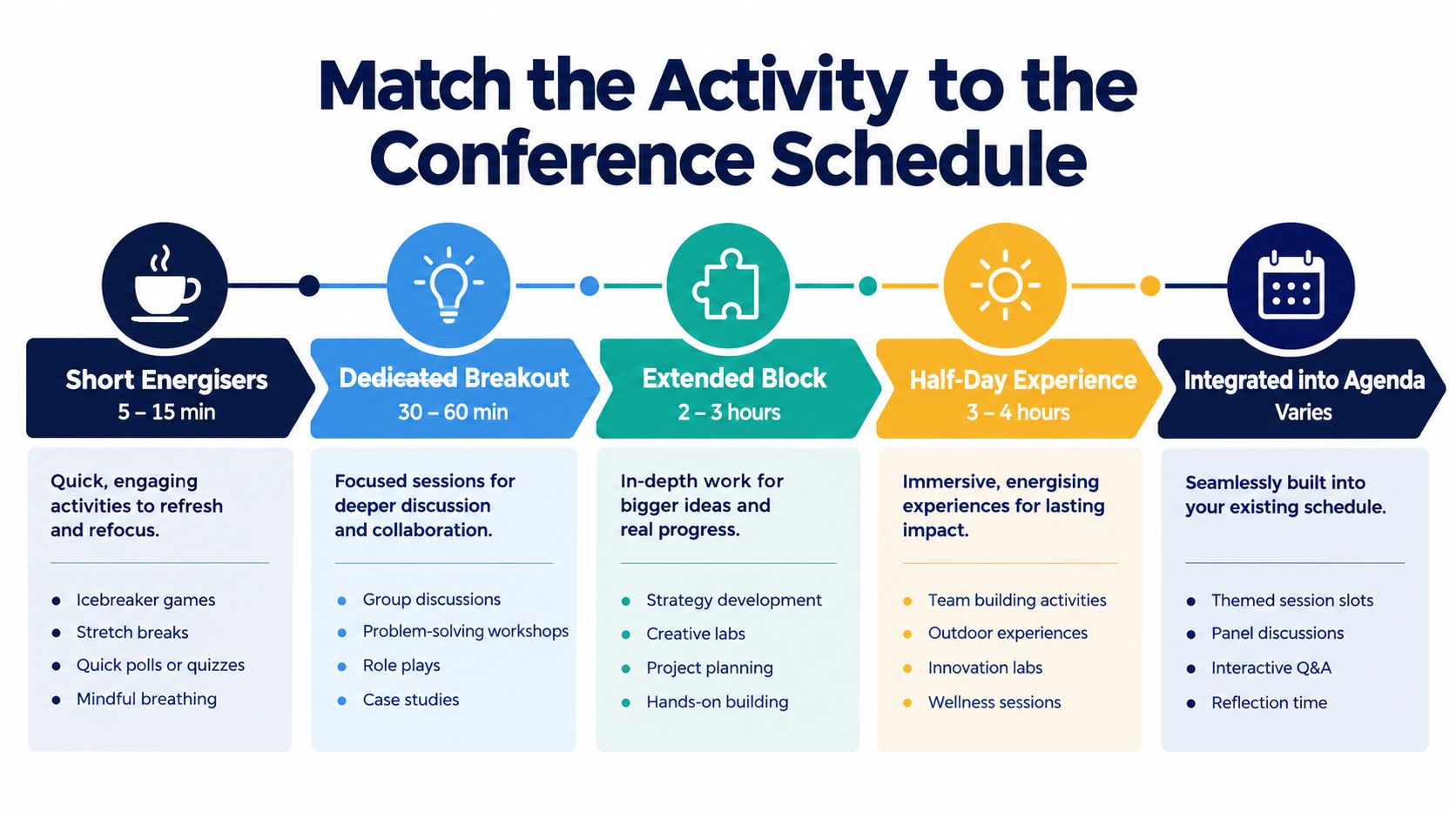
Match the activity to the available time
The conference schedule should determine the size of the activity, not the other way around. Briefing, team formation, participation, debriefing and pack-down all need to fit inside the allocated block.
Short conference blocks
Short sessions need simple mechanics and very little movement between spaces. Minute to Win It can provide a quick energy lift through a series of accessible challenges, while Play Offs gives groups repeated opportunities to interact through varied activities.
These formats work well when the aim is to wake up the room, mix participants or create a clear change of pace. The organiser still needs to allow time for instructions and team allocation rather than treating every advertised minute as activity time.
Dedicated breakout sessions
A longer breakout allows more complex instructions, stronger interaction and a proper debrief. This is where organisers can move beyond energy and work with communication, problem-solving or leadership. Participants have time to understand the task, test an approach and reflect on what happened.
Extended and outdoor sessions
Half-day or precinct-based experiences create more room for movement and richer team interaction, but they also place greater demands on transport, weather planning and return times. Evening activities need to work around catering, networking and service schedules rather than competing with them.
Planning backwards from the next fixed agenda item is often the safest method. This guide to structuring a conference agenda provides a useful wider planning reference. Catering should be mapped into the same timeline. Even guidance on coordinating coffee catering for an event shows how menu choices and service arrangements can affect delegate movement and session timing.
Use structured challenges for communication and problem-solving
Some of the most useful corporate conference activities are not the loudest. They are the ones that require teams to share information, divide responsibilities and adjust when their first plan does not work.
LEGO Legends makes interdependence visible. Participants need to interpret information, communicate accurately and contribute to a shared build. The activity can expose where instructions become unclear and how quickly a team checks its understanding.
Risk Reward places teams in a different decision-making environment. Participants weigh options, manage limited information and decide how much risk to accept. The value comes from discussing the process afterwards, including who influenced decisions, how assumptions were tested and what changed under pressure.
A short challenge will not permanently transform team performance, but it can give people a practical example to discuss. CCE's explanation of a creative problem-solving model can help connect the activity to workplace behaviours without overstating what a single session can achieve.

Give the debrief a clear purpose
Not every conference activity needs a lengthy reflection. A short energiser may only need a quick close before the agenda moves on. A session designed around communication or leadership should reserve enough time to help participants connect the challenge with their work.
Useful questions include: What information did the team need earlier? Which roles emerged naturally? What happened when the first plan failed? Who helped the group regain direction? The facilitator can then connect those observations with the conference theme or the behaviours leaders want to encourage.
The debrief should remain specific to what participants experienced. Broad claims about trust, culture or performance can make a straightforward activity feel inflated. Two or three precise observations are more useful than trying to turn every challenge into a major workplace breakthrough.
Use movement without losing control of the agenda
Outdoor and precinct-based activities can provide a welcome change after hours of presentations. They work best when the venue has easy access to a courtyard, park or surrounding area and the route can be managed within the conference timetable.
AppVenture uses technology to guide teams through challenges while allowing the experience to be adapted to the location. City Scramble gives teams a broader urban challenge that combines navigation, communication and decision-making.
Before choosing either format, confirm:
-
How long participants need to leave and return to the venue
-
Where teams are permitted to go
-
How progress and location will be monitored
-
Which routes are accessible
-
What happens if the weather changes
-
Where participants regroup at the end
-
How the facilitator will return everyone on time
The wet-weather option needs to be credible, not a rushed substitute created on the morning of the event. If the outdoor format cannot move indoors, the organiser needs a clear decision deadline and an alternative program.
Scale the design for large conference groups
Dividing a large audience into smaller teams does not automatically make the session manageable. Large groups need clear briefing, visible team identification, sufficient equipment and enough activity zones to prevent long periods of waiting.
Sound also becomes part of the activity design. If participants cannot hear the instructions, the room loses momentum before the challenge begins. Facilitator numbers, team rotations and scoring systems need to be designed for the actual attendance figure rather than a rough estimate.
This guide to team-building ideas for large groups provides further guidance on choosing formats that can scale without leaving sections of the room watching from the sidelines.
| Conference need | Activity style | Possible program | Main planning consideration |
| Fast energy lift | Short team challenges | Minute to Win It | Keep instructions and scoring simple |
| Varied interaction | Rotating activity stations | Play Offs | Reduce waiting and keep teams moving |
| Communication | Structured collaborative task | LEGO Legends | Give participants clear, useful roles |
| Decision-making | Choice-based challenge | Risk Reward | Explain scoring and consequences clearly |
| Managed precinct movement | Technology-supported route | AppVenture | Set boundaries and return times |
| Extended urban challenge | Location-based team experience | City Scramble | Confirm access, weather plans and regroup points |
Large-format sessions should give participants something useful to do throughout the experience. A program is not properly scaled if half the group is consistently waiting for another team to finish.
Check the venue before confirming the program
A conference room can hold hundreds of people in theatre style and still be unsuitable for an interactive session. Once staging, seating, AV equipment and catering stations are included, the usable floor area can shrink quickly.
Before booking, confirm:
-
Clear floor space in the proposed layout
-
Whether furniture can be moved
-
Power and AV access
-
Ceiling height and noise restrictions
-
Equipment load-in arrangements
-
Setup and pack-down windows
-
Outdoor access and weather alternatives
-
Accessible paths through every activity area
The venue should be assessed against the activity rather than relying on its maximum advertised capacity. This checklist for confirming whether a venue can support team building can help organisers ask the right operational questions early.
Design for the people in the room
A conference audience may include different levels of seniority, physical abilities, cultural backgrounds, working styles and confidence. Participation should not depend on being fast, loud or comfortable performing in front of colleagues.
The strongest activities provide several legitimate roles. Participants might plan, communicate, build, check, organise, encourage or keep track of time. This widens participation without lowering the challenge for the group.
It is also worth considering the audience's previous experience of workplace activities. Employees often object to poor design or forced public participation rather than rejecting collaboration itself. The discussion of why employees can resist team building provides a useful lens for avoiding formats that embarrass or exclude people.
The broader engagement picture reinforces the need to design carefully. The People at Work 2025 findings reported that only 16% of Australian employees were fully engaged. A conference activity will not solve workforce engagement on its own, but it can give participants a genuine role in a day that might otherwise require them to sit and listen for hours.
Questions to ask before booking
Before approving a program, confirm:
-
What is the primary purpose of the session?
-
How many people will participate?
-
How much time is genuinely available?
-
Will participants already know one another?
-
What room layout has been confirmed?
-
Are there mobility, sensory or accessibility requirements?
-
What level of physical activity suits the group?
-
Is additional AV or power required?
-
What is the wet-weather plan?
-
How will the session connect with the wider conference?
-
Is a facilitated debrief required?
-
How much setup and pack-down time is available?
These questions turn a broad request for something interactive into a usable event brief.
Choose an activity that earns its place in the agenda
The best conference team building activity is not necessarily the biggest, loudest or most elaborate. It is the one that fits the audience, available time, venue and purpose of the event. A short activity may be enough to restore energy between sessions, while a longer facilitated program can create space for stronger communication, problem-solving and connection.
Start with what you want participants to experience, then choose an activity that can be delivered comfortably within the wider conference schedule. When the format suits the group and supports the agenda, team building becomes a valuable part of the conference rather than an interruption to it.
Corporate Challenge Events designs and facilitates conference team-building experiences that can be matched to time, group size, venue constraints, and the outcome a conference needs. If the next event needs a structured way to lift energy, improve connection, or keep a large room actively involved, visit Corporate Challenge Events to plan a facilitated conference team-building experience that fits the agenda rather than fighting it.