
A restructure can be completed on paper long before it is working in practice. Reporting lines change, roles move and departments merge, but people still carry the habits, loyalties and uncertainty of the old structure into the new one. The organisation may have a new chart. It does not automatically have a new team.
This is where team building after a restructure has a clear job to do. It cannot explain a decision leadership has avoided explaining, and it cannot remove genuine concerns about workloads, security or accountability. What it can do is help people form new working relationships, practise communication across changed boundaries and create an early experience of succeeding together.
The distinction is important. A social event may give people a welcome break, but a carefully chosen team experience can help the new structure become usable. The value is not in distracting people from the restructure. It is in giving them a practical way to begin working within it.
A new structure does not create trust
Restructures interrupt more than job titles. They change who people rely on, where decisions sit and which relationships carry influence. Even employees whose roles remain secure may be unsure about new expectations or reluctant to speak openly while the dust settles. Newly appointed leaders face their own challenge: they must establish credibility with people who may not have chosen the change or the team now around them.
Australian research into organisational change and trust found structural reorganisation particularly damaging to trust in management, reinforcing the importance of clear communication, consultation and employee involvement throughout change.
That is why the first post-restructure team session should not be framed as a celebration that everything is fixed. If people are still processing the change, forced positivity will feel tone-deaf. The more credible message is simpler: the structure has changed, the team is still forming, and this session is part of learning how to work well together from here.
Team building is not a substitute for change management
Before asking people to participate in team building, leaders need to complete the change work that only leadership can do. Employees should understand what has changed, why it has changed, how decisions were reached and what remains unresolved. Where consultation is required, it must be genuine. Fair Work guidance on consultation and cooperation reinforces the need to plan communication, consult affected employees and explain final decisions.
WorkSafe Victoria's guidance on organisational change also highlights regular communication, employee consultation and manager support as important controls when workplace change may affect psychological health. A team activity cannot compensate for silence, mixed messages or avoidable uncertainty.
The operational details count as well. Access to systems, calendars, shared channels and meeting invitations should be ready when the new team begins. Even a basic resource such as a step-by-step team invitation guide illustrates the small setup tasks that shape whether a transition feels organised or improvised. These details are not team building, but they create the conditions in which team building can be taken seriously.
For leaders still working through the broader transition, our guidance on supporting people through workplace change is a useful starting point before choosing an activity.
Decide what the new team needs first
Post-restructure team building becomes vague when it is expected to repair everything at once. Trust, role clarity, communication, morale and culture are connected, but they are not the same brief. Choosing one primary outcome gives the session a clear purpose and makes the debrief far more useful.
· Rebuild trust. Use this priority when people are guarded, relationships have been disrupted or employees are unsure whether it is safe to contribute honestly.
· Create connection across former teams. Choose this when two groups have been merged but still communicate, socialise and make decisions as separate camps.
· Improve information sharing. Focus here when new dependencies are creating missed handovers, duplicated work or decisions made without the right people involved.
· Build a shared way of working. Make this the priority when the team needs common expectations around ownership, communication, support and accountability.
The SCARF model for understanding workplace responses can help leaders think through what may be driving resistance. A change in status, certainty, autonomy, relatedness or perceived fairness can shape how a person enters the room. Recognising that context helps a facilitator create challenge without treating hesitation as negativity.
Choose a program that matches the gap
The right post-restructure program is not automatically the most serious workshop or the most energetic activity. It is the format that lets the group practise the behaviour it now needs. Leaders choosing between a facilitated conversation and an experiential challenge can use this guide to decide whether the team needs a team-building activity or workshop.
FISH for shared behaviours
FISH! works well when a newly formed team needs a common language for how people will show up for one another. Its four practices give the group something concrete to discuss and use after the session. Rather than asking the team to define an entire culture in one sitting, leaders can focus the conversation on a few visible behaviours they want to see in meetings, handovers and daily interactions.
The PLAY Principles for connection and ownership
The PLAY Principles suits teams that need to reconnect while also taking greater responsibility for the experience they create at work. It can open a more honest conversation about energy, inclusion and participation without turning the session into another formal change meeting.
LEGO Legends for communication across new boundaries
LEGO Legends gives people a shared problem that cannot be solved well through isolated effort. Participants must exchange information, interpret instructions and understand how their part connects with the wider task. For teams adjusting to new dependencies, the activity creates a visible example of what happens when information stays in one part of the system.
Bikes for Tykes for a unifying experience
Bikes for Tykes can help a reshaped group connect around a contribution beyond its internal uncertainty. The charity outcome gives the team a clear shared purpose while the build itself still requires communication, coordination and attention to quality. This can be especially useful when people need a positive first experience together without being pushed into personal disclosure.
Play Offs for energy between combined groups
Play Offs is a strong option when the immediate barrier is social distance. The varied challenges give people multiple ways to contribute and create quick points of connection across old team lines. The facilitation and team mix are important. If former departments simply compete against one another, the activity can reinforce the divide it was meant to soften.
Use discussion to connect the activity with work
The activity creates the experience. The debrief helps the team use it. A facilitator should connect what happened during the challenge with the situations people now face at work: who shared information, how decisions were made, when assumptions appeared and what helped the group recover when something went wrong.
A collection of questions for team conversations can provide useful prompts, but generic questions should be adapted to the restructure. Instead of asking what people enjoyed, ask what made collaboration easier, what information was missing and what the group should repeat in its next real project.
The Australian Public Service Commission has reported an association between positive perceptions of change management and stronger engagement, wellbeing and perceived performance. Its analysis of managing change does not suggest one activity produces those outcomes. It does support treating the reset as an ongoing process whose progress should be checked, not assumed.
Run the session after clarity but before habits harden
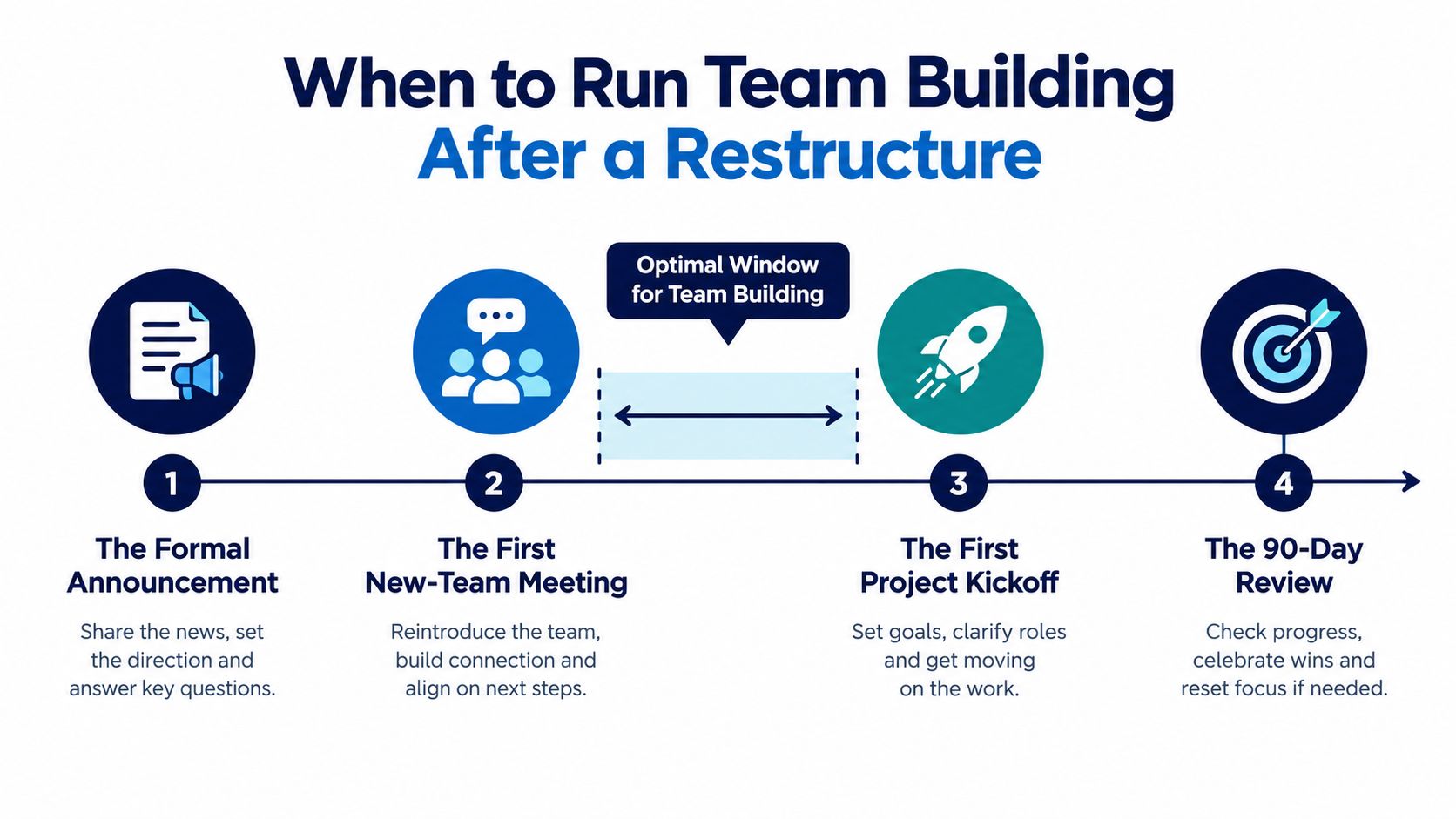
The strongest timing is usually after the team knows the basic shape of the change and before new silos become normal. If consultation is still active, roles are still being decided or employees are waiting for information that affects their jobs, the session is too early. People should not be asked to bond around a structure they cannot yet understand.
Waiting several months creates a different risk. By then, people may have settled into old alliances, informal workarounds and assumptions about who can be trusted. A useful window often sits after the first formal meeting of the new team and before its first major shared project. This allows the experience to prepare the group for real work rather than arrive as a response to problems that have already become entrenched.
Leaders shape whether the session feels credible
Employees will watch the leader more closely than the facilitator. A leader who arrives late, checks emails or stands outside the activity sends a clear message about whose participation is optional. A leader who joins in, listens and accepts the same constraints as everyone else gives the team a different experience of the new hierarchy.
Before the session, the leader should explain why it is being held and what it is expected to help the team practise. During the program, they should participate without controlling every decision. Afterward, they should name what they noticed and identify one behaviour they will model themselves. Our team-building guidance for managers offers further practical preparation for leaders who want the day to translate into everyday behaviour.
Carry the result into the next 90 days
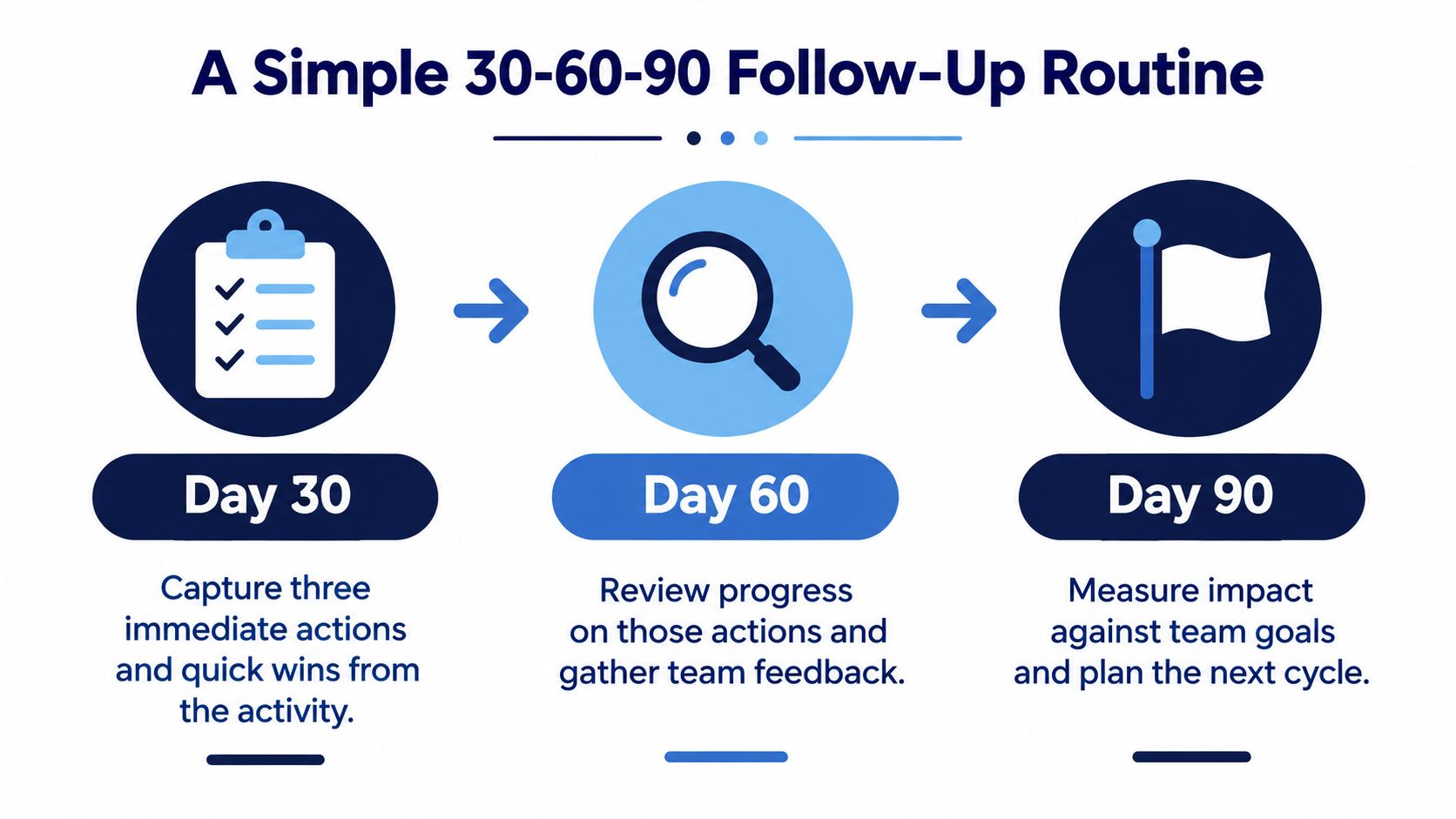
A team-building session can create momentum, but the workplace either reinforces the new behaviour or quietly removes it. Follow-up should be visible, light and connected to the team's actual work.
· In the first 30 days, capture two or three agreements from the session. These might cover how decisions are recorded, when people raise concerns or what information must be shared across roles. Give each agreement an owner and use it immediately.
· At 60 days, ask a short set of questions about trust, communication and clarity. Share the themes with the team and act on one practical issue. The purpose is not to prove the event worked. It is to identify where the new team still needs support.
· At 90 days, review whether the agreements are visible in meetings, projects and handovers. Keep what is useful, revise what is not and include the agreed ways of working in onboarding for anyone joining the team.
For more ideas on protecting the value of the experience, see our guide to maintaining team effectiveness after an event.
Build the team the new structure requires
A restructure defines where people sit. The work that follows determines whether they can rely on one another, share information and move forward as one team. Team building can support that transition when it is introduced at the right time, tied to a genuine need and followed by visible leadership action.
Start with the gap the restructure has created. Choose an experience that lets people practise the behaviour now required of them. Then carry the strongest moments from the session into meetings, handovers and decisions. That is how a changed structure begins to become a functioning team.