
You leave a brainstorming meeting feeling pleased. The conversation flowed, ideas filled the whiteboard and several people were keen to take the next step. From your seat, it looked like strong team engagement.
But what did the meeting feel like from the other seats? Someone may have needed more context before offering an idea. Another person might have spotted a risk but struggled to find a pause in the conversation. A colleague could still be working through the question when the group moved on.
Their silence tells you very little on its own. The useful question is whether the way you ran the meeting helped you hear what your team could contribute. As you plan for 2027, it is worth asking how much of your approach to engagement reflects what works for you, and how much you have learned about what works for your people.

When your preferences become the team default
Your preferences influence ordinary leadership decisions. You might like to solve problems through conversation, receive a concise update or make a decision quickly. Those preferences can serve you well. The blind spot appears when they become expectations that nobody has discussed.
Take a leader who enjoys spontaneous discussion. They introduce a complex question at a meeting and invite immediate ideas. Some colleagues welcome the chance to think aloud. Others would offer a more useful response after reading the background or examining the options. If the decision is made before that happens, the team may miss information it already had.
The same issue can arise when confident speaking becomes the most visible sign of contribution. Someone who explains an idea persuasively gets noticed, while a colleague who tests its assumptions or improves it afterwards receives less recognition. Both contributions can strengthen the outcome. Does your team know you value both?
Improving team engagement starts with examining these expectations. Look at how you invite input, when decisions happen and which contributions you acknowledge. Ask whether those routines give you access to the thinking the work needs.
Learn from the moments when your team works well
Think of a recent moment when your team did its best work. Perhaps it handled a difficult client request, completed a project smoothly or found a solution nobody could have developed alone. What helped people contribute?
Ask the people involved. You might discover that clear responsibilities made it easier to act, an early conversation surfaced a concern or a shared document gave everyone time to improve the idea. Those details give you something specific to build into future work.
A team experience can offer another opportunity to observe how people approach a challenge. You may notice someone coordinating the group, testing an idea or helping a colleague join in. Follow that observation with a conversation about what helped them contribute and whether that condition could be useful at work. Our article on giving teams permission to explore and learn develops this leadership approach further.
People's needs can also change with the task, the pressure and their experience. Use what you learn to guide your next conversation, while staying open to a different answer next time.
Ask questions you can act on

You do not need a lengthy survey to begin. Three questions can open a useful discussion:
· Think of a recent moment when you did your best work. What helped?
· What about the way we run meetings makes it easier or harder for you to contribute?
· What’s one change I could make that would help you do your best work?
Share the questions beforehand and offer a choice of responding in writing, privately or together. Explain what you want to learn and how you will use the answers. Give people time to respond, then check your understanding before deciding what to change.
If someone says they struggle to contribute when a topic arrives without warning, ask what preparation would help. They might need the decision being discussed, a few relevant figures or a clear explanation of the input you want. A useful adjustment could be as simple as sending that information with the invitation.
Discuss the pattern with the team and agree on an approach people can use consistently. Our guide to communication practices that support team contribution offers further ideas for making those expectations clearer.
Take answers about workload, conflicting priorities or unclear responsibilities seriously too. A different meeting format cannot resolve an unrealistic deadline or a lack of resources. The conversation should help you identify the issue you can actually address.
Make room for contributions beyond the meeting
Some useful thinking happens after a discussion. Before closing the meeting, agree whether there is time for further input, where people should put it and when the decision will be finalised. That gives follow-up contributions a purpose and a deadline.
For a marketing team, collaborating on content might involve a subject expert contributing ideas in conversation, a colleague organising the material and another refining it in writing. A guide to turning meeting recordings into marketing content illustrates a related workflow: useful expertise can continue to inform the work after the discussion ends. Where speakers have agreed to the intended use, a recording or transcript can provide material for people to develop together.
The leadership question is who gets an opportunity to improve the work as it moves through those stages. Recognise the contribution as well as the person who first presented the idea.
Test one change before planning 2027
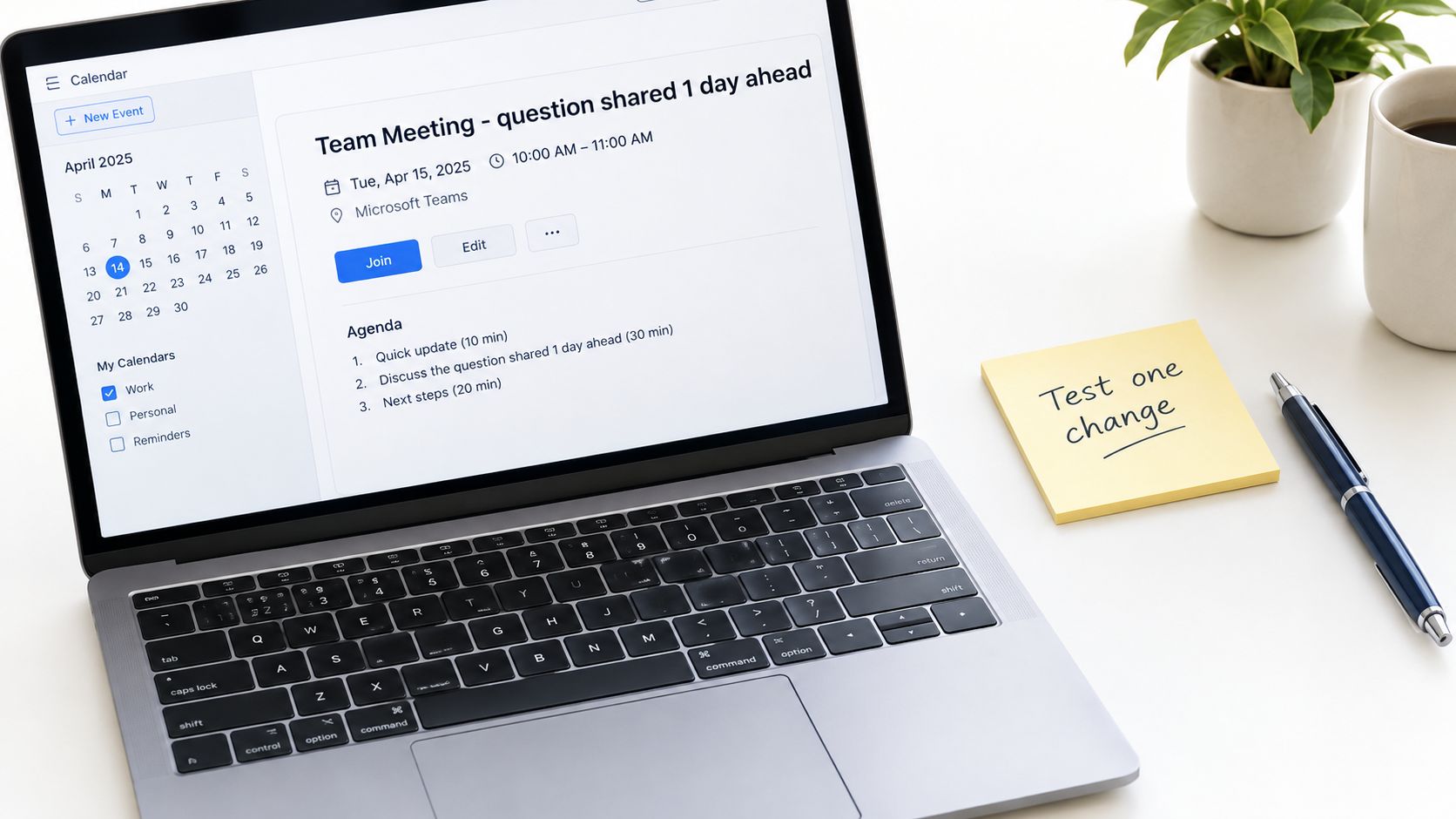
Choose one recurring situation where you would like better input. Before the next team meeting, share the discussion question and enough context for people to prepare. Invite written ideas beforehand, allow time to examine them together and finish with a clear decision or next step.
Afterwards, ask whether the change helped. Did the discussion uncover a perspective you might otherwise have missed? Were decisions clearer? Did people understand their responsibilities? Compare their feedback with what happened as the work progressed.
Choose a small number of useful signals and review them over several meetings. Our guide to measuring team performance explains how to connect observations and feedback to the outcomes your team is trying to achieve.
One successful meeting gives you a reason to keep exploring. If the change adds preparation without improving the work, ask what needs adjusting. The aim is to establish a routine that helps this team contribute effectively.
Build your next plan around what you learn
Before carrying this year's team engagement strategies into 2027, ask what you have learned about your people. Which conditions help them contribute? Where are useful ideas getting missed? What have you changed in response to their feedback?
Those answers can shape your everyday leadership and the team experiences you plan. They also give you a clearer purpose for each investment: you know what you want to strengthen and what to look for afterwards.
Start with one conversation and one change you can review together. Your own preferences remain useful, but they are only part of the picture. Learning what helps the rest of your team do its best work gives you more to lead with.
What’s one team engagement challenge you don’t want to carry into 2027?